Free illustrated stories from Giggle Bureau


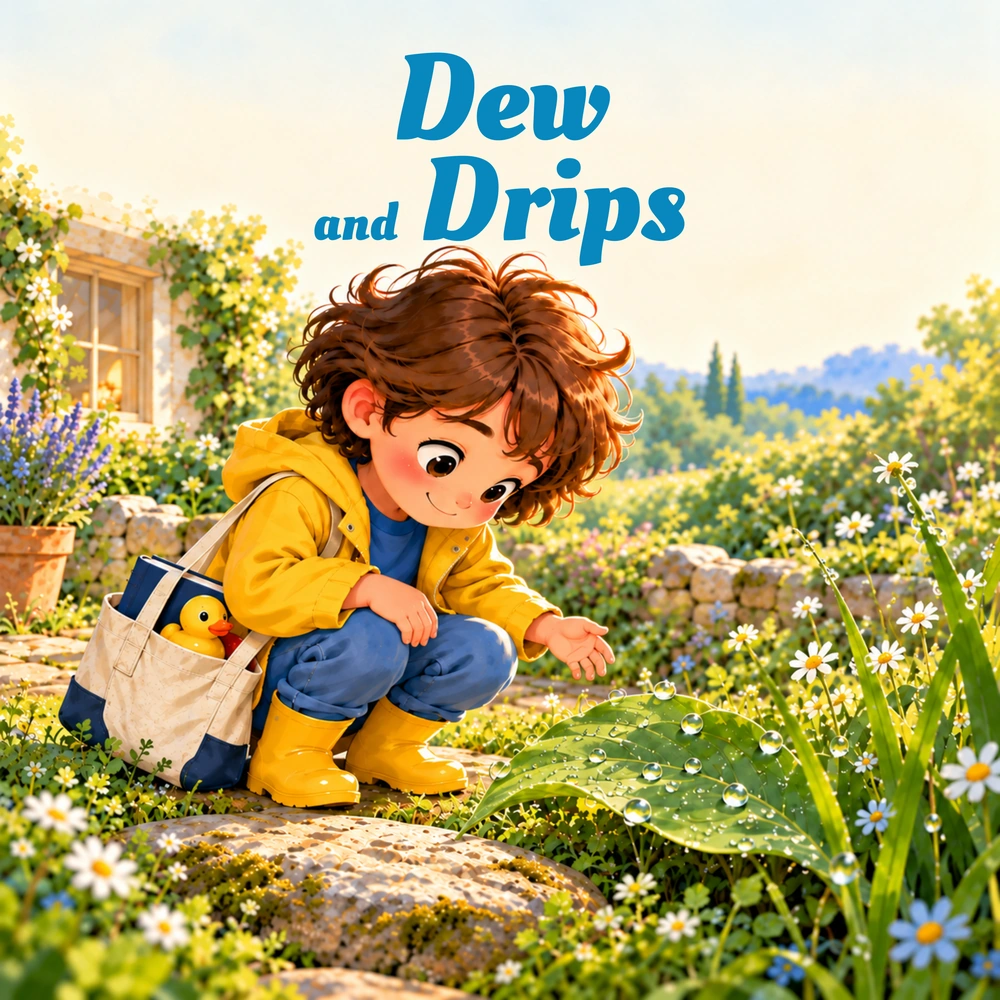
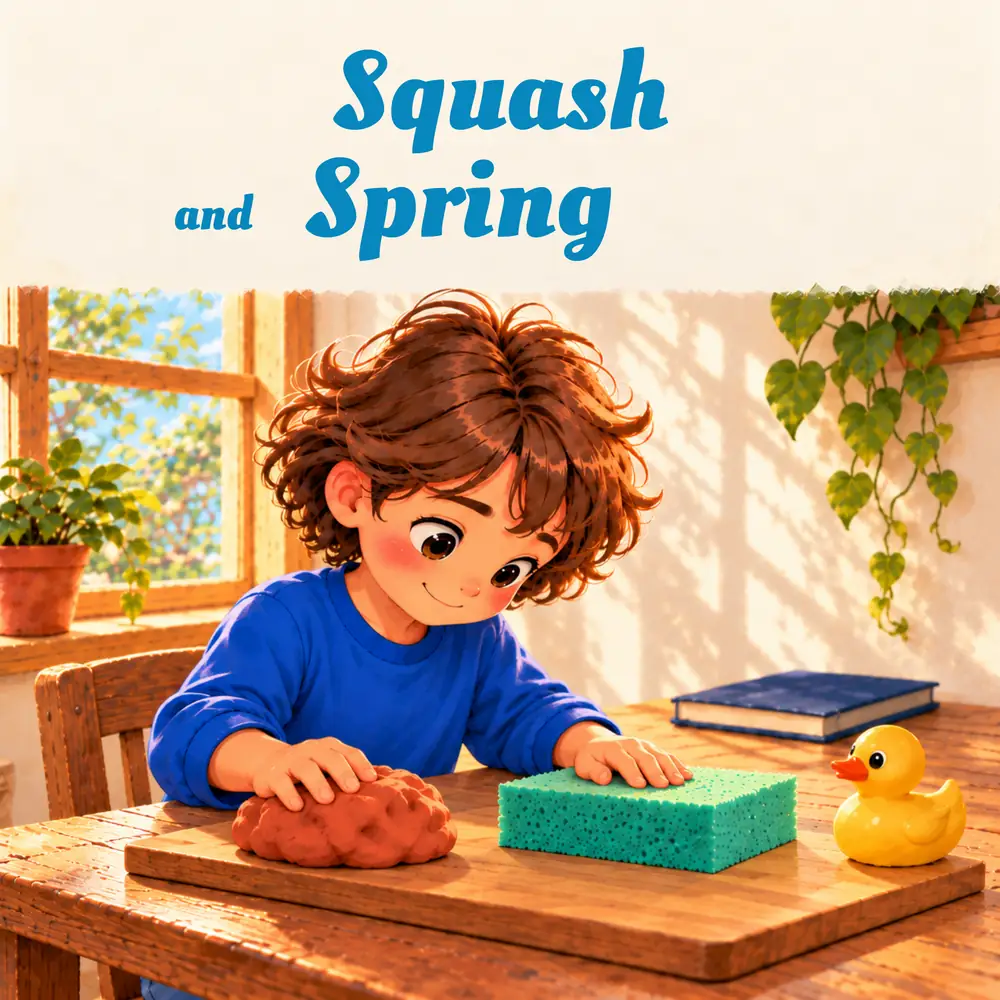
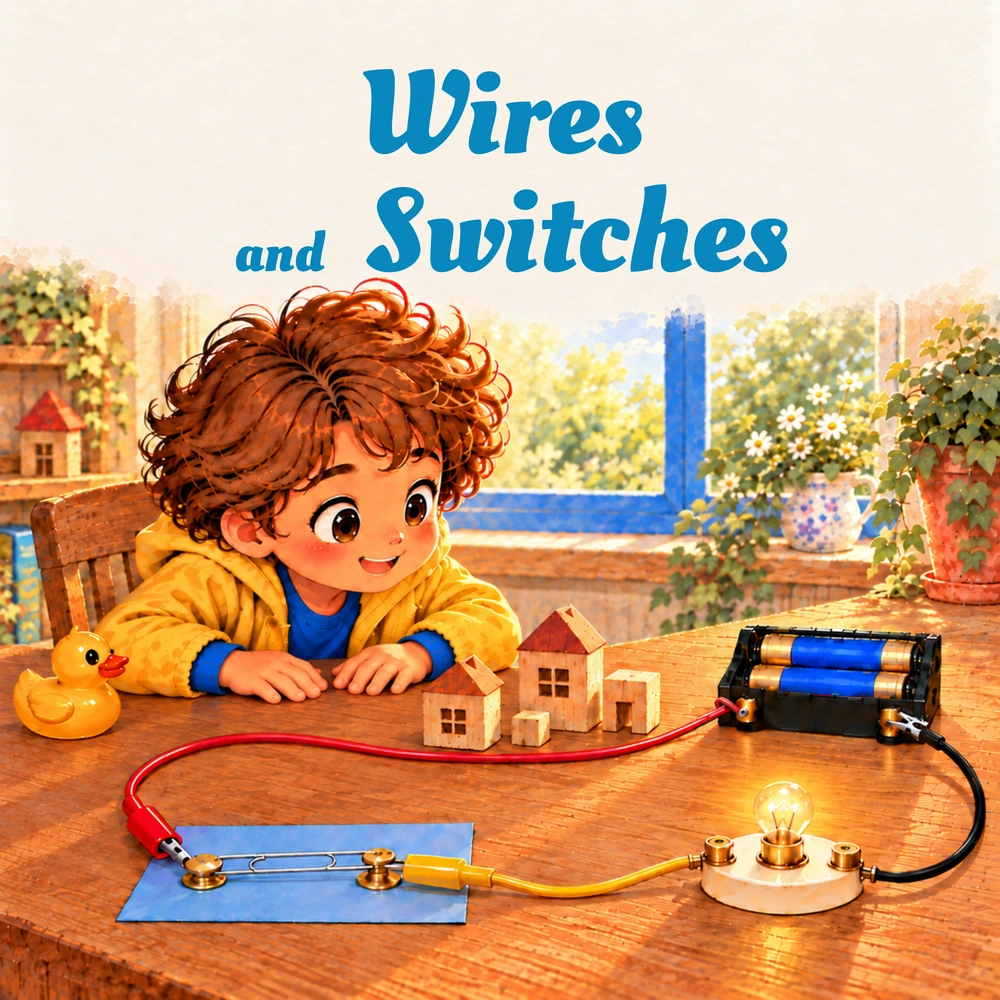
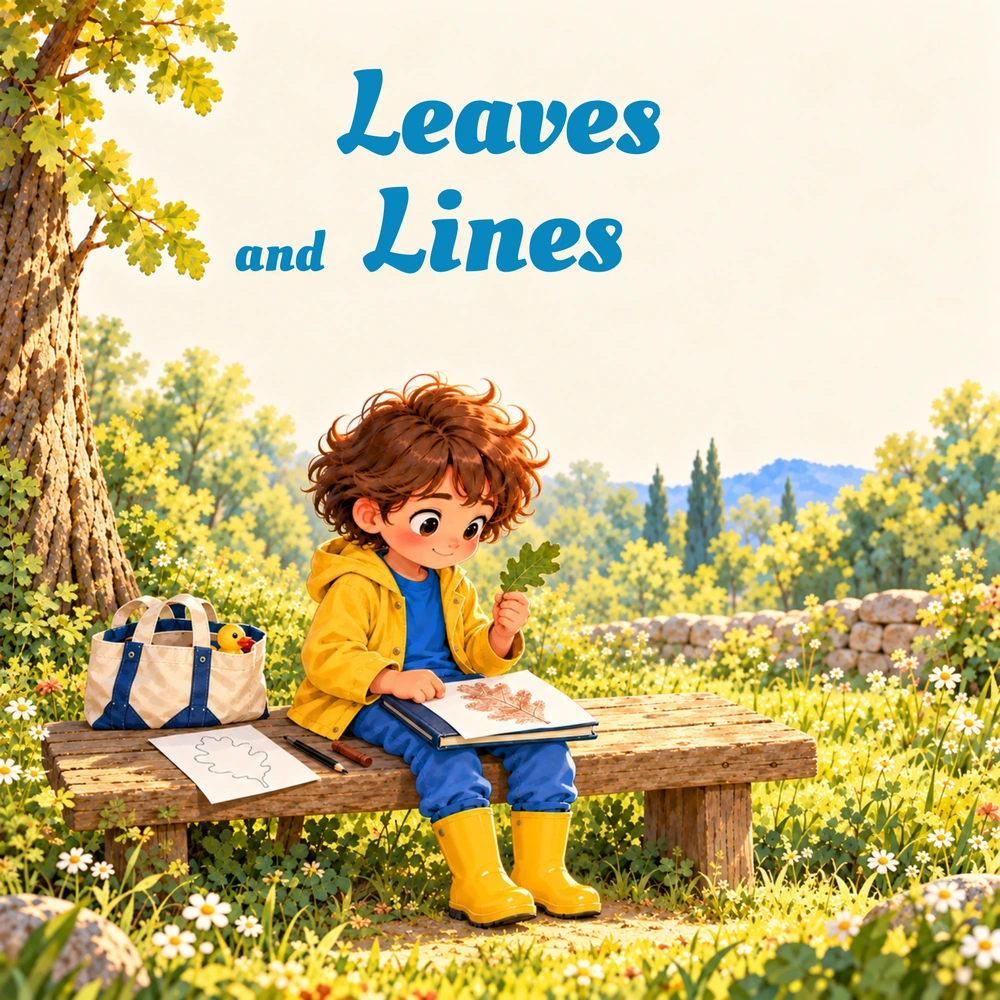

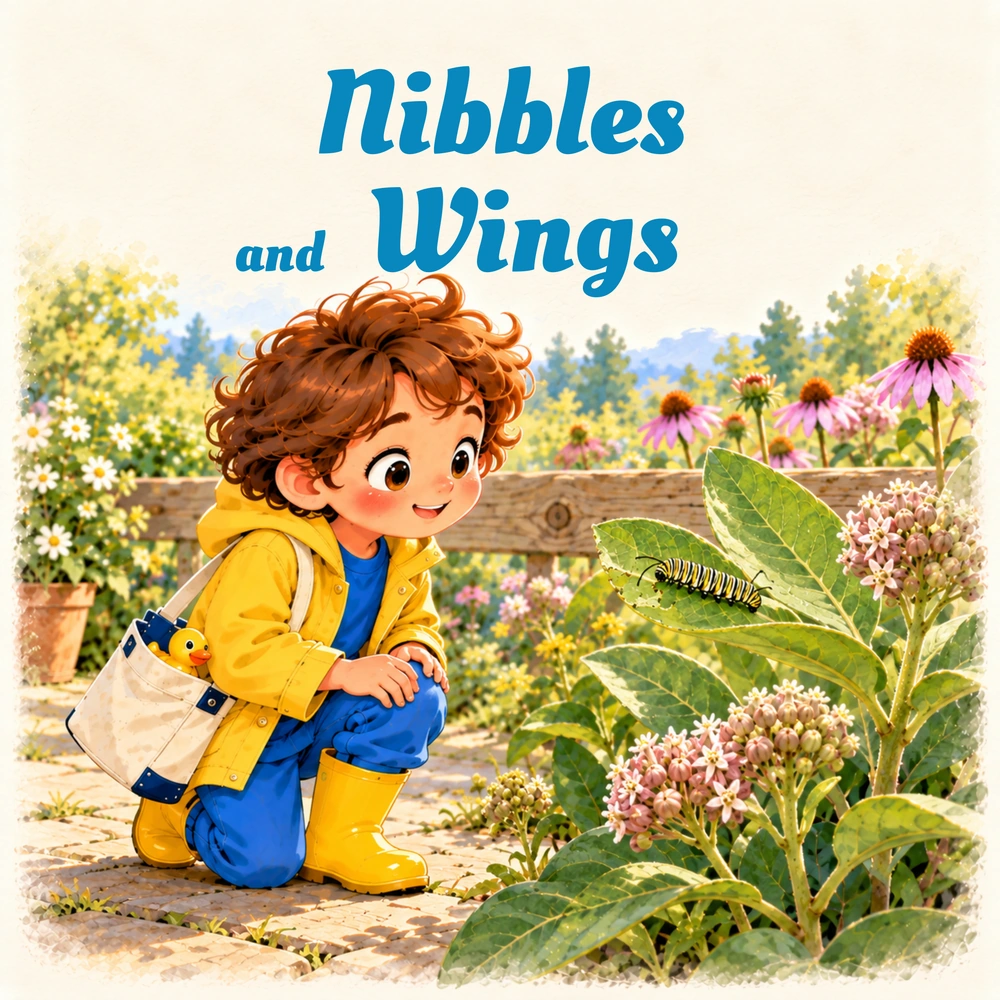
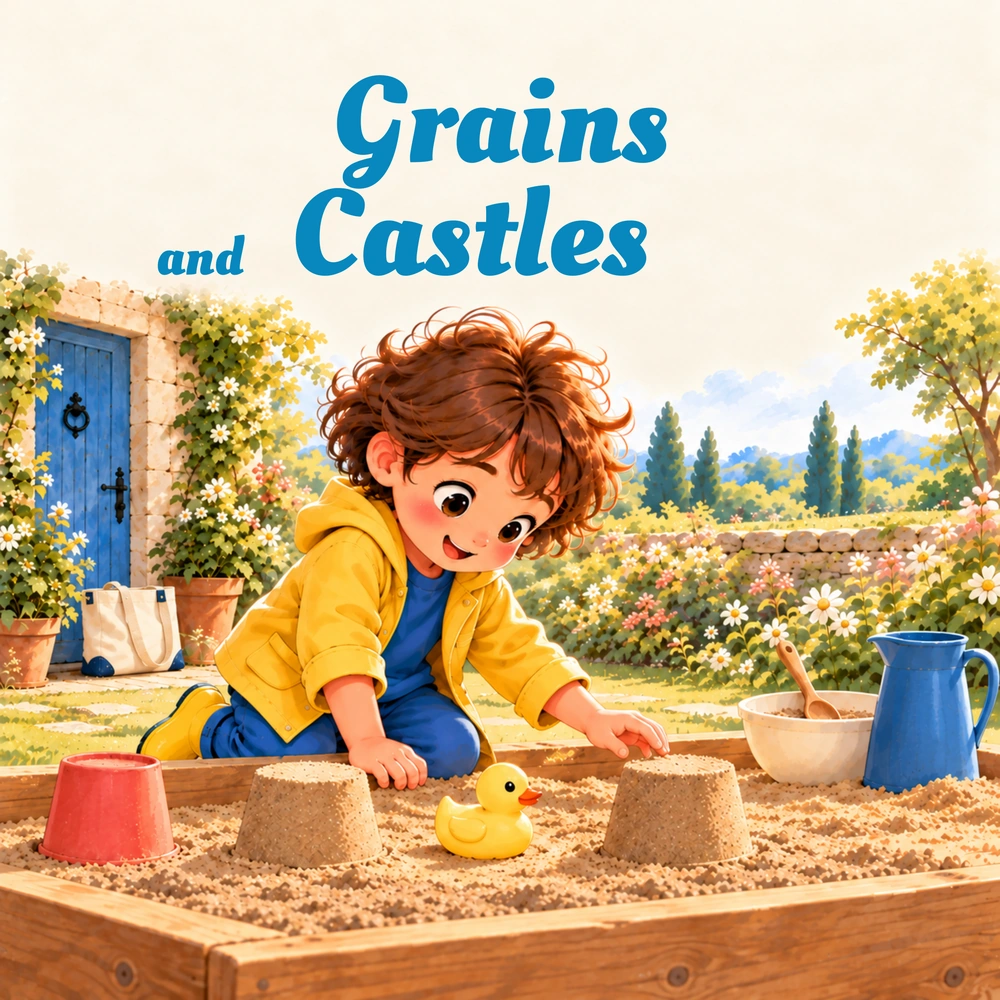
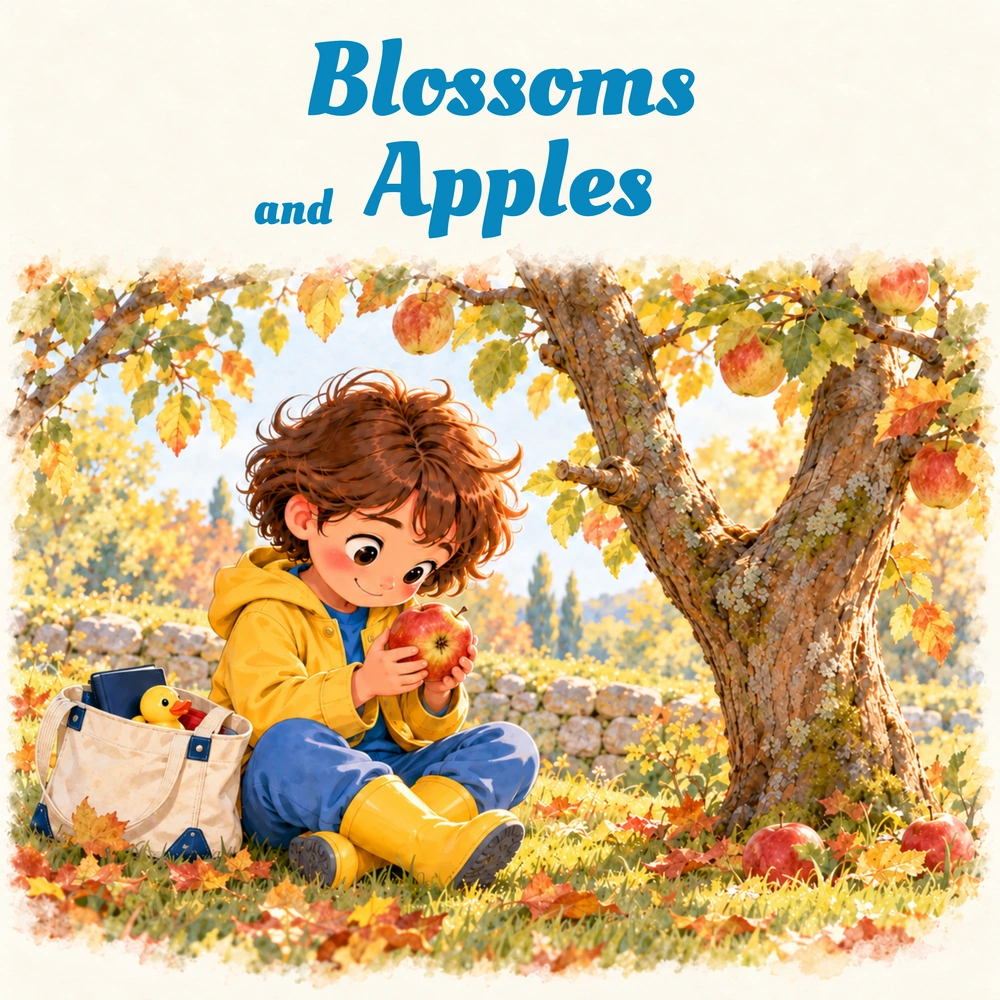
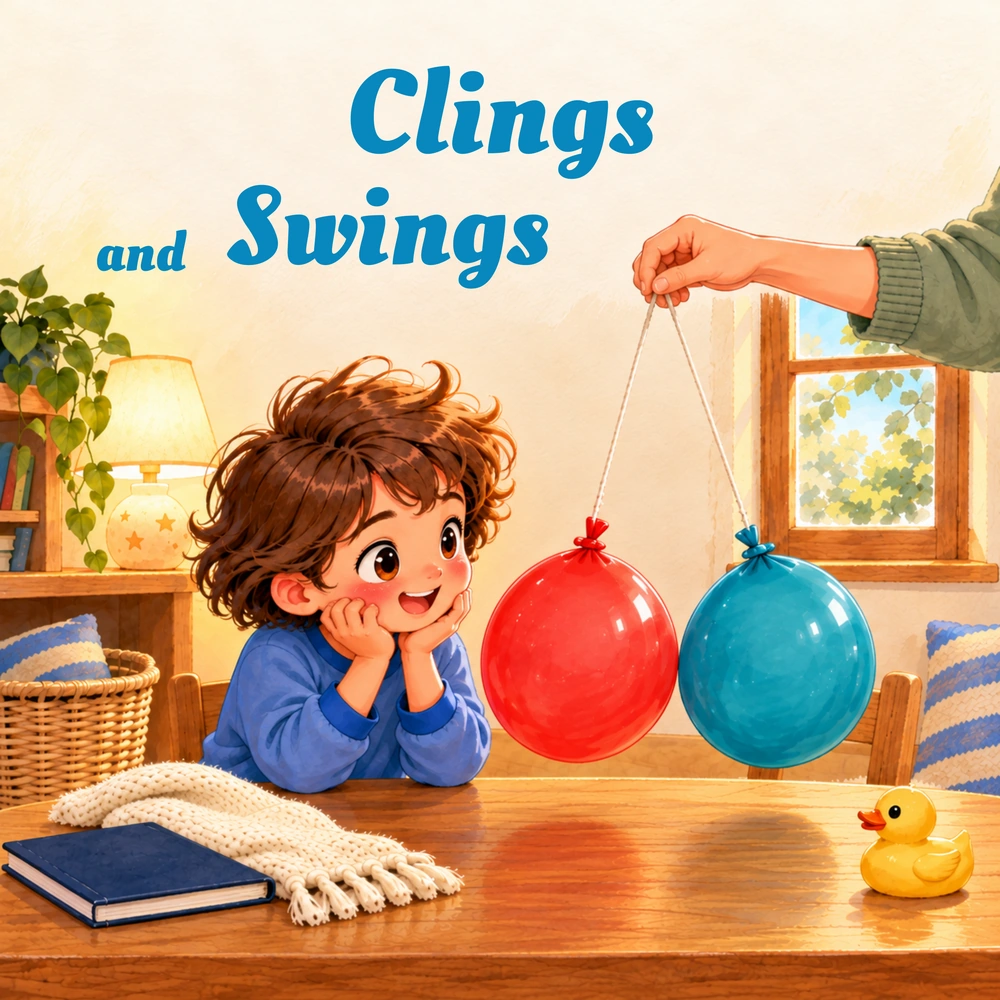
Pick a book. Read the whole story for free.
Pick a book. Read the whole story for free.
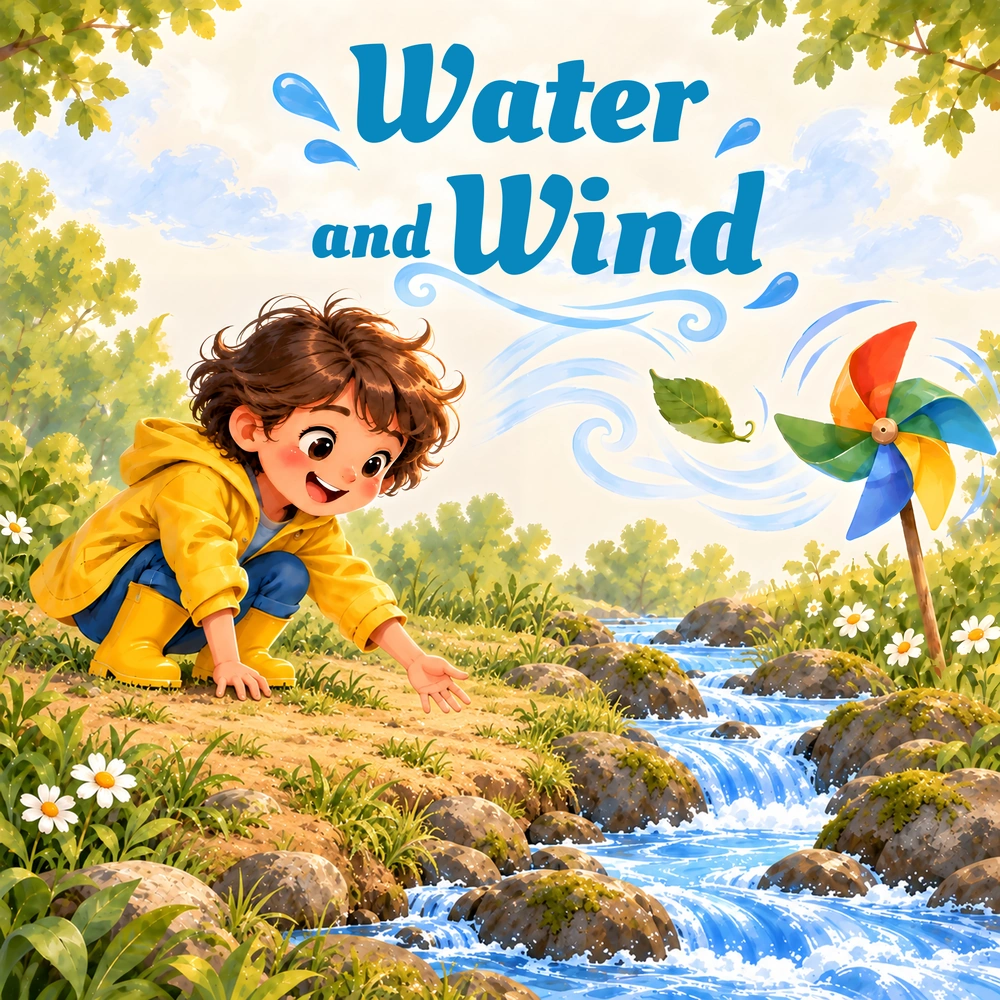
Wind moves the pinwheel. Wind is moving air. Vince feels it on his cheek and sees it push the pinwheel's angled blades.
Ask together: What tells you that the air is moving?
Water passes the rock. A leaf circles behind it. Most water passes the rock; some circles back in an eddy. Laminar flow is orderly; turbulence is irregular, mixing motion. A swirl alone cannot distinguish them.
Ask together: How does the leaf move compared with the water passing the rock?
Waves spread from the stream. The duck bobs. The falling stream makes waves that carry energy outward and make the toys bob. The stream's current also carries toys along. Bobbing and drifting are different motions.
Ask together: What moves up and down? What moves along the pond?
A duck floats. A pebble sinks. Water pushes upward on both objects. This buoyancy balances the duck's weight, but not the pebble's. The pebble's splash makes the rings on the next spread.
Ask together: Where is each object compared with the surface?
Two wave patterns approach one another. When gentle waves overlap, their heights add, briefly raising or lowering the surface. This interference does not erase the waves; they continue through one another.
Ask together: What might happen where the two patterns meet?
Tiny dents appear beneath the strider’s legs. Surface tension helps support the strider where its water-repellent legs dent the water. The duck floats mainly by displacing water.
Ask together: What do you notice where its legs meet the water?
The duck bubbles, fills and squirts. Squeeze underwater: air bubbles out. Release with the opening submerged: the elastic duck springs back, lowering pressure inside. The surrounding water pressure pushes water in. Squeeze above water: water exits through that same opening.
Ask together: What changes when Vince squeezes and then lets go?
A paper plane glides forward and down. The throw starts the plane moving. Airflow around its wings produces lift and turns air downward. Gravity pulls down; drag resists motion. In still air, the plane glides forward and gradually descends.
Ask together: Where might the plane go next?
Milk runs. Honey stretches into a thread. Honey's greater viscosity means greater resistance to flow. It makes a slow thread while milk runs readily. Temperature and pouring method also matter; this snack is an observation, not a controlled test.
Ask together: How do the milk and honey move differently?
Foam curves inward toward the drain. Gravity drives water through the drain. Existing turning motion can become a curved inward flow, traced by foam. Here water travels to the outlet, unlike waves crossing the pond. Not every drain swirls.
Ask together: Can you follow the foam toward the drain?
Vince sketches what he noticed. Vince records something he noticed. Drawings, marks or words let him return to an observation. He does not need all the answers.
Ask together: Which earlier picture matches one of his drawings?
Morning sunshine reaches Vince’s blanket as he gets up. Sunshine reaches the blanket, which reflects some of that light toward our eyes. That is how we see the bright patch.
Ask together: Where has the sunshine reached?
Vince steps through the gate with his duck, and his shadow reaches across the lane. Vince blocks some direct sunlight, leaving a darker area on the lane. Other light can still reach that area, so his shadow need not be black.
Ask together: Where do Vince and his shadow meet?
Vince waves; a passing cloud then softens his shadow. The shadow follows Vince’s pose when he waves. A passing cloud makes the lighting more diffuse, so the shadow becomes softer and fainter.
Ask together: What stayed the same when the shadow faded?
Vince sees an upside-down tree and his own reflection in a puddle. Still water reflects light from the tree and Vince’s face toward the observer, forming their images in the puddle. The images are not another tree or person under the water.
Ask together: Can you find the same fork in both trees?
Vince taps the puddle, and ripples make the reflected tree look wobbly. Still water reflects light to form an image. Vince's tap makes ripples that tilt small parts of the surface and redirect the reflected light. The image of the tree changes; the real tree stays still.
Ask together: Which tree is wobbly? Where did the change begin?
Vince compares a bent-looking straw in water with the straight straw lifted out. Light changes direction as it passes between water and air at an angle. This refraction changes how the submerged straw appears. The glass also affects the view. Lifting the straw out lets Vince compare its appearance; the rigid straw itself has stayed straight.
Ask together: What changes at the waterline?
Sunlight passes through a window prism and spreads colours on the wall. A prism bends different wavelengths by different amounts, separating colours already present in sunlight. Here the coloured light reaches the wall.
Ask together: Where do the colours come from in this picture?
Vince lifts his notebook into the coloured light. The page intercepts coloured light that would otherwise reach the wall and scatters some of it toward our eyes. The colours are light on the page, not coloured marks.
Ask together: Where are the colours now?
Vince packs the blank page away, leaving the projected colours on the wall. After Vince removes his notebook from the prism’s light, the colours reach the wall again. They were projected light, not marks left on the paper.
Ask together: What is Vince taking home, and what is still on the wall?
Vince returns through the familiar lane with a long shadow reaching the gate. With the sun lower in the sky, Vince's shadow stretches across the lane. Shadow length depends on the light's direction and the surfaces it falls on. Early and late sunlight can both make long shadows.
Ask together: Which way does Vince's shadow point? Where might the light be coming from?
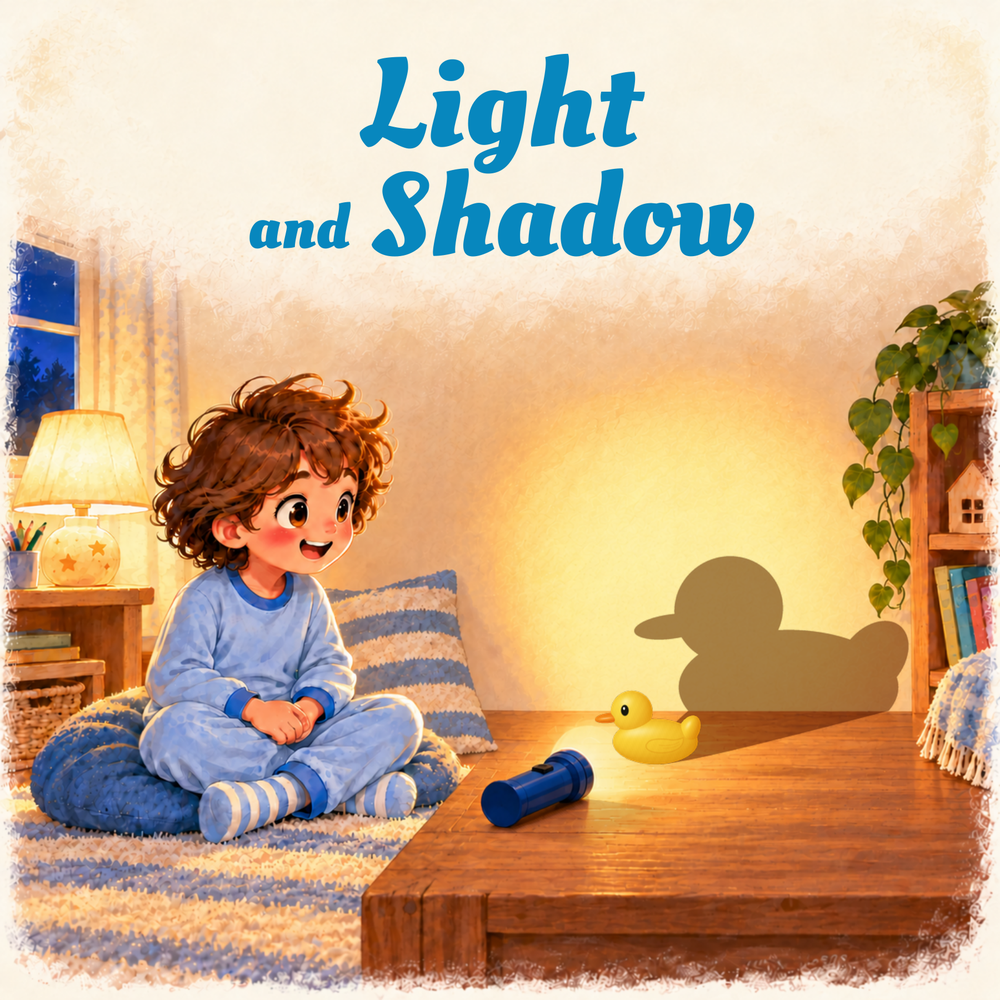
The torch illuminates the duck and produces its shadow on the wall. The duck blocks some of the light travelling from the torch to the wall, leaving a darker area behind it. Other light in the room can still reach that area.
Ask together: What is making light, what is in its way, and where is the shadow?
Vince moves the duck closer to the torch, making its wall shadow larger. With the torch and wall fixed in this setup, moving the duck toward the torch makes its shadow larger. The duck itself stays the same size. Try the actual torch first; different torch beams can behave differently.
Ask together: Which thing moved? Did the duck itself get bigger?
Vince quietly draws in his notebook; the facing page is intentionally blank. Vince records something he noticed. A few imperfect marks are enough; he does not need to explain every discovery. Leave the first reading quiet here.
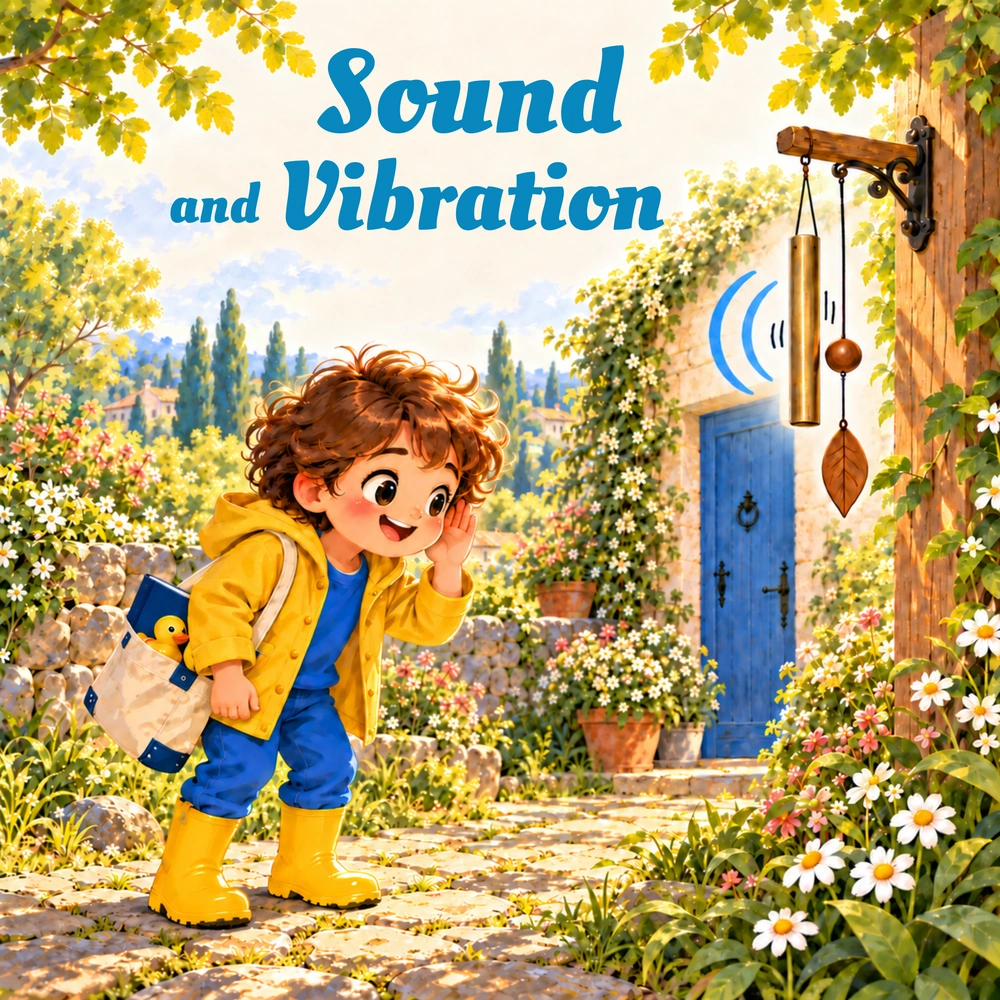
Vince hears a ring while the ringing object is still outside. Sound travels through air and can reach us before we see what made it. Sound is invisible; the blue curves in these pictures are symbols that help us follow it.
Ask together: What makes Vince turn toward the door?
A small striker knocks the metal chime, then moves away while the chime keeps ringing. The knock makes the metal vibrate: move back and forth very quickly. This vibration makes the ring. The slow swing of the whole chime is a different movement.
Ask together: What touches the chime before it rings?
Vince holds the metal tube, and the ringing stops. His hand reduces the metal’s vibration, so the ring dies away quickly. He touches the tube itself.
Ask together: Which part does Vince touch?
The same yellow boot presses small stones on the path and then lands on wooden boards. The stones knock and scrape against one another and the boot, making vibrations and sound. On the boards, the boot and wood vibrate. Both the surface and the step affect what Vince hears.
Ask together: What changes beneath his boots?
Vince claps once, then listens as the clap comes back from the far stone wall. Some sound reflects from the wall and returns after a short pause: an echo. The arrows help us follow its direction. A nearby wall can reflect sound without a separate echo.
Ask together: Can you follow the sound to the wall and back?
Vince taps the drum and lifts the beater away. Rice grains jump on the drumhead. The tap makes the drumhead vibrate. Contact with the moving head pushes the grains up; sound in the air does not lift them. A grown-up handles loose rice.
Ask together: What moves after Vince taps?
Vince taps a metal bowl. He hears a ring and sees ripples on the water. The bowl’s trembling wall makes sound in the air and moves the water touching it. Visible water ripples and invisible sound in air are different waves. Results depend on the bowl, its support, the water level and the tap.
Ask together: What can Vince hear? What can he see?
Vince keeps his fingers lightly in place as he hums, then stops humming. Air from the lungs makes the vocal folds vibrate. The tremble he feels stops when he stops humming; his fingers stay in place. Looking is an option, too.
Ask together: Hum, pause, then hum again. What can you feel?
Vince hears the familiar chime as he arrives home. The chime rings when its metal vibrates, just as it did at the start. A familiar sound can help us recognise a place.
Ask together: Which sound has Vince heard before?
Vince quietly draws in his notebook; the facing page is intentionally blank. His drawing helps him remember what he noticed. Leave this ending quiet.
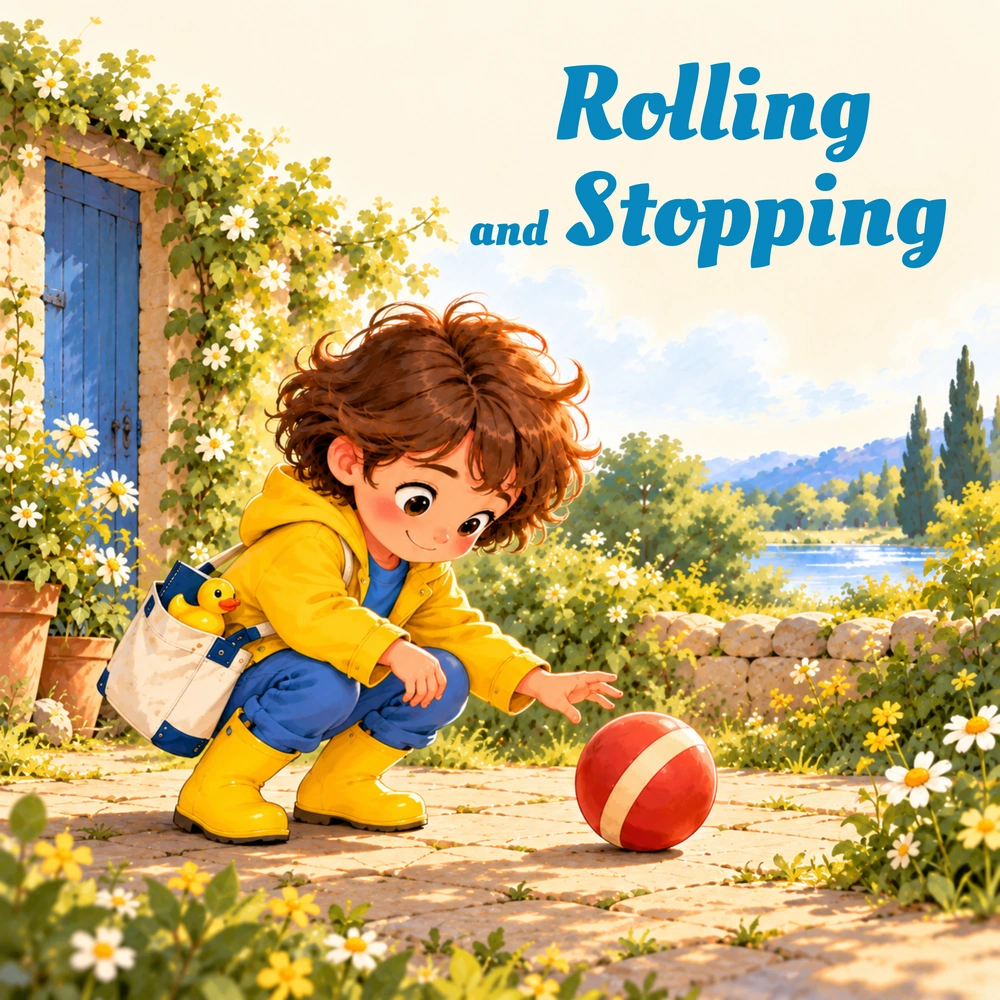
Vince crouches beside a resting ball, then touches it with his hand to give it a push. Contact with his hand starts the ball moving. The next spread shows what happens when his hand leaves.
Ask together: What changes when Vince’s hand touches the ball?
Vince lifts his hand away. A gap stays between his hand and the ball as it rolls farther along the path. The hand’s push ends when contact ends, but the ball can keep rolling. Resistance from the real path gradually slows it; a push is not fuel that gets used up.
Ask together: What can you see between Vince’s hand and the rolling ball?
The ball rolls from the path into grass, where blades touch its lower surface. Vince finds it stopped, with his hands clear. The ball, grass and ground bend or squash, and small collisions take energy from the rolling. How much it slows depends on the ball and surface; these pictures do not show a measured comparison.
Ask together: What is touching the ball now?
Vince lifts the ball out of the grass and carries it toward the nearby hill. He retrieves the same ball and takes it to a new place before letting it go again. This connects the stop in the grass with the next rolling scene.
Ask together: How is the ball moving with Vince now?
Vince holds the ball in place on a firm downward slope, then lifts his hand away as it rolls downhill. Earth’s gravity pulls on the ball throughout the journey. On this suitable slope, gravity can make the released ball roll without a hand push. The sloping ground supports and guides it.
Ask together: What is different about the path here?
Vince waits near the foot of the hill with his hands ready, then meets and cradles the incoming ball. His hands slow and stop the ball through contact. The ball is caught gently at ground level.
Ask together: What changes when his hands meet the ball?
Vince holds the caught ball while facing home, then gives it a fresh push toward the blue door. The ball is stopped before the new push. Vince’s touch sets it off toward home; the ball does not steer itself there.
Ask together: Where does Vince send the ball this time?
Inside the cottage, Vince puts the ball on the rug and sits beside it. The rolling journey ends with the ball resting beside Vince. Next comes a quiet moment with his notebook.
Ask together: What tells you that Vince and the ball are home?
A hand pushing a resting ball can set it rolling.
NGSS: K. Forces and Interactions: Pushes and Pulls
PS2.A and PS2.B: contacting objects can change motion, including starting an object. First-party curriculum framing, not a measurement of this prop.
The ball is a single ordinary soft play ball on a firm, approximately level path; push near its middle. No claim about an exact push strength or speed.
After the hand leaves, the ball can keep rolling without a continuing hand push.
NASA Glenn: Newton’s Laws of Motion
First Law, opening paragraph: unchanged velocity when the net external force is zero. This distinguishes continuing motion from continuing propulsion.
The illustrated ball is not force-free: gravity, support and resistance still act. It is slowing on the real path; the book does not claim constant speed or perpetual rolling. A push is not fuel stored inside the ball.
Contact with the ground and grass resists this ball’s rolling and brings it to rest.
B. N. J. Persson (2010), Rolling friction for hard cylinder and sphere on viscoelastic solid
Introduction, paragraph on Greenwood and Tabor: deformation of rubber loses some elastic energy. Theory section, equations (4)–(6): rolling resistance is linked to energy dissipation. Abstract explicitly limits the model to a rigid ball on a flat viscoelastic solid.
Application to grass is a qualitative mechanical inference, not an experiment reported in this paper. The picture shows a light ball gently rolling into dense grass, bending blades and stopping; there is no measured stopping distance or comparative trial. Grass, soil and ball deform, and small collisions contribute. Ideal static friction in pure rolling is not itself a universal explanation of energy loss.
On a suitable downward slope, a released ball can start rolling without a hand push because gravity acts on it.
NASA Space Place: What Is Gravity?
Opening definition and “What else does gravity do?”: Earth attracts objects toward its centre; the pull is present before release as well as afterward.
NGSS: K. Forces and Interactions: Pushes and Pulls
K-PS2-2 clarification examples include a ramp that increases an object’s speed; PS2.A describes motion changes. Starting from rest on this slope additionally applies gravity and contact mechanics, rather than reproducing a measured NGSS experiment.
Gravity is downward, not a force pointing along the path. The sloping support constrains motion; sufficient downhill component overcomes resistance. A firm gentle slope is pictured, not deep grass. Gravity also acts on the earlier level path. No universal statement that every ball rolls on every slope.
Vince’s hands can slow and stop the incoming rolling ball by contact.
NGSS: K. Forces and Interactions: Pushes and Pulls
K-PS2-1 clarification includes stopping a rolling ball; PS2.A/B describe motion changes during contact.
A slow soft ball is caught at ground level; hands yield slightly. No instantaneous stop, force magnitude, rebound or stopping-time claim.
Vince can send the ball toward home with another push after turning to face that way.
NGSS: K. Forces and Interactions: Pushes and Pulls
PS2.A: pushes have directions and can change an object’s motion.
The ball is caught and stationary before this new push. The book does not imply that a ball follows a curved path by itself or that Vince’s gaze steers it. Direction is observed, not quantitatively compared.
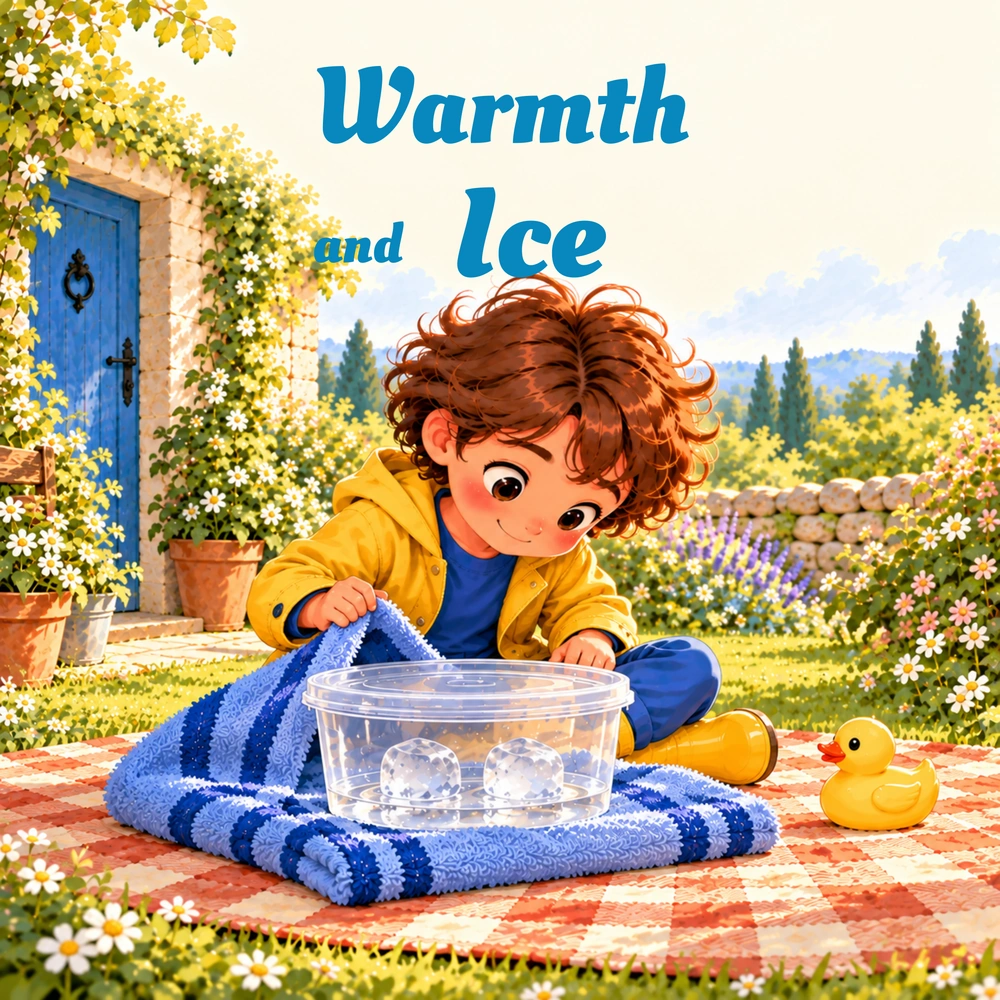
Vince packs two matching closed tubs, with two ice cubes in each. A spare cube sits separately in the ice tray. Ice is solid water. The pieces keep their own block shapes while frozen, unlike the liquid water Vince will pour later.
Ask together: What shapes can you see in the tubs?
Vince holds the spare cube over a dish. A closer view shows meltwater on his palm and a drop falling below it. Energy transfers from his warmer hand to the colder ice, helping it melt while his hand cools. Warmer air and surfaces can melt ice too.
Ask together: Where is the water on Vince’s hand coming from?
Vince brings both tubs together to the garden table. A folded towel lies beside them. His wet-hand discovery gives him a reason to wonder whether the picnic ice will last. He is about to try wrapping one tub; this scene does not yet show a result.
Ask together: What do you think Vince could try with the towel?
Vince folds a thick towel beneath, around and over one closed tub. The matching tub beside it stays bare. A thick, dry wrap can slow energy transfer from warmer surroundings to colder ice. Keeping the starting ice, tubs, place and waiting time alike makes the wrap the important difference to compare.
Ask together: What is the same about the two tubs, and what has Vince changed?
After setting out the picnic, Vince opens both tubs. Some ice has melted in each, but larger pieces remain in the tub he wrapped. The wrap has slowed melting; it has not made new ice or stopped all change. These pictured amounts illustrate the difference rather than report a measured trial.
Ask together: What differences can you see inside the two tubs?
Later, the ice in both tubs has melted. Vince pours water from the formerly wrapped tub into the round wells of a mould. The wrap did not keep the ice forever. It is still the same water, now a liquid that flows into the lower part of each well.
Ask together: What can this water do that the hard blocks could not?
Vince slides the mould into the lower freezer drawer. Its four round wells contain shallow water with space below the rims. A working freezer removes energy from the water. If the water cools enough, it can freeze; the change needs time. The space above it leaves room for expansion.
Ask together: What do you think Vince will find when he comes back?
The next morning, three round pieces of ice remain in the mould and one rests on a saucer beside it. One well is empty. The meltwater has become solid again. The new pieces have the round outlines of the wells, and the piece on the saucer keeps that shape. It is still water, even though its form and shape have changed.
Ask together: How is this ice like the ice at the start, and how is it different?
Solid ice keeps a shape of its own; when it melts, the same material is liquid water that can flow and take the shape of the lower part of its container.
Lesson 2.5: Changing State—Melting
Key Concepts; Engage, Step 2: Where do you think the energy came from to melt the ice?; Explore, Step 3: How could you set up an experiment to test your method?: Melting changes a solid into liquid. Air and a supporting surface can supply energy to colder ice. The lesson suggests hand contact as a way to warm ice, and recommends similar starting pieces when comparing treatments.
Taking the Shape of the Container
Answer by Tamara, paragraphs on ice and liquids, published 22 October 2007: The explanation contrasts stiff solid ice with flowing liquid water. Gravity draws the water downward while the vessel confines it. This supports pouring meltwater into new wells and later observing solid pieces whose outer shapes come from those wells.
Liquid water flows into the lower part of a container; it does not fill all the available space as a gas would.
Ice keeps its own shape while frozen, but that shape gradually changes as it melts. The material is still water.
Energy transfers from Vince's warmer hand and warmer surroundings toward colder ice, helping it melt. His hand loses energy during contact, so the ice can feel cold while his palm becomes wet.
Lesson 2.5: Changing State—Melting
Key Concepts; Engage, Step 2: Where do you think the energy came from to melt the ice?; Explore, Step 3: How could you set up an experiment to test your method?: Melting changes a solid into liquid. Air and a supporting surface can supply energy to colder ice. The lesson suggests hand contact as a way to warm ice, and recommends similar starting pieces when comparing treatments.
This scene shows brief contact and meltwater, not a timed test of how quickly a hand melts ice.
Warmer air and surfaces can also transfer energy to ice. Touching it is not necessary for melting.
Heat is a transfer of energy, not a visible substance. The visible drops are melted ice.
The handled cube stays separate from the ice used for the wrapped-versus-bare comparison.
A sufficiently thick dry insulating wrap around a closed ice container can slow transfer from warmer surroundings, leaving more ice after the same interval than an otherwise matching bare container.
Activity – Be Cool... with Insulation!
Materials; Procedure, steps 1–3; How does it work?; Safety Suggestions: The activity compares ice inside covered containers with and without insulating material; socks are an example. It calls for approximately equal starting ice. Warmer surroundings supply energy to the ice. Materials from the activity should not be consumed.
The pictured amounts are illustrative, not measured results.
A thick, dry wrap can slow heat transfer to colder ice. It does not make cold or prevent melting forever.
The towel stays outside the closed tub, separate from the meltwater.
After the meltwater is cooled sufficiently in a working freezer, it can become solid ice again; round mould wells give the new solid pieces round outer shapes.
Lesson 2.4: Changing State—Freezing
Key Concepts; Engage, Step 1: Teacher Preparation; Explain, steps 4–5: Water becomes solid ice when cooled sufficiently. A teacher demonstration places a small quantity of water in a freezer overnight and observes it the next day. Freezing expands the water, so an open flexible tray with headroom is appropriate. The source does not promise a universal freezing time.
Taking the Shape of the Container
Answer by Tamara, paragraphs on ice and liquids, published 22 October 2007: The explanation contrasts stiff solid ice with flowing liquid water. Gravity draws the water downward while the vessel confines it. This supports pouring meltwater into new wells and later observing solid pieces whose outer shapes come from those wells.
Pump Up Your Savings with Heat Pumps
How They Work, opening paragraph: Refrigeration uses electrical work to move thermal energy out of the cooled space. Combined with the freezing source, this supports explaining that the freezer removes energy from the water; it does not add a substance called cold.
A freezer removes energy from water; it does not add a substance called cold.
Freezing depends on the water amount, starting temperature and freezer conditions. The next-morning scene does not promise a universal freezing time.
Water expands as it freezes, so the partly filled, freezer-safe mould leaves room below its rims.
The open round wells produce shallow round pieces, not spheres. Freezing changes the water’s form; it does not restore the original square cubes.
This exploratory meltwater and refrozen ice are kept separate from food and drinks.
A useful wrapped-versus-bare comparison changes the wrap while keeping the other important starting conditions alike.
Lesson 2.5: Changing State—Melting
Key Concepts; Engage, Step 2: Where do you think the energy came from to melt the ice?; Explore, Step 3: How could you set up an experiment to test your method?: Melting changes a solid into liquid. Air and a supporting surface can supply energy to colder ice. The lesson suggests hand contact as a way to warm ice, and recommends similar starting pieces when comparing treatments.
Activity – Be Cool... with Insulation!
Materials; Procedure, steps 1–3; How does it work?; Safety Suggestions: The activity compares ice inside covered containers with and without insulating material; socks are an example. It calls for approximately equal starting ice. Warmer surroundings supply energy to the ice. Materials from the activity should not be consumed.
A useful comparison begins with similar ice pieces at the same temperature in matching closed tubs, kept together for the same interval. Only one tub is wrapped.
The illustrations show a qualitative comparison, not a measured experiment or a guarantee that every wrap will perform the same way.
Vince brings one bar magnet near another in a shallow wooden channel. The second bar moves away before the bars touch. Matching poles of the two bar magnets repel. The channel keeps the moving magnet aligned so it cannot simply turn around. Red and blue identify ends; the colours are not the force.
Ask together: What is between the two magnets when one moves away?
Vince turns the magnet in his hand end for end. The two bars come together in the channel. Unlike poles attract. Turning one bar changes which ends face, changing the interaction from a push apart to a pull together.
Ask together: What did Vince change before the magnets came together?
A steel paper clip follows Vince’s magnet. A shiny piece of aluminium foil stays on the table. The ordinary steel clip is strongly attracted; the foil does not visibly follow this magnet. Shiny appearance does not guarantee strong attraction. The picture compares these objects, rather than isolating every difference between them.
Ask together: Which object moved, and which stayed where it was?
Vince tries the blue end and then the red end near the same clip. The clip comes to either end. An ordinary initially unmagnetised steel clip can be attracted to either pole. It does not behave like the second permanent magnet in the opening.
Ask together: How is the clip’s response different from the other magnet’s?
The clip rests on the tabletop while Vince holds the magnet farther away. He brings it closer along the table and the clip moves. A nearer magnet can pull strongly enough to overcome friction. A still clip farther away does not show that magnetic force has vanished. The pictured gaps are illustrative, not measured ranges.
Ask together: What changes between the two pictures?
Vince moves the magnet just under a dry blue sheet on an open frame. The clip on top follows. A magnet can attract a steel clip through a thin nonmagnetic sheet. Thickness, separation, friction and magnet strength affect whether this setup works.
Ask together: Where is Vince’s magnet while the clip moves?
An adult secures the clip to a light orange paper fish while Vince watches. Vince then moves the hidden magnet under the sheet to guide the fish above. The magnet pulls the steel clip, which carries the paper fish. This is a dry paper pond; the fish is not swimming in water.
Ask together: What part of the fish helps Vince move it?
Vince stops moving his hand under the sheet. The clipped paper fish rests above. The fish follows the magnet’s movement through its clip. When Vince stops, friction helps the fish stop too.
Ask together: What happens to the fish when Vince stops?
Two bar magnets can push apart with like poles facing and pull together after one is turned end for end so unlike poles face. They need not touch to exert force.
Brookhaven National Laboratory — Marvelous Magnets
PDF p1 Background and p2 Part 2 steps 1–3 explicitly compare like/unlike pole attraction and repulsion.
Only conventional bar magnets with poles at opposite ends; not arbitrary multipole fridge magnets. Red and blue identify ends, not visible force or universal colours. No field-line beams are drawn. A guided sliding setup keeps the released bar aligned; no free stable levitation.
The pictured ordinary steel paper clip is strongly attracted; an ordinary aluminium-foil piece and paper fish do not visibly follow this classroom magnet. Shiny metal does not guarantee strong attraction.
NASA eClips — Magnets and Metals, student packet
PDF printed p5 Explore lists paper clip, paper and aluminium foil; pp3/8 distinguish iron screw from aluminium items.
Brookhaven National Laboratory — Marvelous Magnets
p1 objectives: test materials and discover not all metals magnetic; material list includes paperclip and aluminium foil.
Precheck clip: some alloys/coatings behave differently. Do not say all metals stick, all steel sticks, or nonmagnetic materials have absolutely no magnetic response. Foil piece stays on table; moving magnets near conductors can have other effects outside this slow ordinary comparison.
An initially unmagnetised ferromagnetic steel clip can be attracted to either pole of a magnet; turning this magnet does not make that clip repel like another permanent magnet.
Exploratorium — Diamagnetism, Paul Doherty
To do, then What is going on paragraph 1: ferromagnetic iron strongly attracted to both poles; contrasts weak paramagnetic aluminium and diamagnetic water.
Use ordinary initially unmagnetised steel clip, not a second magnet disguised as clip. Do not infer that every object can only attract. No microscopic domain diagram promised.
For a fixed small magnet and clip on a horizontal surface, bringing the magnet sufficiently near can make the clip move when it did not visibly move farther away.
NASA eClips — Magnets and Metals, student packet
Printed p5 Explore: adjust the magnet–clip separation so clip stands without contact; attempt to raise clip without touching.
Exploratorium — Magnetic Shielding, Tien Huynh-Dinh
To do paragraph 1: a too-weak magnet, thick cardboard or large separation can prevent clips being held; setup matters.
Illustrated separation is qualitative, not measured range. A stationary clip farther away does not prove zero magnetic force. Visible sliding requires attraction to overcome friction. Exact tabletop setup untried; adult must precheck a smooth level surface and magnet/clip combination.
A magnet can attract a steel clip through a thin nonmagnetic sheet. Moving a nearby magnet underneath can move a light paper fish clipped to it on top.
NASA eClips — Magnets and Metals, student packet
Printed p5 Explore: interpose paper or cloth between noncontact magnet and clip; clip remains influenced.
Exploratorium — Magnetic Shielding, Tien Huynh-Dinh
To do paragraph 1 and What is going on paragraph 1: clips attracted through cardboard and air, but thickness/strength/separation can defeat the setup.
The depicted pond is dry paper/thin card, not actual water. Use one thin smooth sheet on an open-bottom frame; magnet just underneath. Heavy fish, thick board, rough surface or weak magnet may fail; test before offering activity. No guaranteed distance or load. This precise fish game has not been physically tried. The adult guide must make dependence explicit; scenes cannot imply all barriers transmit unchanged.
Small high-powered magnets pose serious ingestion hazards; optional shared activity uses large intact age-appropriate encased magnets under adult control, and the adult handles loose clips.
U.S. Consumer Product Safety Commission — Magnets
Opening safety text, lines 29–41: ingestion/inhalation hazards, internal attraction and injuries.
No claim that size or supervision certifies a toy. Follow manufacturer age guidance; no loose strong neodymium pieces or magnetic balls. Adult prepares and accounts for clips; watching is enough. This is an optional invitation, not a validated safety protocol.
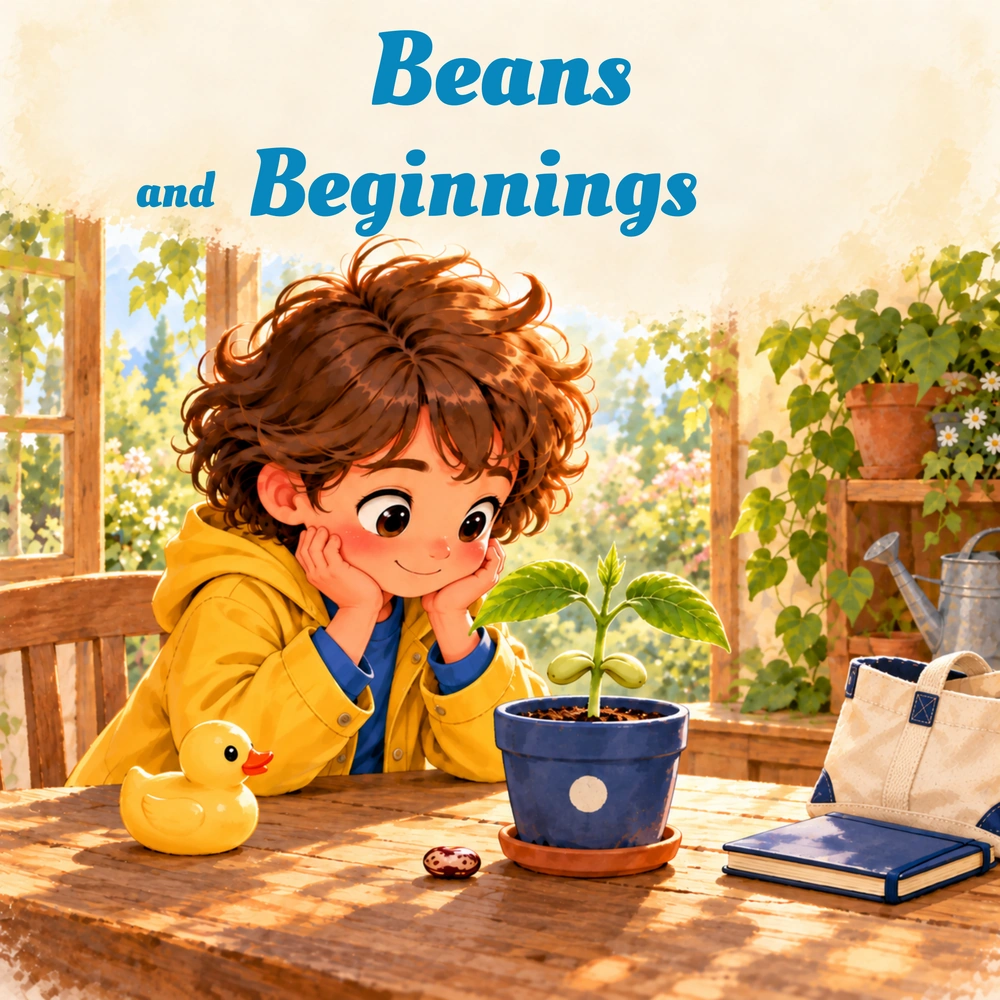
Vince compares the beans in his palm with the plant pictured on their packet. A viable common-bean seed can begin growing when its conditions are suitable. The picture poses the question; it does not promise that every seed will sprout.
Ask together: What looks different about the beans and the plant on the packet?
Three beans rest against white paper in each open jar. Vince adds water to the blue-banded jar and leaves the red-banded jar dry. Moisture is one condition for germination. Oxygen, a suitable temperature and a viable seed also matter; adding water alone cannot guarantee growth.
Ask together: What has Vince changed in one jar?
Days later, the dry beans look unchanged. A swollen bean in the damp jar is splitting, with a short white root emerging. The root is the first part to emerge from the germinating seed. Seeds can develop at different rates, and some may not sprout.
Ask together: What can you spot on the splitting bean?
A long pale root curls downward while a green shoot lifts two fleshy seed leaves and a small folded tip. In this common bean, the shoot lifts the cotyledons, or seed leaves. The first true leaves begin above them. Other kinds of beans can emerge differently.
Ask together: Which part goes down, and which part lifts up?
Fine roots branch from the main root and two flatter leaves open above the fleshy seed leaves. Vince points to his earlier bean drawing. The first true leaves of a common bean form an opposite pair. Later leaves have three leaflets. These drawings show changes in parts, rather than measured growth in height.
Ask together: What has changed since Vince drew the little bean?
An adult steadies the seedling while Vince tucks soil around its roots in a blue pot. Two seedlings remain in the damp jar. A paper-lined jar is a temporary observation setup. An adult can help transfer a seedling gently into potting mix, with drainage, suitable light and water; avoid pulling the stem or roots.
Ask together: Where are the roots going now?
The plant leans toward the right-hand window. Vince turns the pot, and the existing plant now leans away from the window. Turning the pot turns the plant with it. The cream dot on the pot moves out of view; the window stays on the same side. This turn is Vince's action, not new growth.
Ask together: What moved when Vince turned the pot?
Vince waits. The lower stem keeps its older bend while a longer upper tip curves back toward the window. The growing shoot can curve toward light as its two sides grow differently. This is gradual growth, not a decision or an instant turn. A clear bend depends on conditions and is not guaranteed.
Ask together: Where is the new tip pointing now?
A dry bean seed can begin growing when conditions are suitable; in this illustrated comparison the damp-paper beans sprout while dry-paper beans remain unchanged.
University of Illinois Extension, Great Plant Escape: Germination
Opened 2026-10-23; Germination paragraphs 1-2: water, oxygen and suitable temperature; root emerges before shoot; dry conditions and excessive water can prevent germination.
Royal Horticultural Society: All about seeds
Opened 2026-10-23; Activities / What are seeds: apparently inactive seeds can grow under suitable conditions; damp-paper observation and comparison with dry seeds.
University of New Hampshire Extension: Grow a bean in a jar
Opened 2026-10-23; Plant beans in a jar (Week 1), steps 1-7: 3-4 beans between jar and damp paper, observe each day and record changes if any, add water only as needed. Source supplies a multiweek exploration, not guaranteed timing.
Use several viable untreated common-bean seeds from one packet, same containers/place; vary moisture only. Water is necessary, not sufficient: oxygen, suitable warmth and seed viability matter. Results and timing vary. No claim every seed sprouts. Physical setup not performed.
In the depicted common bean, the seed coat opens, a root emerges first, then the shoot develops; roots and leaves are visibly different structures.
University of Illinois Extension, Great Plant Escape: Germination
Opened 2026-10-23; Germination paragraphs 1-2: water, oxygen and suitable temperature; root emerges before shoot; dry conditions and excessive water can prevent germination.
University of Florida / Kentucky / Texas A&M: Germination patterns
Opened 2026-10-23; epigeous pattern: hypocotyl hook and cotyledons raised above substrate. Distinguishes hypogeous pattern; not every bean species shares the same morphology.
Government of Saskatchewan — Dry Bean Adaptation and Varieties
Lead independently opened 2026-10-23 after reviewer check. Opened actual page; Classes of dry bean, web line 109, after the list that includes kidney types. Raised cotyledons, a first opposite pair of simple true leaves, followed by alternate trifoliolate leaves.
Show common bean (Phaseolus vulgaris), not broad/runner bean morphology. Roots emerge continuously from the seed axis; two fleshy cotyledons and two emerging true leaves must not be confused. No instant plant or detachable sprout. Downward root/upward shoot describe depicted growth, not an absolute direction rule.
Agronomic guidance supplies morphology, not household timing. This directly resolves the leaf-stage question without changing the chosen species.
The first true leaves are opposite and simple; later leaves are alternate and trifoliolate. Final growing tip remains folded with no second simple leaf pair.
As this seedling grows, its root system branches and true leaves unfold; a whole developing plant came from the original small seed.
University of Florida / Kentucky / Texas A&M: Germination patterns
Opened 2026-10-23; epigeous pattern: hypocotyl hook and cotyledons raised above substrate. Distinguishes hypogeous pattern; not every bean species shares the same morphology.
University of Illinois Extension, Great Plant Escape: Germination
Opened 2026-10-23; Germination paragraphs 1-2: water, oxygen and suitable temperature; root emerges before shoot; dry conditions and excessive water can prevent germination.
Government of Saskatchewan — Dry Bean Adaptation and Varieties
Lead independently opened 2026-10-23 after reviewer check. Opened actual page; Classes of dry bean, web line 109, after the list that includes kidney types. Raised cotyledons, a first opposite pair of simple true leaves, followed by alternate trifoliolate leaves.
Gurdeep Singh, South Dakota State University — Quantification of Auxin-Cytokinin Response During Primary Root and Lateral Root Development in Common Bean (2025)
Lead independently opened 2026-10-23 after reviewer check. Opened original thesis repository abstract; web lines 40–48. The research explicitly addresses lateral-root initiation and emergence in Phaseolus vulgaris, independently supporting the branching mechanism in c3.
Illustrative sequence over multiple days; no guaranteed rate or size. Distinguish new structures from repeated increase in height. Root absorption and seed stores may be explained in guide but are not claimed visible experimental discoveries.
Agronomic guidance supplies morphology, not household timing. This directly resolves the leaf-stage question without changing the chosen species.
Abstract inspected, not full thesis or figures. Reporter and transgenic-root experiments do not establish the illustrated jar sequence or timing.
A growing shoot can curve toward light; after the pot is turned, later new growth can curve toward the window again.
Georgia Tech Organismal Biology: Plant Hormones and Sensory Systems
Read 2026-10-23 via verified-TLS curl after web fetch 502; local HTML and extracted text retained. Response to Blue Light / Phototropism: differential stem elongation bends growing shoots toward light. Plant Responses to Gravity treats roots and shoots differently. Mechanism supports gradual new curvature, not rigid repositioning or intent.
Phototropism is growth, not walking, feeling or conscious searching. Keep older stem bend after half-turn; only later growing upper section curves back. Light direction and elapsed days must be explicit. Illustration is source-supported possible response, not a tested household result or exact time promise.
Growing upper tissue may already exist before turning; new growth wording means elongation/development, not a universal claim that only newly created tissue bends.
Moist but aerated conditions and careful handling support the observation; a seedling can be moved gently into potting mix for continued growth.
University of New Hampshire Extension: Grow a bean in a jar
Opened 2026-10-23; Plant beans in a jar (Week 1), steps 1-7: 3-4 beans between jar and damp paper, observe each day and record changes if any, add water only as needed. Source supplies a multiweek exploration, not guaranteed timing.
University of Illinois Extension: Snap Beans
Opened 2026-10-23; Care: excessive moisture can crack seed coats and harm germination; do not pre-soak these beans for sowing. Weak/shallow roots can be injured. Used as counterevidence against generic soak-all-beans instructions.
University of Illinois Extension, Great Plant Escape: Germination
Opened 2026-10-23; Germination paragraphs 1-2: water, oxygen and suitable temperature; root emerges before shoot; dry conditions and excessive water can prevent germination.
Colorado State University Extension, Stephanie Lamm — Plants in a Bag
Lead independently opened 2026-10-23 after reviewer check. Opened the actual two-page PDF text; page 1 steps 1–3 and page 2 steps 4–7, especially Step 7 lines 37–41. The extension activity moves damp-paper green-bean seedlings gently into soil in a pot or garden for possible continued growth.
Adult helps with seeds, containers and potting; avoid pulling stem/root, support seedling gently, keep roots covered in receiving hole, use pot drainage. Do not soak common-bean seeds as a universal instruction. No tasting experiment material; wash hands. Guide invites observation rather than guaranteed reproduction.
This is a bag activity, not a trial of this open jar. It supports qualified possible transplantation; its suggested height is not imposed on the story. PDF screenshot failed with cache miss, so the diagrams were not visually inspected.
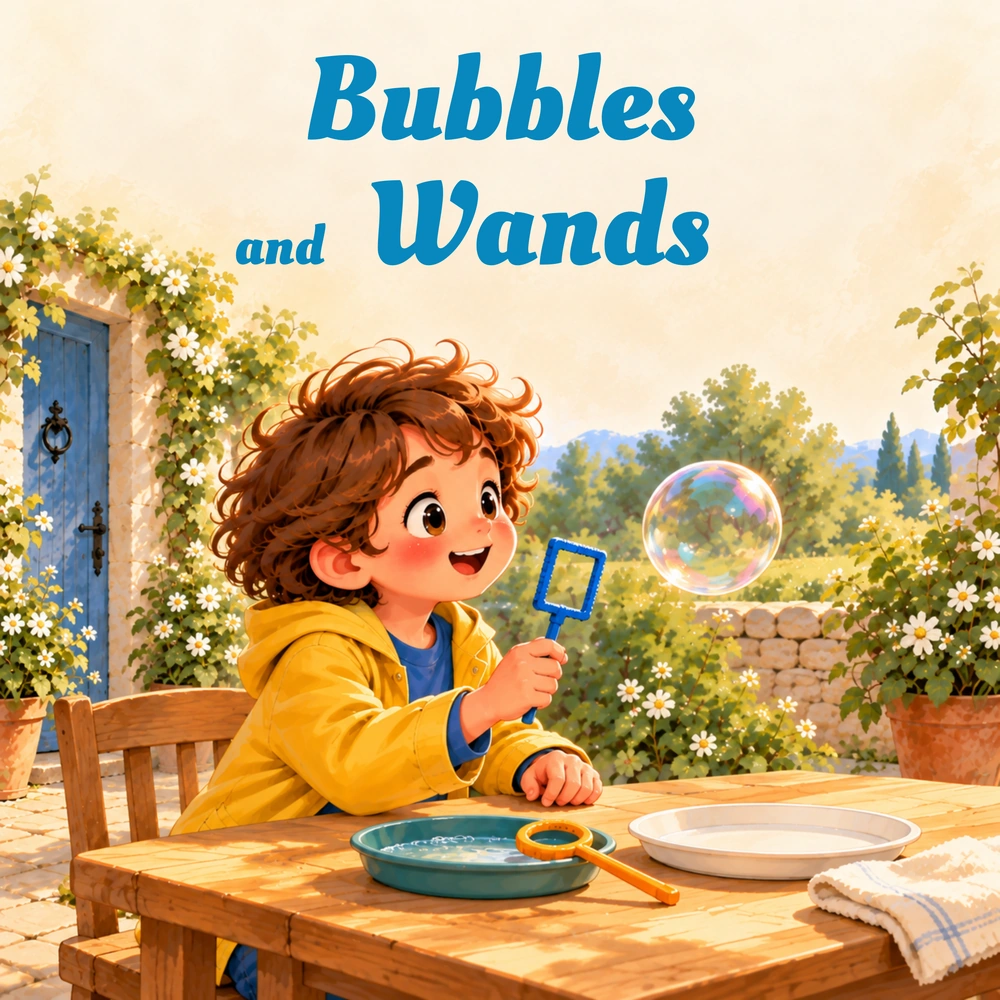
Vince dips a blue square wand, then lifts a shimmering film across its opening. Bubble solution can form a thin film across a wand. The square loop gives this flat film its edges; the opening question invites a prediction.
Ask together: What do you notice inside the square?
Vince blows through the square loop. A round bubble floats free while the wand stays square. Blowing stretches the film around air. Once free, a small bubble tends toward a sphere, even when its wand is square. Bubbles attached to a tool or surface can have other shapes.
Ask together: What changed when the bubble left the wand?
Vince reaches for a bubble with a dry palm. The next picture shows an empty hand with wet flecks. Dry contact can disrupt a bubble film. This is one observed outcome; the pictures do not establish that every dry touch will always pop every bubble.
Ask together: What is different in Vince’s hand after the pop?
Vince wets his left hand in the bubble solution, then a small bubble rests on that same palm. A hand coated in the same bubble solution can support a small bubble briefly. Clean surfaces, calm air and the solution matter; not every catch works.
Ask together: What did Vince change before trying again?
Vince spreads solution on a white plate, then watches a bubble resting there with a curved top. A wet plate can support a dome-shaped bubble. Its surface contact makes its shape different from the free round bubble earlier in the story.
Ask together: Where is this bubble curved, and where does it meet the plate?
Vince makes another bubble beside the first. A close view shows two joined domes with a narrow common seam. Two bubbles can join and share a film. For similar-sized bubbles the common wall is nearly flat, shown edge-on here; unequal bubbles generally have a curved shared wall. Bubbles may also pop or merge.
Ask together: Where do the two bubbles meet?
Vince keeps his hands folded away from the joined bubbles. Later the plate has only wet traces. A bubble can burst without someone touching it. Drainage, evaporation or a disturbance can weaken the film. These pictures show moments, not a measured lifetime or simultaneous popping.
Ask together: What stayed the same about Vince’s hands? What changed on the plate?
Vince dips the square wand again, then quietly watches another round bubble. A fresh dip puts another film across the wand. Vince returns to the opening action after trying, changing a surface and watching what happens.
Ask together: What do you notice about how Vince watches this bubble?
A dip leaves a thin liquid film across a flat wand; blowing can inflate it around air and release a bubble.
B is for Bubble, American Chemical Society
Ordinary bubble solution contains water and detergent. The depicted setup has not been physically trialled.
A square planar wand can hold a square-edged flat film, but its small detached bubble tends toward a round, approximately spherical shape.
Magic Bubble Wands, Science World
The Shape of Bubbles, Exploratorium
A small free bubble tends toward a sphere. Bubbles still attached to a tool or surface may have different shapes.
Dry hand contact can rupture a soap film; coating the hand with the same bubble solution can let a small bubble rest briefly.
A solution-wet palm can support a small bubble briefly; not every catch works. Clean surfaces, calm air and solution affect the result.
A small bubble can rest as a dome on a plastic plate wetted with bubble solution.
Bubble Sculptures, Science World
The picture shows one possible dome on a solution-wet plate, not a guaranteed household result.
Two similar-sized joined soap bubbles can share an approximately flat film, changing their shapes at the join.
When Bubble Meets Bubble, Exploratorium
Bubble Sculptures, Science World
Two bubbles may join, pop or merge. The similar-sized pair shown shares a nearly flat wall seen edge-on; unequal bubbles generally have a curved common wall.
A bubble can rupture without being touched as its liquid film thins; the liquid remains as tiny drops or wet traces and its air joins surrounding air.
The views show moments, not an exact lifetime or simultaneous rupture. Liquid remains as tiny droplets or wet traces, while the enclosed air mixes with surrounding air.
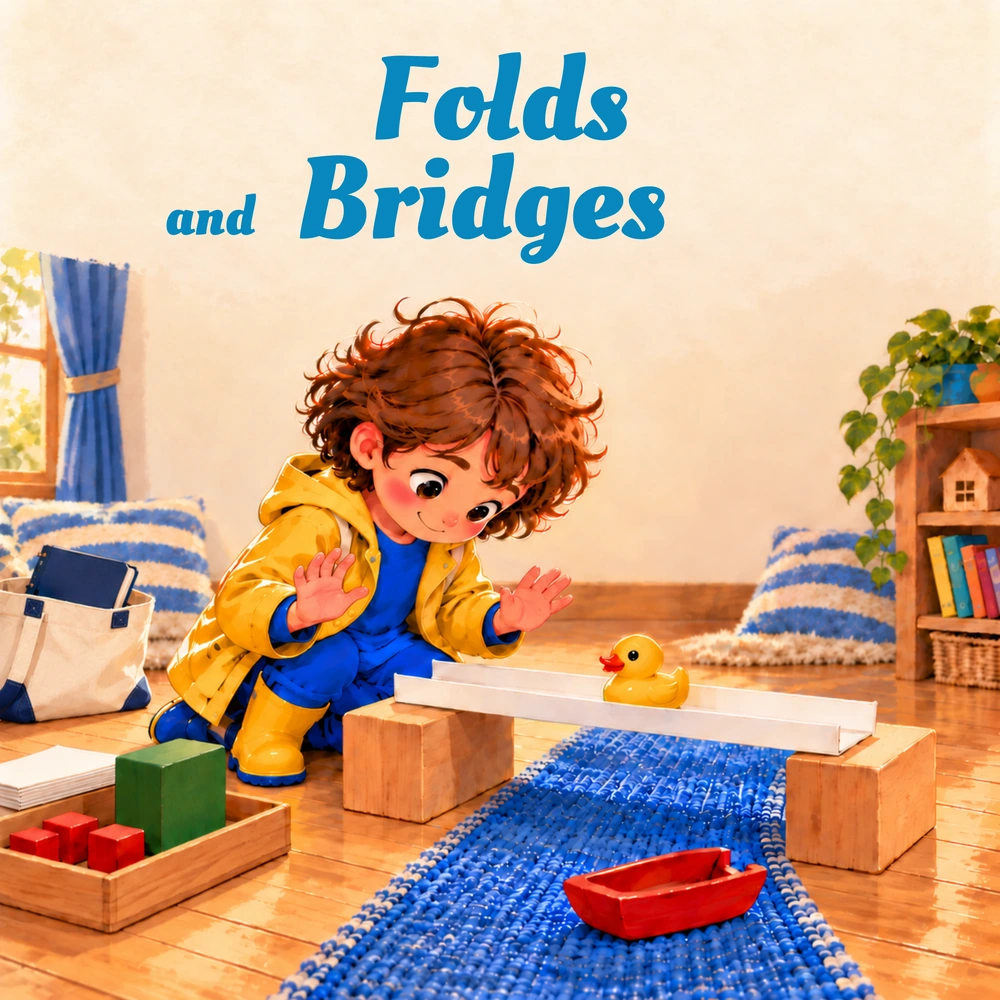
Vince places his duck on a flat paper bridge. With his hands clear, the middle bends down. A flat sheet can bend under a toy between its supports. The picture shows one possible result, not a measured weight limit.
Ask together: What changes when Vince lets go?
Vince brings the same end blocks closer. The duck stays up and the paper ends reach farther past the supports. Shortening the unsupported span can reduce bending under the same load. The longer overhangs help show what changed.
Ask together: Where does the paper reach beyond the blocks now?
The boat is wider than the narrow opening. Vince moves the blocks apart again. A bridge can carry a toy yet leave too little room below. The boat gives Vince another requirement to consider.
Ask together: What is stopping the boat?
Vince folds one long edge upright, then the other, making an open channel. The same sheet gains a different cross section. Upright lengthwise edges can help it resist bending without adding more paper.
Ask together: What is different about the paper after the second fold?
The folded bridge returns to the wide opening. The duck stays up while Vince lifts both hands. The channel can resist bending better than the earlier flat sheet at the same span. Paper, folds and toy weight still matter.
Ask together: What stayed the same, and what changed?
Vince adds red cubes beside the duck. The paper creases and the passengers drop into the sag. Holding one toy does not establish unlimited capacity. Enough added weight can permanently crease a paper bridge; the illustrated cube count is not a tested threshold.
Ask together: What do you notice about the paper after it bends?
Vince uses fresh flat paper and a broad middle block. The block supports the duck and cargo above but stops the boat below. A block in contact beneath the load can carry it through the paper. This is a new design with a fresh sheet and a new support, and it uses the passage the boat needs.
Ask together: What does the green block help, and what does it stop?
Vince folds the fresh sheet, sets the green block and cargo aside, and sends his boat beneath the duck. The folded bridge carries the chosen light load while leaving the opening clear. Vince combines earlier discoveries to meet both needs.
Ask together: Which parts of the earlier bridges does Vince keep?
A flat paper bridge can bend under a toy placed between its supports.
File Card Bridges — Exploratorium Science-at-Home Team
Depicted gentle sag, not fracture or permanent crease. Actual toy and paper not tested; no fixed weight or dimensions promised.
Reducing the unsupported gap can reduce bending under the same central load.
Beam Displacements — David Roylance, MIT, November30 2000
Same flat sheet, same duck and equal-height supports. Overhang increases as supports approach; no hand holds the deck in result view. Qualitative elastic behavior, not a measured ratio.
Folding the two long edges upright changes the paper cross section and can make a bridge resist bending better.
Paper Bridge Design Challenge — Ben Finio, Science Buddies
File Card Bridges — Exploratorium Science-at-Home Team
A U-shaped channel is different from folding the sheet flat into layers. Folds run along the span. Compare same paper and duck at original support spacing. Not every fold makes every structure stronger.
Adding enough load can crease and collapse a folded paper bridge; holding one toy does not establish unlimited capacity.
Paper Bridge Design Challenge — Ben Finio, Science Buddies
Depict cumulative loading followed by a sharp crease/collapse. Replace the damaged sheet explicitly; do not imply it springs back. Illustrated cubes are not a tested load rating or a guaranteed failure count.
A block in direct contact beneath a load can support it through the paper while occupying the passage below.
Beam Displacements — David Roylance, MIT, November30 2000
The new flat sheet, middle block and loaded configuration are a redesigned bridge, not a controlled one-variable comparison with the failed folded sheet. Keep the full duck/cargo footprint directly over the broad support. Block contacts underside and floor. Boat obstruction is this design’s literal clearance constraint, not a universal property of supports.
A useful bridge design must both carry its chosen load and leave the required passage clear.
Paper Bridge Design Challenge — Ben Finio, Science Buddies
An application of source engineering-design comparisons to this invented play problem, not an empirical test. Final scene changes both load and support deliberately; it is not called a controlled experiment.
Vince adds white salt to tan sand. Both kinds of grain are visible together in a clear cup. The two materials begin as visible grains. Mixing them does not make them the same material.
Ask together: What different grains can you see?
Vince shakes a coarse sieve. White and tan grains fall into the cup below. In this setup, both kinds of grain fit through the openings. A sieve with different openings could give a different result.
Ask together: What falls through this sieve?
Vince stirs water into the mixture. Tan sand remains at the bottom, but the white salt grains are no longer visible. Enough water dissolves the salt into particles too small to see. The selected sand stays as grains; the salt has not melted or ceased to exist.
Ask together: What can Vince still see in the cup?
Vince points to the sand, then fits clean paper into a funnel seated in an empty receiving cup. The paper and supported funnel prepare a different kind of separation. The sand-bearing cup remains separate until the next pour.
Ask together: What has Vince chosen to try next?
Vince pours into the supported paper filter. Sand collects in the paper while liquid drips into the cup beneath. Intact coffee paper can hold these sand grains while water and dissolved salt pass through. Clear liquid can still contain dissolved material and is not made safe to drink.
Ask together: What stays in the paper, and what reaches the cup?
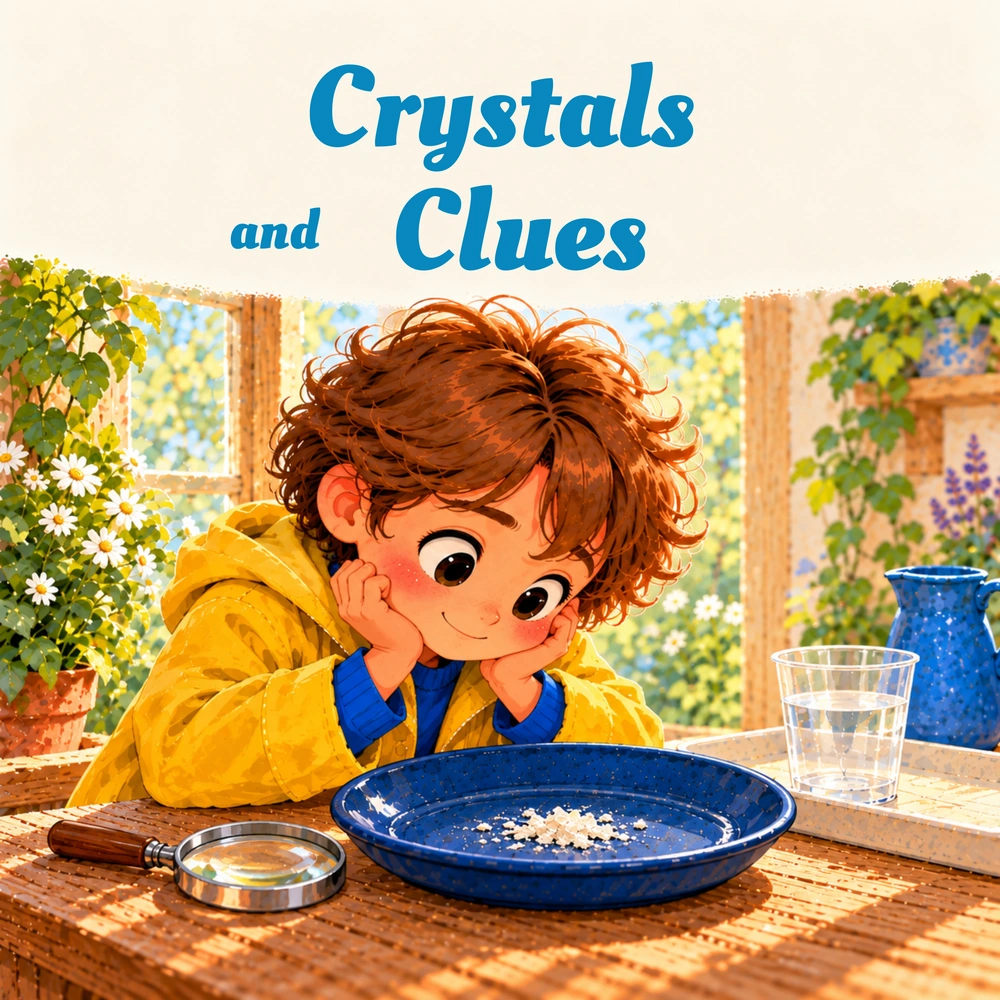
Vince pours collected liquid into a shallow blue dish. Over days, the pool becomes smaller. Water escapes into the air as invisible water vapour. Drying time depends on depth, warmth, airflow and humidity; it can take days or longer.
Ask together: What changes as Vince waits?
Vince looks closely at white crystals left in the blue dish. As water is lost, salt can form new crystals, clusters or a crust. The original grains need not return unchanged.
Ask together: What does the white patch help Vince work out?
Vince adds water to a small sample of recovered salt. The sample becomes invisible while a remaining dry patch stays in the dish. A little recovered salt can dissolve again in enough fresh water. The dry patch gives Vince a comparison while he recognizes the clear mixture.
Ask together: Where does Vince think the salt is now?
A coarse sieve whose openings exceed both selected grain sizes lets both salt and sand pass; this attempt need not separate them.
Separating Mixtures: Teacher version
Not all sieves behave alike. This particular sieve has openings larger than the illustrated grains. No claim that every sieve fails or that this exact prop trial occurred.
A small amount of salt dissolves in sufficient room-temperature water while the selected clean sand remains visibly undissolved.
Use additive-free salt and washed coarse sand; appearance varies with impurities. Dissolving is not melting or destruction. Amount must be below capacity; original grain size need not be preserved.
A supported coffee-paper filter retains the selected sand while liquid containing dissolved salt passes through.
Separating Mixtures: Teacher version
The filter must be intact and supported; do not overfill. Extremely fine suspended material may pass. Clear filtrate is not purified drinking water. UCSD incorrectly says atoms: use ions, as supported by ACS. Omit its tasting suggestion and all heating.
Water in an open shallow dish can evaporate into the air while dissolved salt remains and forms visible crystals as the water is lost.
No fixed completion time: allow days, potentially longer with humidity or depth. Small deposits may be crusts or clusters, not large perfect cubes. No visible steam, salt floating away or sunlight as an essential requirement.
Recovered salt can dissolve again when sufficient fresh water is added; recovery shows that clear salt solution contained salt.
Separating Mixtures: Teacher version
The same ions can form new crystals, not necessarily the original grains. Re-dissolve a small recovered sample in ample water. No claim of complete quantitative recovery or safe tasting.
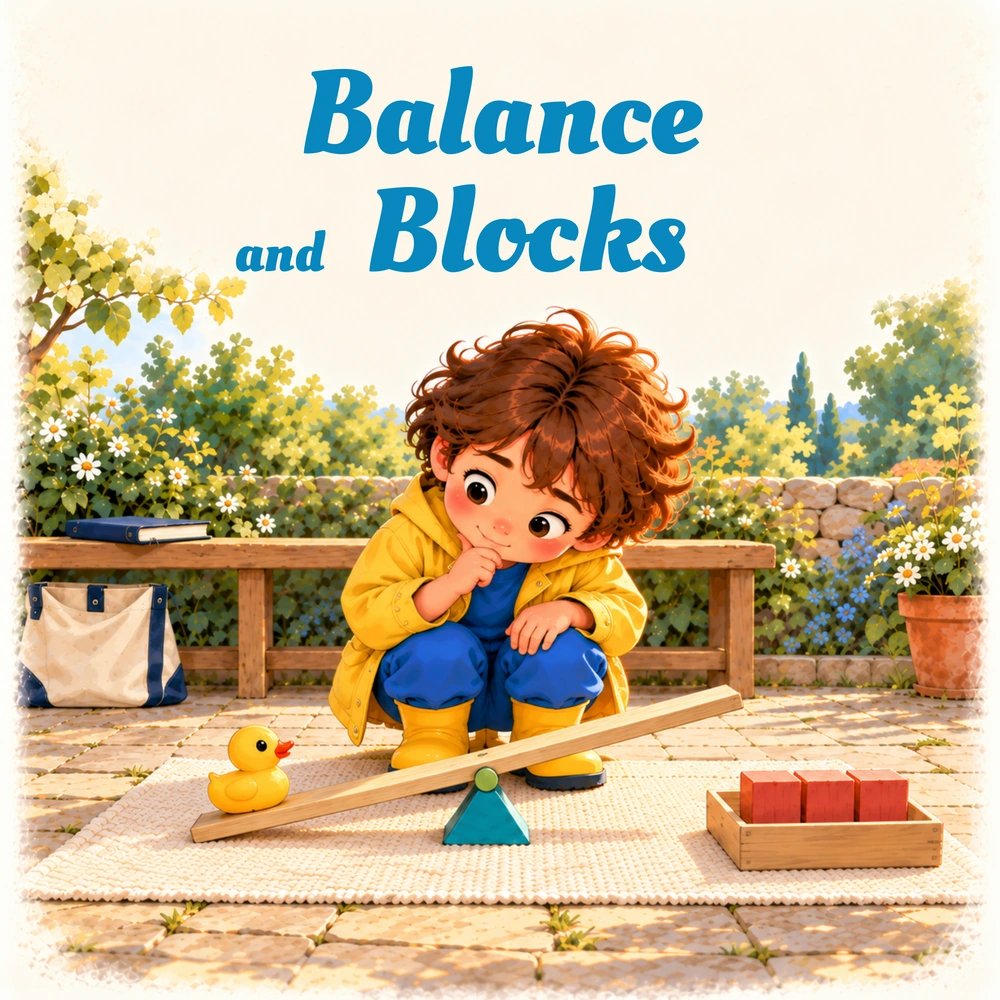
Vince watches his yellow toy duck on the low end of a wooden beam. The other end is raised. A load away from the pivot can turn the beam toward its side. The lowered end rests on the mat.
Ask together: Which end is down?
Duck waits beside the tray while Vince puts one matched block on the beam. The three blocks are alike in weight as well as appearance. Using matched objects helps Vince compare their positions.
Ask together: What will Vince try with his blocks?
Vince steadies the beam as he places a block opposite the first. After he releases it, the beam is level. Equal weights at matching distances can balance a centered beam. This brief result does not promise that the beam will stay level after a disturbance.
Ask together: Where are the two blocks?
Vince moves the right block farther from the pivot. That side tips down after he lets go. The block has not become heavier. Farther from the pivot, it has a greater turning effect.
Ask together: What changed while the blocks stayed the same?
Vince moves the other block out too, steadies the beam, and releases it to find level again. Matching the distances restores equal opposing turning effects. Vince prepares the level position by hand.
Ask together: How did Vince match the blocks this time?
Vince stacks the third block on the left block. The pair's side goes down. The pair shares one horizontal position. Adding a matched block increases that side's turning effect.
Ask together: What is different on the low side?
Vince steadies the beam while moving the pair closer to the pivot. The two close blocks balance the single block farther away for a moment. For matched blocks and a centered beam at level, two can balance one when their shared center is about half as far from the pivot. Real materials need adjustment.
Ask together: Which blocks are closer to the middle?
Vince tries a place for the duck and a closer place for one block, then releases the level beam. The duck and block need not weigh the same. Vince adjusts their positions to balance their opposing turning effects.
Ask together: How has Duck's ride changed since the beginning?
A centered uniform beam with a load on only one side tends to turn down on that side.
Lifting with a Lever — Ben Finio, Science Buddies
Center of Gravity — Exploratorium Teacher Institute
Rigid approximately uniform beam; narrow freely rocking support; sufficient load to exceed friction. A down end may rest on the mat; it is not then in free balance.
Equal-weight blocks at equal distances on opposite sides can balance the centered beam.
Lifting with a Lever — Ben Finio, Science Buddies
9.3 Stability — OpenStax College Physics 2e
Identical looking does not always mean identical mass; these three matched wooden cubes are one set. Center the unloaded beam first.
Equal moments at level do not imply self-righting. Vince steadies the beam level before release; the result is brief and may tip again. Physical support friction and load height affect stability.
With equal loads, moving one farther from the pivot increases its turning effect; matching the other distance can restore balance.
Lifting with a Lever — Ben Finio, Science Buddies
9.3 Stability — OpenStax College Physics 2e
Distance is horizontal distance from pivot to load center, not distance from the edge. Keep pivot/beam/blocks fixed except specified moved block.
Equal moments at level do not imply self-righting. Vince steadies the beam level before release; the result is brief and may tip again. Physical support friction and load height affect stability.
Adding a matched block at the same side/distance increases that side's turning effect.
Lifting with a Lever — Ben Finio, Science Buddies
Stack the pair centered at the same longitudinal position; added mass, not increased height, causes the changed moment at level.
Two equal blocks can balance one if their shared center is about half as far from the pivot as the single block.
Lifting with a Lever — Ben Finio, Science Buddies
9.3 Stability — OpenStax College Physics 2e
Idealized weight-distance relation at level; friction, block variation and beam balance require small practical adjustment. Exact illustration is not measured data.
Equal moments at level do not imply self-righting. Vince steadies the beam level before release; the result is brief and may tip again. Physical support friction and load height affect stability.
A differently weighted toy and block can balance by adjusting their distances from the pivot.
Lifting with a Lever — Ben Finio, Science Buddies
Center of Gravity — Exploratorium Teacher Institute
9.3 Stability — OpenStax College Physics 2e
Toy has an unspecified mass; do not imply one duck equals one block. Final duck farther out and denser wooden cube nearer support is plausible for a light hollow duck; art is illustrative.
Equal moments at level do not imply self-righting. Vince steadies the beam level before release; the result is brief and may tip again. Physical support friction and load height affect stability.
An adult can explore these relationships with a stiff strip, a low support and matched large blocks, making small adjustments.
Lifting with a Lever — Ben Finio, Science Buddies
9.3 Stability — OpenStax College Physics 2e
Source uses ruler/pencil/weights; our broad smooth strip/low triangular wood support is an adaptation, not a physically tried kit. Prebalance beam and confirm each comparison. Use light large pieces on a low surface; keep fingers clear. Not a claim that every toy/beam works.
Equal moments at level do not imply self-righting. Vince steadies the beam level before release; the result is brief and may tip again. Physical support friction and load height affect stability.
Water from Vince's cup reaches his pencil duck drawing and spreads into the paper. Absorbent paper takes water into small spaces among its fibres. The damp patch spreads while the pencil outline remains visible.
Ask together: Where has the paper become wet?
A towel corner touches the puddle. Its wet patch grows while some puddle remains. Water can move into an absorbent towel without wiping. The water has changed location, rather than vanished.
Ask together: What changes in the towel and in the puddle?
Only the tip of the towel strip is in the cup, but wetness rises above the waterline. Water's interactions with the paper fibres and with itself help it move through small spaces. Gravity still limits how far it can rise.
Ask together: Where is the waterline, and how high is the wet patch?
A shallow puddle remains on intact foil beside a damp patch in absorbent paper. Foil does not absorb water like the chosen paper. Water can spread on its surface without soaking inside.
Ask together: Where can you see water sitting on top?
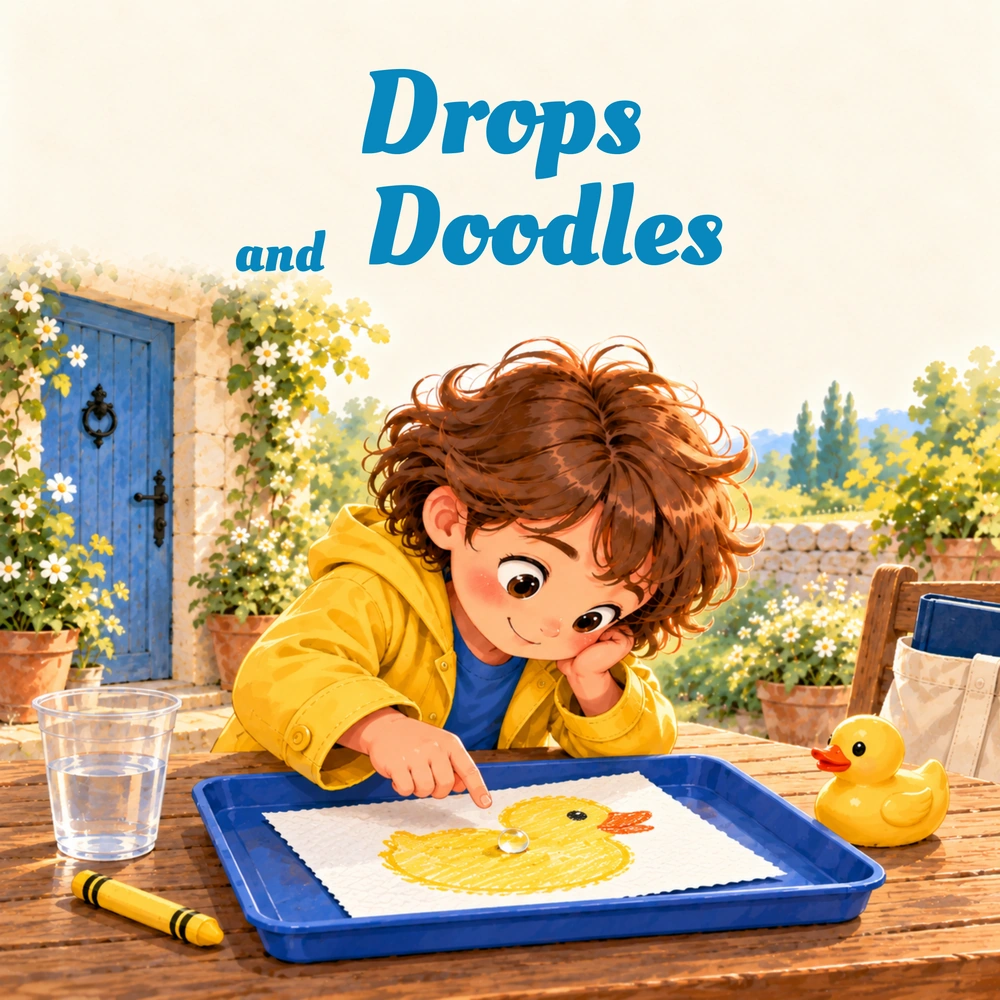
Vince makes a dense crayon patch. A drop remains above it while nearby bare paper becomes damp. A thick wax coating reduces how readily water wets the paper beneath it. The uncoated part can still take water in.
Ask together: What is different about the two wet places?
Vince tips the sheet and water runs from the waxy area onto adjoining bare paper. A sufficiently large drop may run downhill on a tilted coating and reach absorbent paper. Tiny drops can remain stuck, so this is not a guaranteed result for every crayon or drop.
Ask together: What happens where the wax ends?
Vince draws a waxy yellow duck, then brushes a light blue wash across the picture. Colour reaches exposed paper while the dense wax drawing remains visible. Gaps in wax can leave speckles; the coating, rather than yellow colour, matters.
Ask together: Where has the blue wash reached?
Water can soak into uncoated absorbent paper and spread beyond its first contact area; a paper towel can take up a small spill.
American Chemical Society — Waterproof Wonders
USGS Water Science School — Capillary Action and Water
Use absorbent, uncoated paper and an ordinary paper towel. Coated or heavily sized paper may behave differently. The wet patch can darken without added colour; its speed and size depend on the materials and amount of water.
The exact materials pictured have not been physically tried. No fixed soaking time, capacity or instant drying is promised.
With only the lower tip of a paper-towel strip in water, wetness can travel upward above the water surface through the strip.
USGS Water Science School — Capillary Action and Water
Keep only the lower tip submerged and hold the strip still. The rise takes time and varies with the towel; no particular height or time is guaranteed.
Water moves through small wettable spaces in the towel. Gravity still limits the rise; this does not mean gravity has stopped.
A small puddle remains on intact aluminum foil rather than soaking through as it does in the selected absorbent paper.
American Chemical Society — Waterproof Wonders
Use intact foil without holes. Water can spread into a shallow surface puddle; perfectly round beads are not required.
This comparison concerns the chosen foil and absorbent paper. Materials and surface coatings vary.
A thick wax-crayon coating on part of the same paper reduces wetting there; bare paper nearby can absorb water.
American Chemical Society — Waterproof Wonders
University of Florida Harn Museum — Watercolor Resist Painting
Press a wax crayon firmly to cover a broad patch densely. Sparse marks, cracks, washable crayon products and paper sizing can change the result.
Water may form beads or a shallow pool on the wax. The coating does not make the entire sheet permanently waterproof.
A sufficiently large surface drop can run downhill on tilted wax-coated paper and soak into a bare-paper region it reaches.
American Chemical Society — Waterproof Wonders
The picture illustrates runoff from a coated surface onto adjoining absorbent paper, extending the coated-surface demonstration described by ACS. The exact crayon, paper, drop and tilt combination has not been physically tried.
Tiny drops can stay pinned in place. A larger drop may run when the sheet is tilted, but no particular angle or speed is guaranteed. Water can soak into bare paper when it reaches it.
Applying watery watercolor after a firm wax-crayon drawing can colour exposed paper while leaving the crayon drawing visible.
University of Florida Harn Museum — Watercolor Resist Painting
Crayola — A Paper Relief for the Coral Reef
American Chemical Society — Waterproof Wonders
Use non-toxic wax crayons, firm coverage and a light watery wash on suitable sturdy paper. Thin pigment can briefly cover wax before beading, and gaps in crayon can leave speckles.
The picture shows a representative result. The wax coating matters, rather than the yellow colour; results vary with materials.
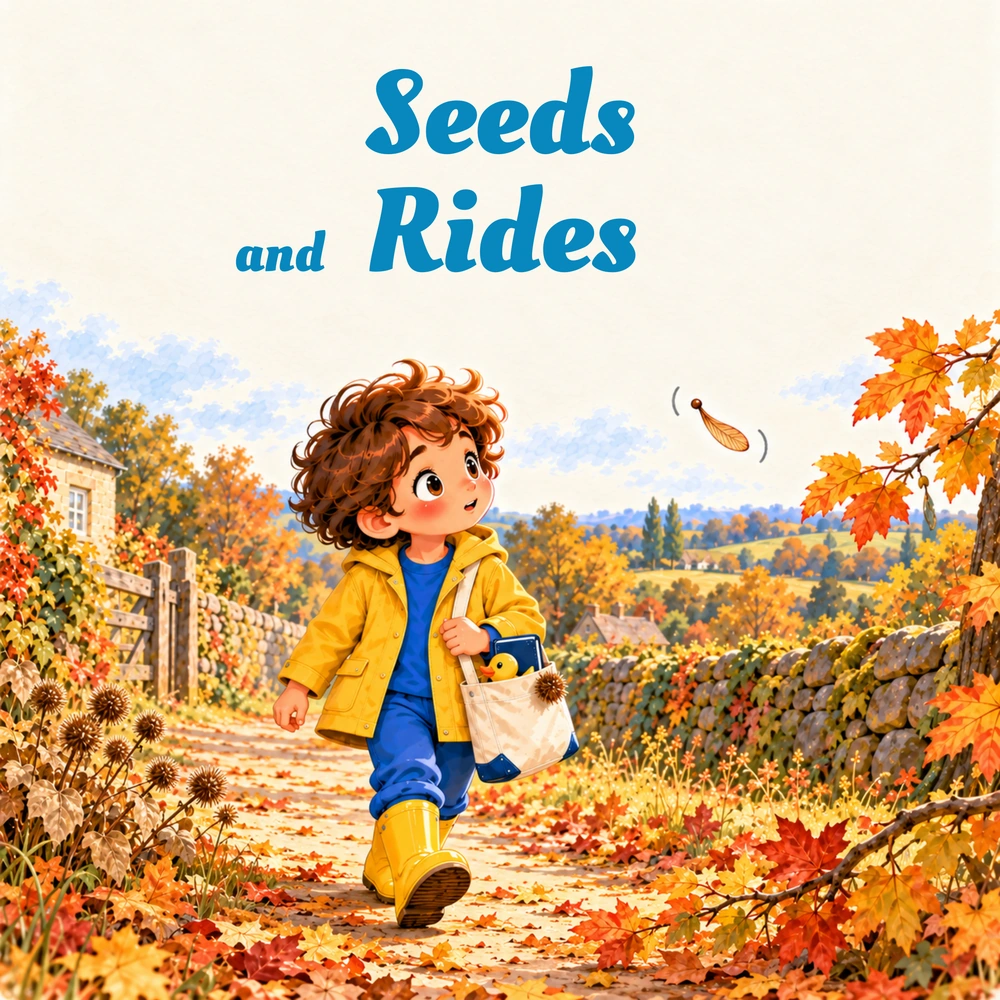
Vince’s bag brushes dry burdock heads. One brown burr catches near the bag’s seam. A burdock burr carries several fruits with seeds inside. Its bracts have hooked tips that can catch fibres or fur.
Ask together: What caught on Vince’s bag?
A closer view shows curved hook tips catching loops in the cream fabric. The burr is held by hooks caught in the cloth, not by glue. How well it catches depends on both surfaces.
Ask together: Where do the hooks meet the cloth?
The burr stays on the moving bag. Ahead, one winged maple fruit falls near a tree. Vince carries the bag and its attached passenger. The separate winged fruit turns while it falls through air.
Ask together: Which traveller is Vince carrying?
Vince releases one mature maple fruit. It is lower than his open fingers and turning. A maple samara has a wing and a thick seed-bearing end. Its shape interacts with air during descent; a short drop may not show a clear spin.
Ask together: Where is the fruit after Vince lets go?
An adult holds a complete dandelion unit while Vince looks. A thin stalk joins its tiny brown fruit to white bristles. The object often called a dandelion seed is a fruit containing a seed. Its tuft of bristles is called the pappus.
Ask together: What hangs below the fluffy top?
Vince blows gently toward a rooted dandelion head. Some complete units travel sideways; others remain attached. The bristles help slow falling, allowing moving air to carry the fruit. Dryness, maturity and the air affect what happens.
Ask together: What travels with each fluffy top?
One complete dandelion unit rests beside a yellow boot, and another rests on the path. Seeds and fruits can land in different places. A landing does not establish that a seed will grow there.
Ask together: Where did these two travellers land?
At the cottage, the same burr is still caught on the bag. An adult is ready to remove it. The burr arrived because Vince carried the bag. Adults should identify and remove plant hitchhikers appropriately and avoid spreading unfamiliar or invasive plants.
Ask together: Who carried this passenger home?
A mature burdock burr can catch on fibrous fabric with hooks and be carried with the fabric.
Manitoba Agriculture: Common Burdock
Latter (1941), A Factor in the Dispersal of Burdock
Attachment depends on the hooks and the material they meet.
A burr is a seed-bearing head: it can carry several fruits with seeds inside, rather than being one seed.
Manitoba Agriculture: Common Burdock
Latter (1941), A Factor in the Dispersal of Burdock
A burdock burr is a seed-bearing head holding several fruits, not a single seed. Adults should handle or remove burs without pulling them apart.
A mature single maple samara can rotate as it falls; its wing interacts with air and slows descent.
Caltech (2009): Maple Seeds and Animals Exploit the Same Trick to Fly
US Forest Service: Silvics of North America, Norway Maple
A mature intact maple samara may need sufficient falling distance to establish a clear spin. The illustrated short drop is a plausible example, not a measured trial.
A dandelion dispersed unit has a small fruit at one end of a slender stalk and a tuft of fine bristles at the other.
The ordinary word seed refers here to a tiny fruit containing a seed. Its thin stalk joins the fruit to the tuft.
Moving air can carry dandelion fruits with their tufts; the bristles help slow falling.
Cummins et al. (2018): A separated vortex ring underlies the flight of the dandelion
Release and movement vary with moisture, maturity and air conditions. Many fruits land nearby; no particular distance is promised.
Dispersal moves seeds to other places, through attachment to a carrier or movement in air; arriving somewhere does not ensure growth.
Cummins et al. (2018): A separated vortex ring underlies the flight of the dandelion
Movement and landing do not guarantee germination or survival. No growth outcome is depicted or tested.
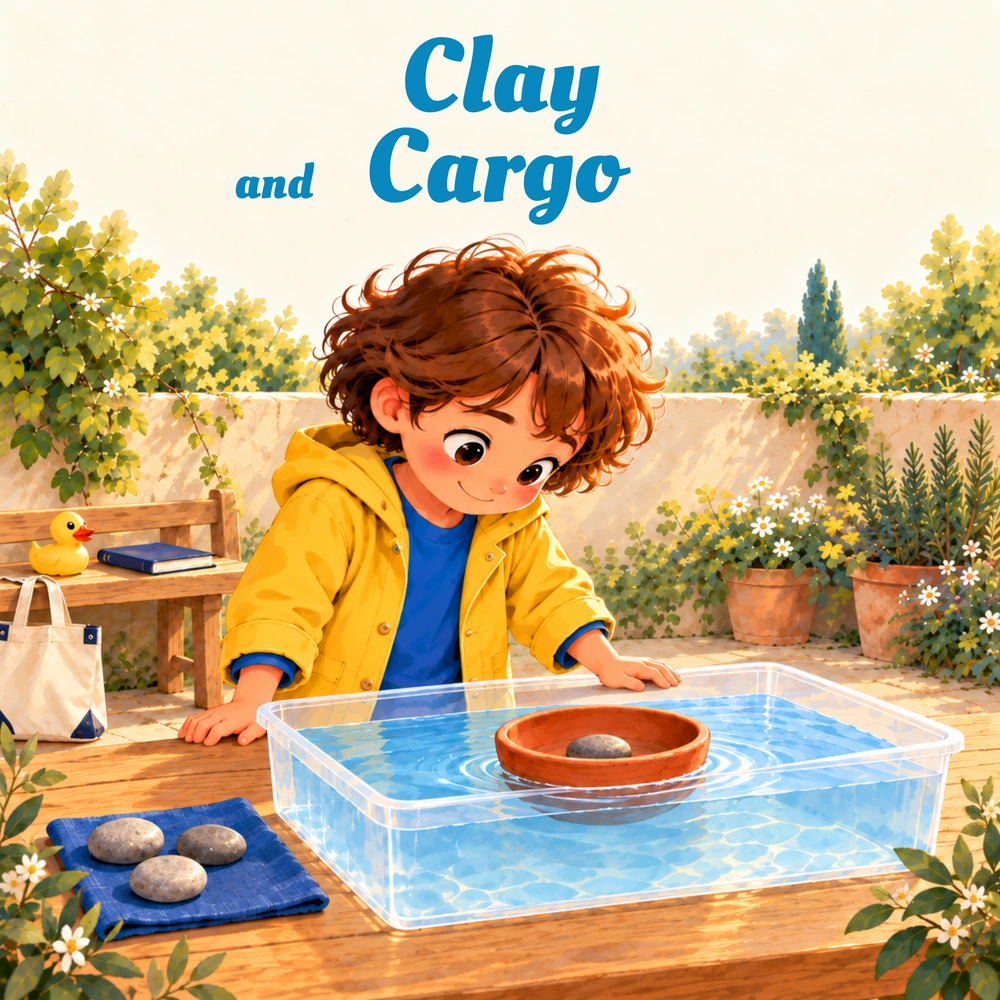
Vince releases a solid clay lump into a shallow tub. It settles on the bottom while four stones wait on a blue cloth. The selected clay is denser than water. A solid lump sinks; the waiting stones give Vince a reason to try a different shape.
Ask together: What could Vince change about his clay?
Vince presses the same clay wide and turns its edges up into a broad bowl. An intact hollow shape can keep water out of a larger space. The raised edges and unbroken bottom matter; a wide solid pancake is not the same thing.
Ask together: Where could water get into a boat?
Vince lowers the empty clay bowl into the tub, then takes both hands away. It floats with a dry interior. The clay has not become lighter. A suitable bowl shape can displace enough water to support its weight before water reaches its rim.
Ask together: What changed, and what stayed the same?
Vince gently presses the empty bowl a little deeper, then lifts his fingers away. The bowl rises while remaining partly in the water. A slightly deeper intact boat displaces more water. If it stays level, dry and undamaged, the increased upward force can lift it again after release.
Ask together: What happens when Vince lets go?
One stone rides in the dry hull. With three stones aboard, the same boat sits lower in the water. Added cargo increases the weight. A floating hull settles deeper until the upward force balances its new total weight, provided it can still keep water out.
Ask together: Which boat has more rim above the water?
Vince adds the last stone. Water crosses the low rim and enters the clay bowl. A low open rim can let water in when a load brings it down to the surface. The exact load depends on the clay, hull and stones; these counts are illustrative.
Ask together: Where does the water enter?
Vince removes the stones and tips water out of the intact bowl. The empty dry hull can float again. Removing the cargo alone does not empty a flooded boat. Vince drains the water before relaunching the undamaged hull.
Ask together: What two things does Vince take out?
Vince nudges a one-stone load across the tub, then lifts the stone out at the far blue cloth. Three stones still wait for later trips. A smaller load leaves more rim above water. Repeating a successful lighter trip gives Vince a way to carry the stones without trying to carry them all at once.
Ask together: How could the waiting stones get their rides?
The selected dense non-hardening modeling clay sinks as a compact solid lump in water.
ACS Grade 5 Lesson 2.4: Density and Sinking and Floating, Teacher Background
The clay is selected to be denser than water; not every modeling material behaves the same way.
The same clay can float when formed into a broad watertight bowl whose above-water rim keeps water out and whose submerged envelope excludes enough water.
ACS Grade 5 Lesson 2.4: Density and Sinking and Floating, Teacher Background
The bowl needs an intact watertight bottom and raised rim, enough space to displace water, and a dry interior. Reshaping does not reduce the clay mass.
An intact stable empty floating bowl depressed gently without flooding can rise after the fingers separate.
OpenStax University Physics Volume 1, 14.4 Archimedes’ Principle and Buoyancy
The gentle press is conditional on a level, unchanged, dry hull with its rim above water. Soft clay can deform, tip or flood.
Adding cargo makes the same stable boat float deeper while its dry interior excludes more water; removing cargo before flooding can reduce the required immersion.
OpenStax University Physics Volume 1, 14.4 Archimedes’ Principle and Buoyancy
One, three and four stones are an illustrative sequence, not a tested load limit. Hull thickness, shape and stone size change the result.
If loading brings the rim low enough for water to enter, an open dense clay hull can flood and sink.
OpenStax University Physics Volume 1, 14.4 Archimedes’ Principle and Buoyancy
Water entry must occur at a rim low enough to be overtopped. Upward force also acts on sinking objects; it is insufficient to support this flooded dense hull.
Emptying the water and cargo from an undamaged hull restores the light-load conditions; carrying smaller loads in several trips can solve the cargo task.
ACS Grade 5 Lesson 2.4: Density and Sinking and Floating, Teacher Background
Vince removes the cargo and drains an intact hull before relaunch. Draining does not repair cracks. The story shows the first delivery and proposes later trips.
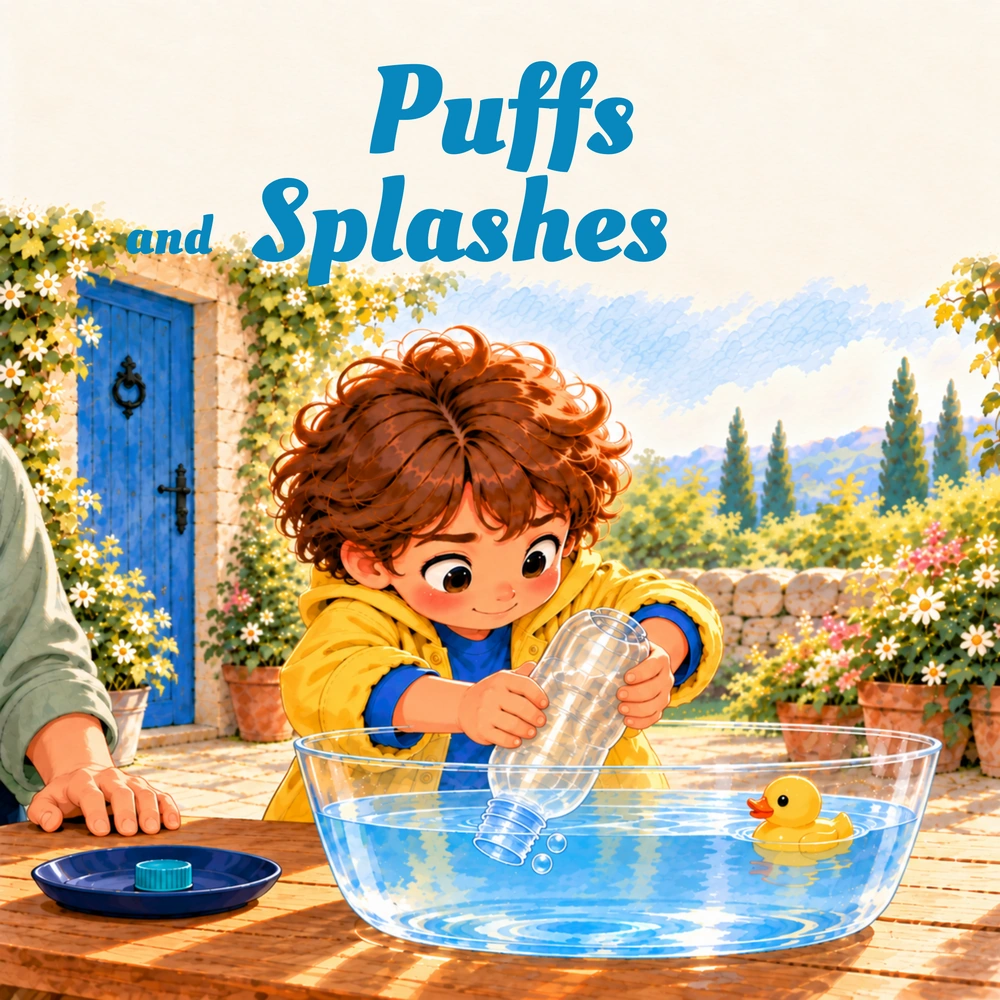
Vince holds up an empty-looking capped bottle, then gently dents its flexible sides. The bottle contains air. With the lid closed, a gentle squeeze puts that air into a smaller space; the bottle wall also resists bending.
Ask together: What might be inside even when we cannot see it?
A grown-up removes the cap. Vince squeezes the bottle toward his open palm. With the mouth open, the squeeze can push some air out. Its effect can be felt even though the air itself is invisible.
Ask together: What changes when the lid comes off?
Vince lowers the open bottle mouth under water and squeezes. Bubbles leave the mouth and rise through the basin. Water gives the escaping air visible boundaries. These are air bubbles in plain water, not soap bubbles.
Ask together: Where do the first bubbles appear?
Vince relaxes his hands with the bottle mouth still submerged. The sides recover and water appears inside. A resilient bottle expanding after a squeeze lowers its internal pressure. Water can enter through the submerged opening; the amount depends on the bottle and squeeze.
Ask together: What is different inside after Vince lets go?
A grown-up fills the same bottle to the brim. With its cap on, Vince finds it much harder to squeeze. With the bottle full and closed, its volume changes very little under a gentle squeeze because water compresses far less than air.
Ask together: How does this compare with the first squeeze?
The cap comes off again. Vince gently squeezes the bottle over the basin and a short splash leaves its mouth. Opening the mouth gives the water a route out. A squeeze can drive outflow, and tipping an open bottle can also pour.
Ask together: What has the open lid changed?
Vince drains the remaining water, then holds the empty-looking bottle and feels another puff against his palm. Air enters as the bottle recovers outside the water. The bottle can look empty while still holding air.
Ask together: Does the bottle seem the same to Vince now?
A bottle without liquid still contains air, which occupies space.
Science World: What's in a Bottle?
Air is invisible; the story depicts observable effects rather than air particles.
Air in a tightly capped flexible bottle can be compressed into less space; a gentle squeeze changes its shape but meets resistance.
ACS Inquiry in Action, Grade 5 Lesson 1.1: Matter is Made of Tiny Particles
Use a flexible bottle that recovers after a gentle squeeze. Some resistance comes from its wall; a crushed disposable bottle may not recover.
Squeezing an open flexible bottle pushes some of its contents out through its mouth; escaping air can be felt, and escaping water is visible.
UBC PHAS: Punctured Bottle, Pressure Grade 4
Science World: What's in a Bottle?
The opening provides an outlet. Tipping can also pour water; a stream alone does not measure the contribution of the squeeze.
Squeezing an uncapped resilient bottle with its mouth under water expels air as bubbles; releasing the squeeze while the mouth remains submerged allows water into the recovering bottle.
Dorothy Alfke, Squeeze Bottle Science (The Science Teacher, October 1954), reprinted NSTA 1963
ACS Inquiry in Action, Grade 5 Lesson 1.1
JSME Fluids Engineering Division: Water Fountain 3 (Using Negative Pressure)
Keep the opening submerged and downward while the sides recover. Orientation and bottle stiffness affect the result; no particular bubble count, refill fraction or timing is implied.
The same capped flexible bottle filled to the brim with water is much harder to squeeze than when it contained air.
ACS Inquiry in Action, Grade 5 Lesson 1.1
The comparison uses the same bottle filled to the brim with its lid closed and a gentle squeeze. Trapped air and wall stiffness affect how it feels.
As the drained, uncapped resilient bottle recovers its shape in air, surrounding air enters again; it can give another puff.
Science World: What's in a Bottle?
UBC PHAS: Punctured Bottle, Pressure Grade 4
A drained bottle can retain droplets while air enters the space left by the water.
Vince notices small paw-shaped marks beside his much broader boots. A print can preserve parts of the shape that touched the ground. Shape is a clue; it does not identify a particular animal by itself.
Ask together: What looks different about the two kinds of marks?
Vince presses a boot into soft soil and lifts it to reveal a dent. Soft ground can change shape under a foot and keep an impression after it lifts. The broad outline and tread come from contact.
Ask together: Which parts of the boot can you find in its print?
Mud sticks to Vince's boot, then some remains on a pale stone. The mark on the stone is a thin deposit of mud. Unlike the soil impression, it does not require the stone to dent.
Ask together: How does the mark on the stone look different from the dent in the soil?
The small prints become hard to follow where the soil meets stone. A clear trail may disappear when the surface changes. A missing visible mark does not mean that its maker stopped there.
Ask together: Where would you look next?
Vince watches a cat place a paw in soft soil and leave a new print. Seeing a foot make a mark connects the maker and this new impression. Similar older marks are still uncertain clues.
Ask together: What changes when the cat lifts its paw?
The cat crosses pale stone and leaves visible prints again in soft ground. The same moving animal can leave a clear record on one surface and little visible record on another.
Ask together: What can Vince see happening that the prints alone did not show?
Vince and the cat walk home with differently shaped trails behind them. Their newly made marks preserve different foot shapes. Here, Vince can compare the traces with the makers he is watching.
Ask together: Which trail leads to Vince, and which leads to the cat?
Foot contact can leave an impression in suitable soft ground.
NIST: Pattern and Impression Evidence
Virginia Department of Forensic Science: Impressions
The clarity of an impression depends on the ground, moisture and contact; some marks are incomplete.
An impression can preserve broad features of the contacting sole or paw.
Virginia Department of Forensic Science: Impressions
New Mexico State University Circular 561: Identifying and Preserving Wildlife Tracks
A broad shape may be recognizable without identifying a particular individual.
Mud carried on a boot can transfer to a hard stone as a surface mark.
NIST OSAC Lexicon: Transfer Impression
Mud transfer depends on how much mud adheres to the foot and whether it transfers to the next surface.
A visible trail may have gaps because surfaces differ in how well they record and reveal marks.
New Mexico State University Circular 561: Identifying and Preserving Wildlife Tracks
Hard surfaces can sometimes carry transfer marks; they do not always leave a completely blank record.
Watching a new print form provides direct evidence about its maker; an older similar print remains a clue.
NIST: Pattern and Impression Evidence
New Mexico State University Circular 561: Identifying and Preserving Wildlife Tracks
Watching this cat make new prints does not prove that it made the older similar marks.
A walking domestic cat can leave tracks with four toe impressions and a larger pad.
University of Michigan BioKIDS: Smaller, four front and four back
Ordinary clear domestic-cat prints show four toe impressions and a main pad; incomplete marks and other animals can look similar.
Vince looks beneath a moving shell and notices the snail’s head and body. The shell stays attached while the snail travels. It is part of the animal, not an empty object being pushed along.
Ask together: What can you see underneath the shell?
The snail glides over the stone and leaves a narrow shining trail. A broad muscular foot moves the snail. Mucus helps it move and can leave a visible trace; the shine varies with the surface and light.
Ask together: Where does the trail begin and end?
Vince watches the snail’s long tentacles, with tiny eyes at their tips. This snail has two long upper tentacles and two short lower ones. They carry sensory structures; the eyes sit on the upper tips.
Ask together: Which tentacles are long, and which are short?
The snail reaches a leaf and grazes its edge. A garden snail’s mouth faces downward. Inside, a tiny toothed ribbon scrapes food; those teeth are too small to see in this picture. Snail diets differ.
Ask together: What changes at the edge of the leaf?
The snail pulls its head and exposed body into its shell. The shell can protect soft parts. We do not know what triggered this withdrawal, and the shell remains attached.
Ask together: Which parts can you still see?
Vince waits back from the shell. Later, the snail extends again. Waiting gives the animal space, but does not make it come out. Another snail might stay tucked away much longer.
Ask together: What could Vince do if the snail stayed inside?
The snail is beneath the edge of low leaves, and Vince leaves it there. Many land snails are sensitive to drying. Damp, shaded places can offer cover; a single scene does not reveal everything a snail needs.
Ask together: What is different about this spot and the open stone?
A brown garden snail carries its attached shell while moving on a broad muscular foot, without legs.
Missouri Department of Conservation — Land Snails and Slugs
This story depicts a brown garden snail. Other gastropods have different body forms.
Mucus associated with crawling can leave a shiny trail behind a land snail.
A trail’s visibility depends on the surface, moisture and lighting.
The depicted garden snail has two long upper tentacles with eye tips and two shorter lower tentacles; these sensory structures help it explore.
Missouri Department of Conservation — Land Snails and Slugs
Carnegie Museum of Natural History — Land Snails Ecology: Diet & Behavior
Tentacles also sense chemicals; the story does not suggest human-like sight.
A brown garden snail can scrape leaf material with the radula in its downward-facing mouth.
Carnegie Museum of Natural History — Land Snails Ecology: Diet & Behavior
Missouri Department of Conservation — Land Snails and Slugs
Snail diets vary. A single leaf encounter is not a promise that every snail will eat an offered leaf.
A shelled land snail can withdraw exposed soft parts into its shell and later extend them again.
Carnegie Museum of Natural History — Land Snails Ecology: Predators & Defenses
Missouri Department of Conservation — Land Snails and Slugs
The trigger and delay are unknown. Waiting does not cause or guarantee emergence.
Many land snails are sensitive to drying and are often active in damp conditions or found in cool shaded cover.
Carnegie Museum of Natural History — Land Snails Ecology: Diet & Behavior
Missouri Department of Conservation — Land Snails and Slugs
Snails differ in habitat. The leafy border is cover, not a complete captive-care prescription.
Vince notices beads of water on a leaf and grass, then turns to a grown-up with a question. Dew can form when a surface cools enough for water vapor to become liquid. A wet leaf alone cannot tell us where every drop came from: rain, spray and water released by a plant can also wet it.
Ask together: Where can you find drops in the picture?
Two matching cups start dry outside. A grown-up lowers ice into the right-hand cup while Vince watches. Starting with matching cups, similar water levels and dry outsides makes a later difference easier to notice. Ice cools one cup; its water level can also rise as the ice goes in.
Ask together: What changes when the ice goes in?
Vince touches the dry cup, then the beaded outside of the cup with ice. Water vapor from the surrounding air can become liquid on a sufficiently cold surface. In this room the cold cup gets wet outside while the other stays dry. Humidity, temperature and the cups affect what happens.
Ask together: How do the two outsides look different?
Vince wipes part of the cold cup. Later, the cloth is set aside and drops cover the surface again. Wiping takes away liquid already there. More can form while the cup stays cold enough and moist air surrounds it. The sequence shows new wetness after wiping; it does not by itself establish every possible source of water.
Ask together: What do you notice after Vince puts the cloth down?
Vince leans toward the window, then looks at a small cloudy patch on the glass. Breath contains invisible water vapor. On cool glass it can form tiny liquid drops that make a cloudy patch. The cloudiness is liquid on the glass; the water vapor itself is invisible.
Ask together: What changes in the view through the window?
Two touching drops on the cold cup join. The next picture shows a larger drop lower down, with a thin wet trail above it. Touching drops can merge into a larger drop. Collected water can run down the cup, but the surface and amount of water affect whether a drop stays put or moves.
Ask together: How has the big drop changed between the two pictures?
Vince keeps his hands away while the cloudy patch disappears from the window. Liquid water can become invisible water vapor in the air, leaving the glass visibly dry. The water has not been destroyed. Drying does not require wiping or boiling, and its speed depends on conditions.
Ask together: What can Vince see through the window now?
Vince returns to the familiar leaf and grass, now dry, then looks back as he walks away. The return connects the window's drying with a change outdoors. Dew can evaporate later in the morning. Looking again tomorrow may reveal a different result; dew does not appear every morning.
Ask together: What is different from Vince's first visit?
Water vapor in air can condense as liquid droplets on a sufficiently cool surface.
American Chemical Society, Lesson 2.3: Changing State—Condensation
USGS Water Science School, Condensation and the Water Cycle
Water vapor is invisible. Visible beads and cloudy patches are liquid water on a surface.
In the illustrated humid room, the ice-water cup becomes wet outside while the matching room-temperature cup remains visibly dry.
American Chemical Society, Lesson 2.3: Changing State—Condensation
American Chemical Society, Condensation Station
USGS Water Science School, Condensation and the Water Cycle
The cup comparison depends on humidity, temperature and the cups. Start with matching intact cups, similar water levels and dry outsides; keep their surroundings comparable. In very dry air, little may happen. No fixed time or amount is promised.
Wiping liquid from a cold cup does not prevent more condensation while suitable conditions persist.
American Chemical Society, Lesson 2.3: Changing State—Condensation
USGS Water Science School, Condensation and the Water Cycle
More condensation can form after wiping while the surface remains cold enough and surrounding air supplies moisture. Wiping alone does not establish every possible source of wetness.
Exhaled breath contains water vapor that can form tiny liquid drops on cool glass.
American Chemical Society, Lesson 2.3: Changing State—Condensation
A gentle breath may leave a cloudy patch on cool glass. The patch consists of liquid drops on the surface, not visible water vapor in the air. A grown-up handles any glass; do not breathe on or share drinking rims.
Two touching water drops can merge into a larger drop, and collected liquid can run down a vertical surface.
Argonne Advanced Photon Source, How Two Drops Become One
Drop shapes and movement vary with surface conditions and the amount of water. Not every drop will run, and no exact size, speed or threshold is claimed.
Liquid water can evaporate from a surface, leaving it visibly dry; the water becomes invisible vapor in the air.
American Chemical Society, Lesson 2.2: Changing State—Evaporation
Evaporation can occur at room temperature. The pictures show a visible drying change; they cannot show the invisible gas. There is no fixed drying time or requirement for sunshine.
Dew can form on cool grass or leaves under suitable conditions and later evaporate.
NOAA/National Weather Service, Dew and Frost Development
Dew depends on suitable cooling and moisture conditions. Not every drop on a leaf is dew: rain, spray and plant-released water can also wet leaves. Tomorrow may bring a different morning.
Vince brings his toy duck to the board and touches the sponge beside the clay. Touching and pressing can help us notice how a material yields. Softness alone does not tell us whether a changed shape will stay.
Ask together: What could Vince use to make Duck’s bed?
Vince presses the sponge against the board. With his pressing hand above it, the sponge is thicker again. The selected resilient foam changes shape under a push and returns towards its earlier shape after release. Different foams can recover differently.
Ask together: What changes when Vince lifts his pressing hand?
Vince bends the sponge into a curve, then sets it down with his hands away. It opens out again. Bending changes the shape in another way. This sponge does not keep the curved shape when the bending forces are removed.
Ask together: What happens to the curve when Vince lets go?
Vince brings his fingers to the soft clay and presses a hollow while the sponge waits beside it. The clay also yields under a push. The next spread invites a comparison after the pressing fingers leave.
Ask together: Where is the clay’s shape changing?
Vince lifts his hands. The hollow remains in the clay while the sponge rests nearby. Soft modelling clay can keep a changed shape without turning hard. This lasting change is called plastic deformation; plastic here describes the change, not the material’s name.
Ask together: What stays the same when Vince moves his hands away?
Vince presses the low clay sides outward, then places Duck inside the wider hollow. The sponge waits beside it. Keeping a shape does not mean the clay cannot change again. Further pressing widens the hollow so Vince can try Duck inside.
Ask together: What has changed around Duck?
Vince places the sponge in the clay hollow, then settles Duck on the cushion. The shaped clay supplies low sides and the foam supplies a yielding cushion. A light toy need not leave a large dent, and neither material is best for every job.
Ask together: What job does each material do?
Forces at the hands and supporting board can change shape through compression; opposing hand contacts can bend a flexible sponge.
Institute of Physics: Stretching and compressing materials
Shape changes depend on the material and where forces act. The story shows successive moments, not measured forces or an equal-force comparison.
The selected resilient foam sponge can recover towards its earlier shape after gentle compression or bending and release.
OpenStax College Physics2e 5.3 Elasticity: Stress and Strain
Polyurethane Foam Association: Foam Performance
The story uses resilient foam. Some foams recover slowly, lose shape or tear; no exact recovery time or limitless elasticity is promised.
Soft non-hardening modelling clay can retain a pressed hollow after release and can be reshaped by further pressing.
Institute of Physics: Stretching and compressing materials
Crayola: Modeling Clay, Natural Colors
The story uses soft non-hardening modelling clay. A retained hollow does not mean the clay has hardened or can never change again; composition and temperature affect its response.
Material choice can combine a retained clay shape and a yielding foam cushion for a light toy.
Polyurethane Foam Association: Foam Performance
Crayola: Modeling Clay, Natural Colors
This is a small toy bed. A light duck may barely compress its cushion; neither material is best for every purpose.
Foam firmness/recovery and clay stiffness vary, so an optional comparison should follow the actual materials rather than assume all behave alike.
Polyurethane Foam Association: Foam Performance
Crayola: Modeling Clay, Natural Colors
Use what your own materials show. Choose materials suitable for the child with a grown-up, press gently, avoid mouths and tearing pieces off, and follow age and handling guidance. Watching is welcome.
Vince points to his wooden street while an adult brings the parts on a tray. The two free clips are apart and the lamp is dark. The battery supplies energy, but the lamp needs a complete conducting path through its two contacts. The prepared set leaves one gap for Vince to join.
Ask together: What do you notice about the two clips on the tray?
The red and yellow metal jaws touch, and the small lamp shines. The wires lead from the battery through the lamp and back. With working matched parts, joining the metal contacts completes this single conducting path. Electric current itself is invisible; the light is an observable result.
Ask together: Where do the red and yellow clips meet?
Vince lifts the black return clip from the battery holder, then reconnects it. The lamp is dark, then bright, while the red and yellow clips stay joined. A break elsewhere in this same path also stops current through the lamp. Restoring that connection completes the path again.
Ask together: Which connection changes between these two pictures?
The clips grip opposite ends of a dry wooden stick. The metal jaws are separated, and the lamp remains dark. The stick bridges the physical gap, but this dry wood does not carry enough current to light the lamp. The rest of the circuit remains connected.
Ask together: What is between the two metal jaws now?
A strip of foil takes the wood’s place between the separated clips, and the lamp shines. The wooden stick rests beside Duck. Clean aluminum foil provides a conducting connection here. Comparing the same apparatus helps distinguish the material change from a loose connection elsewhere.
Ask together: What changed, and what stayed the same?
Vince finds a foil clip fiddly. An adult helps with a metal arm on a card; one end stays at a pivot and the other can move toward a second contact. The arm can open or close the existing path without repeatedly joining the two loose clips. The lamp remains part of the circuit.
Ask together: Which end of the metal arm stays attached?
The arm touches the second contact and the street’s lamp shines. With the arm turned away, the lamp is dark. A switch controls whether this path is complete. It does not create electricity; the battery still supplies the energy.
Ask together: What changes at the far end of the metal arm?
In the pictured low-voltage battery circuit, closing the final conductive connection through the correctly rated working lamp lets it light.
Which Materials are the Best Conductors?
Circuit Workbench — Exploratorium Teacher Institute
Use adult-prepared, low-voltage educational parts that match. Loose contacts, weak cells or a faulty lamp can keep an apparently joined circuit dark.
Opening a different point of that single path also extinguishes the lamp; the lamp needs the entire connected path.
Which Materials are the Best Conductors?
The different-gap comparison concerns the single unbranched path shown. A circuit with another available path can behave differently.
A dry plain wooden craft stick between separated clip jaws does not light this lamp, while clean aluminum foil bridging those same jaws can.
Which Materials are the Best Conductors?
Make a Simple Circuit — Energizer
Metals — They’re Electrifying! — American Chemical Society
The comparison uses dry plain wood and clean aluminum foil. Moisture, coatings and contact quality can change results; appearance alone does not establish conductivity.
A movable metal connection can serve as a switch: contact closes the path; separation opens it.
Make a Simple Circuit — Energizer
Making a Switch — University of Nebraska–Lincoln Extension
The metal arm must stay in conducting contact at its pivot and actually touch the second contact when closed. An adult prepares and checks the small parts and sharp ends.
The battery supplies energy; the lamp transfers electrical energy to light and heat, while current is not consumed as material inside the bulb.
Circuit Workbench — Exploratorium Teacher Institute
The battery supplies energy transferred by the lamp to light and heat. Electric current is invisible and is not a substance consumed by the lamp. The energy explanation is in the grown-up guide.
Vince picks up a fallen leaf and follows its outside edge with a pencil on paper. An outline records the leaf’s outside shape. It does not capture every detail inside that boundary.
Ask together: Which parts of the leaf does the pencil go around?
The paper has only an outline. Vince turns the leaf over and touches a raised vein. A leaf has a vein pattern as well as an outside edge. The larger veins on this leaf stand out on its underside.
Ask together: What can Vince feel that his outline does not show?
Vince covers the leaf with paper on his closed notebook, then rubs a brown wax crayon sideways across the sheet. The crayon leaves more colour on the paper where it rests against raised features. Thin paper, a firm backing and gentle rubbing help reveal the pattern; some leaves work better than others.
Ask together: Which details appear in the brown rubbing?
Vince compares a rounded-lobed oak leaf with a pointed maple leaf. The oak’s veins branch from a middle line; the maple’s main veins spread from near its stalk. These two leaves differ in both their outlines and their vein arrangements. Comparing several features tells us more than looking at one feature alone.
Ask together: Where do the large lines on each leaf begin?
Vince looks at differently sized leaves attached to one branch, then holds his fallen leaf nearby to compare their rounded lobes. Leaves can vary on the same tree. Similar shapes are useful clues, but resemblance alone cannot prove where a fallen leaf came from.
Ask together: What looks alike, and what looks different, among these leaves?
Vince leaves both real leaves beside the tree and takes the oak outline and rubbing with him in his notebook. A drawing or rubbing can keep selected details when the real object stays behind. Each kind of record shows some features more clearly than others.
Ask together: What is Vince taking home, and what is staying by the tree?
The selected oak leaf has rounded lobes; the selected maple leaf has pointed lobes. These leaves have different outlines.
Oregon State University, Quercus alba
Oregon State University, Acer saccharum
Arnold Arboretum, Marginalia (6 November 2016)
The illustrated white-oak and sugar-maple leaves are examples. Individual leaves vary, and these shapes are not rules for every oak or maple.
A leaf has an internal vein pattern as well as an outer outline. On the selected leaf the larger underside veins are raised enough to feel.
University of Florida IFAS, How to Identify a Tree
Forestry England, Exploring natural materials – forest art
Relief and visibility differ among leaves. Choose a safe, supple fallen leaf with raised veins when looking or feeling with a grown-up.
A side-held wax crayon rubbed over thin paper resting on a vein-up leaf can record its raised pattern. The brown mark is crayon on paper, not green material moving out of the leaf.
Forestry England, Exploring natural materials – forest art
Deschutes Land Trust, Fall Craft Idea: Leaf Rubbings!
Use thin paper, a firm flat backing and gentle side-rubbing with a wax crayon. Thick paper, brittle leaves or weak relief can give faint or broken results. The colour comes from the crayon, not from the leaf.
The oak example has one prominent midvein with side branches; the maple example has several prominent veins spreading from near the stalk.
University of Florida IFAS, How to Identify a Tree
Oregon State University, Quercus alba
Oregon State University, Acer saccharum
The illustrations emphasize major veins. Finer networks need not appear in a rubbing; no moving liquid is visible.
Leaves attached to one tree can differ in size while sharing useful shape and vein features. A resemblance is a clue, not proof of where a fallen leaf originated.
Kew Grow Wild, What leaves reveal about wildflowers
Oregon State University, Quercus alba
University of Florida IFAS, How to Identify a Tree
Resemblance gives clues, not proof of a fallen leaf’s origin. Use several features and a local guide for identification.
Veins support the leaf and transport water and other materials while it is part of the living plant.
Kew Grow Wild, What leaves reveal about wildflowers
Veins help support a living leaf and transport water and other materials. A detached-leaf rubbing records surface shape; it does not demonstrate transport.
Vince pauses with his pencil and notebook to look at a bright curved part of the Moon. Sunlight makes the crescent bright. A drawing can keep the shape he notices at this particular time.
Ask together: What shape is Vince trying to draw?
A closer sky view reveals a faint round part beside the much brighter crescent. Sometimes sunlight reflected from Earth makes the rest of the Moon faintly visible. This earthshine is easier to notice in some twilight conditions than others.
Ask together: What can you notice beyond the bright curve?
A thick cloud hides the Moon; a gap reveals the crescent again while Vince waits. An opaque cloud can block our view. Its passing does not change the Moon’s monthly phase.
Ask together: What changes between these two pictures?
In two views from the same spot, the crescent appears lower and farther across the tree as the evening goes on. Earth’s turning makes the Moon appear to travel across the sky. A fixed tree or roof helps us compare its position.
Ask together: Where is the Moon compared with the tree each time?
Several nights later, Vince compares his earlier crescent drawing with a Moon whose right half looks bright. The Moon itself has not grown. As it travels around Earth, we see different amounts of its sunlit half.
Ask together: How does the bright part compare with Vince’s earlier drawing?
After more nights, Vince carries his notebook to another side of the garden and sees a bright round Moon above the orchard. Near full Moon, almost all of the side facing us is sunlit. A full Moon rises around sunset.
Ask together: What kind of drawing could Vince add now?
In pyjamas at a closed window, Vince spots a pale Moon in the blue morning sky. The Moon reflects sunlight in daytime too. After full Moon it can remain in the morning sky; visibility depends on the phase, date, place and weather.
Ask together: What is different about the sky around this Moon?
On a later morning, Vince draws a half-bright Moon beside an earlier full-Moon record. After full Moon the visible bright portion gets smaller over successive days. His notebook can keep both observations for comparison.
Ask together: What has changed between the two notebook drawings?
A crescent Moon can have a dimly visible round remainder, lit by earthshine. The bright crescent is not the whole physical Moon.
NASA Earth Observatory: Earthshine
Earthshine is sometimes visible; sky clarity and contrast matter. The closer sky view is not a scale map.
Clouds can obstruct a Moon observation without changing its phase; a passing gap may reveal the same phase minutes later.
Some clouds are thin enough for the Moon to remain visible. A thick cloud can hide it, and a clear gap may reveal it again.
The Moon can change position relative to fixed horizon landmarks over one evening, here becoming lower as it approaches setting.
NASA: Why Can You See the Moon During the Day?
Position comparisons work from the same safe viewpoint using fixed landmarks. Movement during one evening and changes in phase across many days occur on different timescales.
Across multiple nights the visible bright portion can grow from crescent through first quarter to full, then become smaller on later mornings. The Moon itself does not grow or shrink.
These selected observations span several weeks. The pictures use northern-hemisphere orientations; apparent tilt varies with the observer’s place and time.
A waning Moon may be visible in a blue morning sky; the Moon is not exclusively a night object.
NASA: Why Can You See the Moon During the Day?
Visibility depends on the Moon’s phase and position, the date, the observer’s location and the weather. Use only your eyes, and never look at the Sun.
Ordinary lunar phases arise from our changing view of the sunlit half as the Moon travels around Earth. Clouds and Earth’s shadow do not cause these phases.
Ordinary lunar phases have a different cause from the darkening during a lunar eclipse.
Repeated dated drawings of the Moon and nearby fixed landmarks can record changes, while missed observations remain gaps in the record.
Weather, obstacles and the Moon’s position can prevent a sighting. Recording a missed observation is useful too.
Vince finds a striped caterpillar with its mouth beside a missing piece of leaf. Monarch caterpillars chew milkweed leaves. The missing edge and feeding position connect the animal with the changed leaf.
Ask together: What do you notice beside the caterpillar's head?
Across later visits, Vince watches the caterpillar; a close view shows rumpled old skin behind its intact striped body. A monarch sheds its outer skin several times as it grows. After these early molts, it is still a caterpillar. The old skin may soon be eaten.
Ask together: What looks different at the two ends of the caterpillar?
The caterpillar is on a wooden rail, then hangs beneath it in a J shape from a small silk pad. A mature monarch caterpillar may leave its food plant. It attaches by its rear end to silk before the next change.
Ask together: Where is the hanging caterpillar holding on?
Striped skin bunches upward, revealing a green form. Later, a smooth chrysalis hangs from the same rail. The last larval skin sheds to reveal the chrysalis. This pupa is a living developmental stage; the caterpillar has not built a silk cocoon around itself.
Ask together: What has changed, and what stays in the same place?
Vince returns to the green chrysalis. A later close view reveals an orange-and-black wing pattern. The adult develops during the pupal stage. Near emergence, its wing pattern becomes visible through the case. Repeated visits may show no visible change before this happens.
Ask together: What can Vince see now that he could not see before?
The emerging butterfly has small crumpled wings. In the next view, it remains hanging with long expanded wings. A butterfly pumps fluid into its wings after emerging. It needs time for them to expand and become ready before it can fly; Vince leaves them untouched.
Ask together: What changes while the butterfly stays hanging?
The butterfly flies away from the rail, then rests on a coneflower with a slender mouthpart reaching its center. The adult drinks nectar through a proboscis. Its flight and flower sipping contrast with the caterpillar's crawling and leaf chewing at the beginning.
Ask together: How is its food different from the first pages?
Monarch caterpillars chew milkweed leaves; adult monarchs drink nectar from flowers.
Monarch | U.S. Fish & Wildlife Service
Metamorphosis: The Life Stages of a Monarch Butterfly on Milkweed, FS-1144
Monarch Butterfly on Purple Coneflower | U.S. Fish & Wildlife Service
This is a monarch feeding on milkweed; other caterpillars have different food plants. A butterfly may drink from several kinds of nectar-bearing flower.
A growing monarch caterpillar sheds its old outer skin and remains a caterpillar through its larval molts.
Life Cycle | Monarch Joint Venture
The illustrated moments are separated by days. Their sizes are not measurements. The exposed old skin may soon be eaten.
A mature monarch caterpillar commonly leaves its feeding plant, attaches a silk pad to a support and hangs in a J before pupating.
Life Cycle | Monarch Joint Venture
The wooden rail is one possible support. The caterpillar hangs by its rear end; a monarch chrysalis is not a silk cocoon.
The last larval skin is shed to reveal a chrysalis; it is a living pupal stage, and adult wing colours become visible before emergence.
Life Cycle | Monarch Joint Venture
The pupa is a living stage, not an empty house containing an unchanged caterpillar. The pictures show different moments.
A monarch emerges with small crumpled wings, then pumps fluid into them so they expand while it hangs; it flies after its wings are ready.
Monarch Butterfly and Caterpillar | University of Maine Cooperative Extension
Life Cycle | Monarch Joint Venture
Crumpled and expanded wings are separated in time. The butterfly remains supported while they expand; no exact duration is promised.
Development takes time and depends on conditions; an outdoor observer may miss a stage or lose sight of an animal. Not every caterpillar reaches adulthood.
Life Cycle | Monarch Joint Venture
Monarch Larva Monitoring Project: Frequently Asked Questions
Timing depends on conditions. An outdoor observer may miss a stage or lose sight of the animal, and not every caterpillar reaches adulthood. The story follows one successful journey.
Vince fills a cup, then pours a stream of sand into a heap. Duck waits beside the tray. Sand is made of many small solid grains. Dry grains can move past one another as they pour, then stop in a heap.
Ask together: What shape does the sand make when it lands?
Vince pats the upside-down cup. When he lifts it, loose grains settle into a low heap. The cup supports the sand while it is inside. Ordinary dry play sand does not hold these steep moulded sides after the cup is removed; grains slide into gentler slopes.
Ask together: What changes when the cup lifts away?
Water enters the bowl of sand. Vince then holds a rough clump on his open palm. In damp sand, tiny water contacts help pull grains together. The clump is visible; those tiny contacts are too small to see in the picture.
Ask together: How is the sand in his hand different from the pouring sand?
The cup lifts clear of a small sand tower that keeps its shape. Damp sand can hold a moulded shape. Packing the grains into a small smooth cup helps, and a wider opening makes release easier.
Ask together: How is this lift different from the first one?
Vince adds more water to the bowl. The mixture pours out and spreads, while his first tower stays beside it. Adding enough water can make a sand mixture runny. More water does not always make a stronger castle.
Ask together: What can this mixture do that the tower cannot?
A cup of dry sand waits beside the runny mixture. After mixing, the cup is empty and Vince holds a clump again. Mixing in dry sand changes the proportion of grains and water. The amount needed depends on the materials and how they are mixed; there is no one perfect spoonful.
Ask together: What could Vince try if the mixture is still too runny?
Vince lifts the cup from a second tower, then moves Duck along the path between the two. He uses the same moulding idea again to finish his play space. The wider view shows the path and both towers together.
Ask together: Where could Duck go next?
At a later visit, the towers are lower rounded heaps. Vince loosens grains with his fingers. Water can leave sand by evaporation. As the sand dries, the grains lose the water contacts that helped hold them together. The timing and remaining shape depend on conditions.
Ask together: What is different from the two towers Duck first visited?
Loose dry sand grains can pour and come to rest as a heap.
MIT OpenCourseWare, The Environment of the Earth's Surface, Chapter10: Mass Wasting
These pictures show ordinary mineral play sand. Grains remain solid when a pile pours.
Ordinary dry loose sand does not keep the steep sides of the illustrated small cup mould when released.
MIT OpenCourseWare, The Environment of the Earth's Surface, Chapter10: Mass Wasting
Damp sand can hold steeper shapes than dry sand. The result depends on grain properties, packing and the amount of water.
Adding and mixing a little water can make this sand clump and retain a packed moulded shape.
The tiny water contacts are too small to see here. Use a short smooth mould with a slightly wider opening.
A mixture with enough added water can become runny and fail to retain the cup shape.
Enough added water can make the mixture runny. Its behaviour depends on the materials and water content; more water is not always better.
Mixing more dry sand into the runny mixture can reduce the water-to-sand proportion and return it to a mouldable damp state.
Mix dry sand in gradually. There is no fixed spoonful or recipe for every sand. Sand with clay or coatings can behave differently.
After this clean sand dries, grains loosen again when Vince gently rubs its edge; water can have left by evaporation.
USGS Water Science School, Evaporation and the Water Cycle
Drying takes different amounts of time. The story makes no exact prediction of the drying time or remaining shape.
Vince looks up at an apple tree full of blossoms. Apple flowers come before the developing fruit. Not every flower will become a mature apple.
Ask together: What do you notice on the tree?
A bee visits a blossom, with yellow pollen caught on its body hairs. Pollen from the flower’s anthers can stick to a visiting bee. The close view makes the small grains easier to notice.
Ask together: Where can you see the yellow pollen?
Vince follows the bee to another apple tree; pollen-bearing legs touch the flower’s central tips. Some pollen can rub onto a receptive stigma. Most apple varieties need pollen from a different compatible variety; a visit alone does not guarantee fruit.
Ask together: What has changed on the flower the bee is visiting?
Petals fall away while a little green base stays attached to the branch. The flower’s attached base can develop into an apple. The petals fall separately; they do not turn into the fruit.
Ask together: Which parts have fallen, and which part is still attached?
Vince notices one small fallen apple while another remains on the tree. Some small fruit drop while others continue growing. Weather, pollination and the tree’s resources can matter, but the picture cannot tell us why this particular fruit fell.
Ask together: What is different about the two apples Vince notices?
Vince returns through summer and sees a rosy apple in autumn. Apples develop over months, with timing and colour depending on variety and conditions. Redness alone is not a reliable test of ripeness.
Ask together: What shows you that time has passed?
Vince lifts an apple and looks closely at the small brown remnant at its blossom end. The dried sepals remain opposite the stalk. This old flower part links the apple to the blossom seen earlier.
Ask together: What does the small brown part remind you of?
A grown-up opens the apple lengthwise, and Vince discovers brown seeds in its core. The papery core encloses the seeds; surrounding flower tissue forms most of the flesh. Visible seed number varies, and a cut can miss some.
Ask together: What was hidden inside the apple?
Cultivated apple blossoms usually have five pale petals, yellow pollen-bearing anthers and five stigma/style tips.
Apple (Malus domestica) - Plant Identification Learning Module
The Biology of Malus domestica Borkh. (Apple)
Most apple varieties need pollen from another compatible variety; some are self-fertile. Nearby trees alone do not establish compatibility.
Pollen can adhere to a visiting bee and be transferred from its body to another flower stigma.
Pollen can be carried on body and leg hairs. Packed pollen baskets are not the only pollen involved in transfer.
Most apple varieties crop reliably with pollen from a compatible different variety; transfer precedes fertilization and seed development.
Bloom thinning apples: How the pollen tube growth model works
Planting of suitable pollinating varieties in sufficient numbers
Pollination and fertilization are different steps. One pictured visit does not guarantee an apple.
After bloom, petals can fall while the attached flower base remains and begins enlarging into a fruitlet.
The ovary forms the core while surrounding flower tissue forms most of the flesh. Falling petals do not become the fruit.
Some developing apple fruitlets drop while others continue to grow.
Bloom thinning apples: How the pollen tube growth model works
Many flowers or small fruits do not reach maturity. A fallen fruit’s cause cannot be diagnosed from its appearance alone.
An apple develops over weeks and months; colour, size and ripening time vary among varieties.
The Biology of Malus domestica Borkh. (Apple)
Apple (Malus domestica) - Plant Identification Learning Module
Development takes months and depends on variety and conditions. Skin colour varies; redness alone does not establish ripeness.
Apple sepals can persist as the dry calyx at the blossom end, opposite the stalk.
The Biology of Malus domestica Borkh. (Apple)
The blossom-end remnant is opposite the stalk. Handle only known edible fruit with a grown-up.
An apple encloses seeds in a papery core; most fleshy tissue comes from the floral cup surrounding the ovary.
8.1 Fruit Morphology - The Science of Plants
Apple (Malus domestica) - Plant Identification Learning Module
Fun with Fruity Figures - GAMES, hosted by Grand Valley State University
The lengthwise illustration shows one plausible cut. Visible seeds vary by fruit and cutting plane; a cut may miss some. A grown-up prepares a familiar washed apple; seeds are for looking.
Vince holds a red balloon against the wall, then watches it fall when he lets go. This first try gives Vince something to compare with later. A falling balloon is not proof that it has no electric charge.
Ask together: What changes when Vince takes his hand away?
Vince rubs the red balloon with wool, then small tissue scraps lift across a gap beneath it. Rubbing suitable dry materials can leave a balloon charged. It can attract very light paper before contact; attraction alone does not mean the paper has opposite overall charge.
Ask together: What do you notice in the space between the paper and balloon?
Vince places the rubbed balloon against the wall; it stays after his hands move away. A sufficiently charged light balloon can cling to a suitable wall. It touches the wall rather than floating freely, and the result depends on the surface and conditions.
Ask together: What is different from Vince’s first wall try?
Vince lifts the red balloon while the teal one waits in the basket, then rubs the teal balloon with wool. Treating two comparable balloons with the same cloth can give them the same kind of charge. Their colours do not determine their electrical behaviour.
Ask together: What is Vince trying with the second balloon?
A grown-up holds both threads from above. Vince releases the balloons, and they hang apart with his hands clear. Similarly charged balloons can repel. The threads support their weight and allow sideways movement; no hand is holding the lower balloons apart.
Ask together: Where are the hands and threads when the balloons move apart?
A damp cloth wipes the red balloon; in the following view the suspended pair hangs together again. Damp wiping can reduce electric charge and repulsion. The story includes wiping both balloons, with one representative wipe pictured. Coming together does not prove attraction or complete removal of every charge.
Ask together: What changes before the pair hangs together again?
After drying and rubbing again, Vince gives the red and teal balloons separate places against the wall. Drying and re-rubbing can restore observable effects. These are chosen wall positions with loose strings below; the gap is not a measurement of the earlier freely suspended repulsion.
Ask together: How is this last wall scene different from the beginning?
Rubbing suitable dry latex balloons with wool can leave them electrically charged; dry re-rubbing can restore observable effects after discharge.
Balloon Electroscope — Science World
Shocking Static Electricity — Science North
Material pair, cleanliness, humidity and handling matter; results are not guaranteed.
Rubbing redistributes charge rather than creating it from nothing; different material pairs can behave differently.
A rubbed balloon can attract very light dry tissue scraps across a small air gap before contact; neutral objects can be attracted by polarization.
Investigating static electricity — Northumbria University NUSTEM
Very light, separated dry tissue and still air make the small effect easier to observe; not every scrap will lift.
Attraction alone does not establish opposite overall charges. Contact can change what happens next.
A sufficiently charged light balloon can cling to a suitable clean wall after the hand is removed.
Shocking Static Electricity — Science North
Electrostatic charges / Forces due to electric charges — Institute of Physics
Wall surface, weight, charge and humidity matter; no particular duration or all-surface result is promised.
The balloon touches the wall. The first fall is a comparison episode, not a measurement of zero charge.
Two comparable balloons rubbed with the same wool cloth can repel when freely suspended near each other.
Balloon Electroscope — Science World
Electrostatic charges / Forces due to electric charges — Institute of Physics
Both comparable balloons need sufficient charge; colour does not determine the effect.
Threads support the balloons and permit sideways movement. Keep them clear of surfaces and airflow; the picture is not a measured angle.
Damp wiping can reduce the balloons’ charge so the suspended pair no longer stays apart; after drying, rubbing can make the effect observable again.
Shocking Static Electricity — Science North
Balloon Electroscope — Science World
Wipe both surfaces. A touch at one point may leave charge elsewhere, and a smaller gap does not prove complete neutralization.
Allow the balloons to dry before rubbing again. Conditions and handling can change the result.
These activities depend on materials, humidity and handling, and need grown-up handling of balloons and strings.
Investigating static electricity — Northumbria University NUSTEM
Shocking Static Electricity — Science North
Pictures can be explored without handling balloons. Follow product age guidance; a grown-up inflates, ties and handles the materials.
Balloons and fragments can choke. Keep loose balloons, fragments and tissue away from young children and mouths; discard fragments immediately. Keep strings away from necks and sleeping spaces. Avoid latex if allergic.
Vince receives a feather in a shallow tray while his open notebook waits on the table. A single body feather can have both a firm vane and a fluffy base.
Ask together: What can Vince look closely at before he draws?
A gentle finger movement parts a small patch in the feather’s firm surface. Neighbouring branches can separate while the shaft and branches stay whole.
Ask together: What has come apart?
Vince gently strokes the feather; the separated patch joins again. Tiny interlocking structures can reconnect when gently aligned, if they are intact. This does not mend a broken shaft or replace missing material.
Ask together: Where is the gap after the stroke?
Vince smooths the loose base, then lifts his fingers; it stays fluffy. This loose structure differs from the firm vane. Pressing it does not turn it into the same joined sheet.
Ask together: Which part stays fluffy?
Vince watches a pigeon touch its wing feathers with its bill. Preening helps birds arrange and care for feathers, including realigning interlocking parts.
Ask together: How is the bird’s action like Vince’s?
A stretching wing reveals rows of overlapping feathers. Long wing feathers overlap as parts of an attached, moving wing.
Ask together: Where do the feathers overlap?
Vince closes his coat while the pigeon raises its body feathers. Loose feathers hold air near the body and slow heat loss. Fluffing can thicken insulation, but a puffed outline alone does not tell us why a bird fluffs.
Ask together: How do Vince and the bird change their coverings?
The pigeon leaves the fence with its feathered wings spread, and Vince waves. Feathers form part of the flight surface; the bird’s whole moving wing and body take part.
Ask together: What can Vince see now that the wings are spread?
A contour feather’s firm vane consists of many branches from a central shaft; adjoining branches can separate without the shaft breaking.
Composition and Structure — AMNH Science Conservation
How Feathers Are Built — Cornell Lab Bird Academy
The picture shows visible branches and gaps. The tiny interlocking structures are too small to see without magnification.
Gently aligning separated parts of an intact firm feather vane can reconnect its tiny interlocking structures. This does not mend a broken shaft or regrow lost material.
Feathers: better than Velcro? — UC San Diego Jacobs School
How Feathers Are Built — Cornell Lab Bird Academy
Keeping Backyard Poultry — Minnesota Department of Health
Rejoining requires intact structures; damaged or processed feathers may not reconnect.
Use a specimen prepared for children’s handling, supplied by an adult. Do not use raw flock feathers. Keep away from mouths and wash hands with soap and water afterward. Looking at the pictures is an alternative.
The loose fluffy basal portion of the selected contour feather does not form the same joined flat sheet when smoothed.
Composition and Structure — AMNH Science Conservation
How Feathers Are Built — Cornell Lab Bird Academy
Loose basal branches may be pressed down temporarily; they do not become the same joined firm vane. Fluff is not simply damage.
Birds use their bills to arrange and maintain feathers, including realigning the interlocking parts of firm vanes.
Preening, sunbathing, dustbathing and waterbathing — BTO
How Feathers Are Built — Cornell Lab Bird Academy
Preening includes several kinds of feather care; a bill touching a feather does not show microscopic connections moving. Watch wild birds from a distance.
Long overlapping wing feathers spread with a bird’s wing and help form a flight surface. A bird flies using its whole wing and body, not loose feathers alone.
How Bird Feathers Work — Natural History Museum of Los Angeles County
The feathered wing and whole body act together. A detached feather is not a complete flying wing.
Loose feather structure retains air near a bird’s body; fluffing can increase insulation and reduce heat loss. Feathers do not create heat.
How Feathers Are Built — Cornell Lab Bird Academy
How do birds keep warm in the winter? — U.S. Fish & Wildlife Service
Feathers slow heat loss rather than make heat. Birds fluff in several contexts, so a puffed outline alone does not establish cold.
Vince sits beside his grown-up with a pencil and an open notebook. A pale stripe crosses the rock tip above the water. The stripe marks a spot you can find again, even when the water reaches a different part of the rock.
Ask together: What would you draw so you could recognize this rock again?
Vince opens his arm toward a broad ledge. The pale stripe is still there, with much more stone below it. As the sea level falls, more of the same rock is exposed.
Ask together: Where does the water meet the rock in your two pictures?
A raised rim surrounds a blue pool in the ledge. Beyond it, the open sea is farther away. The hollow can hold seawater after the outside sea drops below its rim.
Ask together: Where can your finger follow the edge of the water?
Underwater, a snail stretches out from its spiral shell with its broad foot against the stone. A periwinkle is a sea snail. Its foot helps it crawl along the rock.
Ask together: What can you see that tells you this shell has a living animal inside?
Brown fronds drape across the pool’s edge. Part of the snail’s spiral peeks out beneath one frond. At low water, attached rockweed can lie against the ledge and shelter small animals.
Ask together: Where would you look for that spiral next?
Water ripples across the pool rim. The branches fan out from the same place on its far edge. As water returns, gas-filled bladders help lift the rockweed’s fronds while its base stays attached.
Ask together: Which part of the seaweed looks as though it stayed in the same place?
At evening, Vince holds his notebook open. The small striped tip sticks out of the sea again. Rising water covers the ledge and leaves less of the rock showing. The small tip and broad ledge belong to one rock.
Ask together: Which part of the afternoon drawing would still be above water now?
The water level at this rocky shore falls and rises over hours, uncovering and covering different parts of the same rock.
How many high tides are there per day?
The timing and height of high and low water vary by place and day.
A hollow in rock can hold seawater as the tide falls below its rim. A higher tide can reconnect it to the sea.
The Life of a Tide Pool in Acadia
Hollows hold water when it has no lower route out. Waves can splash water into the pool before the tide covers the rim.
A living periwinkle can crawl on rock beneath the water in a tide pool.
A shell can also be empty. Notice the outstretched foot in this picture.
Rockweed can drape over exposed stone. As water rises, buoyant fronds can lift while the base stays attached.
The brown rockweed here has gas-filled bladders and a base attached to rock.
Consult local tide and surf information before visiting a rocky shore. Stay together on secure footing and leave living things where you find them.
Use the printed morning and afternoon pictures for the drawing activity. On a shore visit, watch the waves and leave the low shore before the water rises.
Vince stretches his arms around a pine. His fingers fall short. Another pine log lies farther along the path. His arms give him a way to compare the trunk he can see today with a smaller one he imagines.
Ask together: What would it take for his hands to meet?
Vince crouches by the log. Its rough bark surrounds a smooth golden end with rings inside one another. A cut across a trunk exposes layers of wood that the bark usually hides.
Ask together: Where can you find the smallest loop?
Vince puts his finger on a small ring near the middle. Larger rings surround it. The outer edge of an old ring shows how far the wood reached at that height before later layers grew around it.
Ask together: Where does your finger come back to if it follows that edge?
Vince points across the rings. A separate close view shows pale wood ending in dark edges. In this pine, lighter wood from earlier in the growing season and darker wood from later in the season make up one annual ring.
Ask together: Which way would you move your finger to cross into another year?
A wide sweep of wood sits beside a narrow strip between two dark edges. A wider ring means more thickness was added in that spot during one growing season. The width alone cannot tell us what caused the difference.
Ask together: Where do two dark edges come especially close together?
Vince’s fingertip reaches the rim where the golden wood meets the scaly bark. An upright tree stands across the clearing. As a trunk thickens, new wood grows around older wood, just inside the bark.
Ask together: Where would you look for the most recently formed wood on the log?
Vince stands beside the big pine with his arms around a small space in front of him. The log helps him imagine how narrow the standing trunk once was. Its older wood is still inside.
Ask together: How has his hug changed since the first page?
As a pine thickens, newer wood surrounds older wood just beneath the bark.
Tree Rings: Timekeepers of the Past
An old boundary marks the former extent of wood at that height. Bark covered the wood at the time.
In this temperate pine, lighter earlywood and its darker latewood form one annual ring.
Tree Rings: Timekeepers of the Past
Description of International Tree Ring Data Bank (ITRDB) Data Files and Procedures
Some rings are faint, partly missing or look doubled. Tree species and growing conditions influence the pattern.
The width of a ring shows how much thickness the tree added there in one growing season.
Description of International Tree Ring Data Bank (ITRDB) Data Files and Procedures
Tree Rings: Timekeepers of the Past
Compare whole rings on one radius at the same scale. One width cannot identify the weather on its own.
An exposed end can show growth rings. A count estimates years of growth at the height of the cut.
Tree Rings: Timekeepers of the Past
How Do You Measure the Age of a Tree?
An intact standing trunk hides its rings under bark. Use the page or an already exposed cross section.
Vince steadies Gran’s gray rock by the window. A fan of grooves catches the light. A fossil can preserve the outside shape of a shell even after the shell itself has gone.
Ask together: What makes the hollow look like a shell to you?
Vince presses the outside of a pink shell into soft clay, with his fingers inside the shell. The surface that touches the clay determines the pattern the clay can take.
Ask together: Which side of the shell is touching the clay?
The pink shell rests beside the clay. Vince looks into the fan-shaped dip it left behind. The raised ribs pushed into the clay and left grooves.
Ask together: What changed when Vince lifted the shell away?
Vince squeezes white glue into the shell-shaped hollow. Some grooves are still bare. The liquid glue spreads into low places in the clay.
Ask together: Where could the glue flow next?
Vince holds a pale, ribbed glue copy up to the light. The pink shell and the emptied clay rest on the table. The side of the dry glue that touched the grooves carries raised ribs of its own.
Ask together: What do the pink shell and the pale copy have in common?
One cutaway shows a pale curved shell buried in sediment. The other shows a thin curved space in the rock. A buried shell can slowly dissolve as water moves through rock, leaving a hollow. Vince imagines one way his fossil might have formed.
Ask together: What can you still trace in the second picture?
Vince touches the grooves in Gran’s rock. His own pink shell rests beside it. These grooves give him a clue to the outside shape. The plain stone leaves the ancient shell’s colour a mystery.
Ask together: What can Vince feel, and what does he still wonder?
A ridged shell can leave an impression of its outer surface in soft material.
White-glue fossils: Casts, molds, and impressions
A shallow press into soft modeling clay can pick up ridges. The detail depends on the shell and how cleanly it lifts.
A thin filling can copy the grooves in a mold and carry raised details on its contact face.
White-glue fossils: Casts, molds, and impressions
Dry the glue all the way before lifting it. Drying time and the detail it picks up vary.
A buried shell can dissolve and its outside impression can survive in rock.
In nature, sediment can harden around a shell. Water can dissolve the shell, and sometimes sediment or minerals later fill the space.
This plain rock mold holds clues to shape. It gives Vince no colour to match.
The grooves belong to this particular specimen. Vince can trace its shape and still wonder what colour the shell was.
A pale, dark-speckled moth flies past Vince toward a low tree branch. Movement draws Vince’s eye as he follows the insect.
Ask together: Where is Vince looking?
Vince studies the pale flecks on a rough branch. A moth rests on one of the patches. When the moth is still, the marks on its wings can be hard to separate from the marks around it.
Ask together: Where would you look first?
A close view shows a fuzzy body between pale speckled wings and two fine antennae above the head. A piece of wing edge or the little body can help you see a shape among similar marks.
Ask together: Can you follow one wing tip back to the body?
A plain cream paper moth lies on a much larger flecked sheet. Vince studies it from the side. The empty shape interrupts the field of speckles. Vince can change it with his crayon.
Ask together: What could Vince add?
Vince brings the tip of a gray crayon to one paper wing. Dots and short dashes reach toward both tips. Putting marks on the cutout makes it look more like the sheet underneath.
Ask together: Which marks on the wing look like the ones on the sheet?
The same speckled wing shape rests first on speckled paper and then on a navy notebook. The notebook provides a contrasting background, so the shape becomes easier to pick out.
Ask together: What stayed the same across the two pictures?
Vince leans forward with his hands behind him. A little speckled moth rests by the fork of the branch. This time Vince knows to look for the wing tip, even when the moth is still.
Ask together: What helped you find it this time?
A moving shape can draw the eye against a still background.
Camouflage, detection and identification of moving targets
A flutter is one possible clue. Other movements in the background can change what draws the eye.
The pale mottled wings in Vince’s picture resemble the leafy lichen. In a separate bird-vision study, pale peppered moths matched crust-forming lichen better than dark moths did.
Avian vision models and field experiments determine the survival value of peppered moth camouflage
Vince looks with human eyes. Different kinds of lichen can look different to a bird even when their colours look similar to us.
A paper shape can be harder to pick out on a similar pattern than on a contrasting plain surface.
Camouflage, detection and identification of moving targets
Avian vision models and field experiments determine the survival value of peppered moth camouflage
Light, marks and the paper edge affect how easily the shape can be found.
A little bit of an outline or body can give a resting moth away.
Avian vision models and field experiments determine the survival value of peppered moth camouflage
Camouflage, detection and identification of moving targets
The edge is one clue in this particular picture. Camouflaged animals can still be found.