THE PHYSICAL EDITION
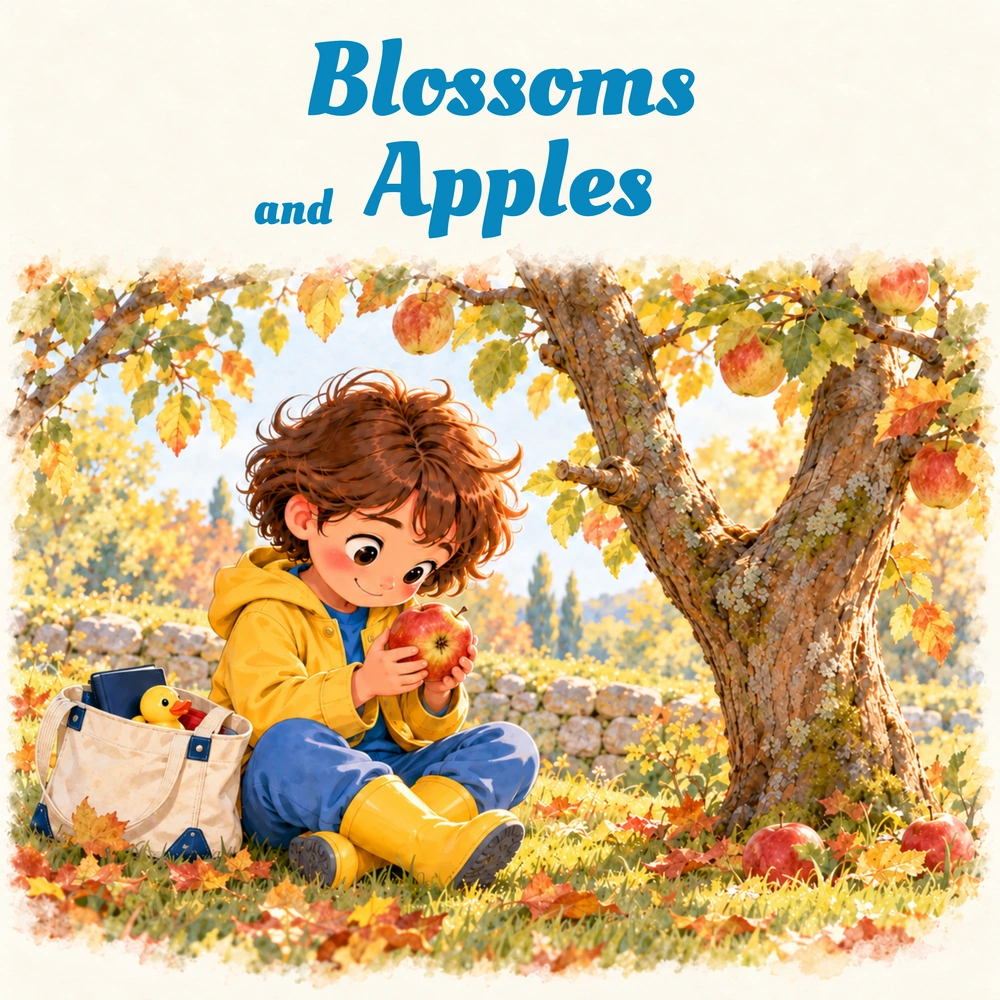
Blossoms and Apples
Follow Vince from spring blossom to autumn apple, noticing pollen, what falls, what grows, and the seeds hidden inside.
A favourite to hold onto.
Picture book. Our physical books will be the premium option for families who want a copy to keep.
Coming soon
Price and ordering details will be announced when the physical edition is ready.
Enjoy the complete story onlineExplore the science
Flowers before fruitPages 1–2
Vince looks up at an apple tree full of blossoms. Apple flowers come before the developing fruit. Not every flower will become a mature apple.
Ask together: What do you notice on the tree?
Pollen on body hairsPages 3–4
A bee visits a blossom, with yellow pollen caught on its body hairs. Pollen from the flower’s anthers can stick to a visiting bee. The close view makes the small grains easier to notice.
Ask together: Where can you see the yellow pollen?
Pollen transfer between flowersPages 5–6
Vince follows the bee to another apple tree; pollen-bearing legs touch the flower’s central tips. Some pollen can rub onto a receptive stigma. Most apple varieties need pollen from a different compatible variety; a visit alone does not guarantee fruit.
Ask together: What has changed on the flower the bee is visiting?
Petals fall; the base remainsPages 7–8
Petals fall away while a little green base stays attached to the branch. The flower’s attached base can develop into an apple. The petals fall separately; they do not turn into the fruit.
Ask together: Which parts have fallen, and which part is still attached?
Some fruit dropPages 9–10
Vince notices one small fallen apple while another remains on the tree. Some small fruit drop while others continue growing. Weather, pollination and the tree’s resources can matter, but the picture cannot tell us why this particular fruit fell.
Ask together: What is different about the two apples Vince notices?
Growth over a seasonPages 11–12
Vince returns through summer and sees a rosy apple in autumn. Apples develop over months, with timing and colour depending on variety and conditions. Redness alone is not a reliable test of ripeness.
Ask together: What shows you that time has passed?
A lasting flower partPages 13–14
Vince lifts an apple and looks closely at the small brown remnant at its blossom end. The dried sepals remain opposite the stalk. This old flower part links the apple to the blossom seen earlier.
Ask together: What does the small brown part remind you of?
Seeds in the corePages 15–16
A grown-up opens the apple lengthwise, and Vince discovers brown seeds in its core. The papery core encloses the seeds; surrounding flower tissue forms most of the flesh. Visible seed number varies, and a cut can miss some.
Ask together: What was hidden inside the apple?
Sources and evidence
Cultivated apple blossoms usually have five pale petals, yellow pollen-bearing anthers and five stigma/style tips.
Apple (Malus domestica) - Plant Identification Learning Module
The Biology of Malus domestica Borkh. (Apple)
Most apple varieties need pollen from another compatible variety; some are self-fertile. Nearby trees alone do not establish compatibility.
Pollen can adhere to a visiting bee and be transferred from its body to another flower stigma.
Pollen can be carried on body and leg hairs. Packed pollen baskets are not the only pollen involved in transfer.
Most apple varieties crop reliably with pollen from a compatible different variety; transfer precedes fertilization and seed development.
Bloom thinning apples: How the pollen tube growth model works
Planting of suitable pollinating varieties in sufficient numbers
Pollination and fertilization are different steps. One pictured visit does not guarantee an apple.
After bloom, petals can fall while the attached flower base remains and begins enlarging into a fruitlet.
The ovary forms the core while surrounding flower tissue forms most of the flesh. Falling petals do not become the fruit.
Some developing apple fruitlets drop while others continue to grow.
Bloom thinning apples: How the pollen tube growth model works
Many flowers or small fruits do not reach maturity. A fallen fruit’s cause cannot be diagnosed from its appearance alone.
An apple develops over weeks and months; colour, size and ripening time vary among varieties.
The Biology of Malus domestica Borkh. (Apple)
Apple (Malus domestica) - Plant Identification Learning Module
Development takes months and depends on variety and conditions. Skin colour varies; redness alone does not establish ripeness.
Apple sepals can persist as the dry calyx at the blossom end, opposite the stalk.
The Biology of Malus domestica Borkh. (Apple)
The blossom-end remnant is opposite the stalk. Handle only known edible fruit with a grown-up.
An apple encloses seeds in a papery core; most fleshy tissue comes from the floral cup surrounding the ovary.
8.1 Fruit Morphology - The Science of Plants
Apple (Malus domestica) - Plant Identification Learning Module
Fun with Fruity Figures - GAMES, hosted by Grand Valley State University
The lengthwise illustration shows one plausible cut. Visible seeds vary by fruit and cutting plane; a cut may miss some. A grown-up prepares a familiar washed apple; seeds are for looking.