THE PHYSICAL EDITION
Bubbles and Wands
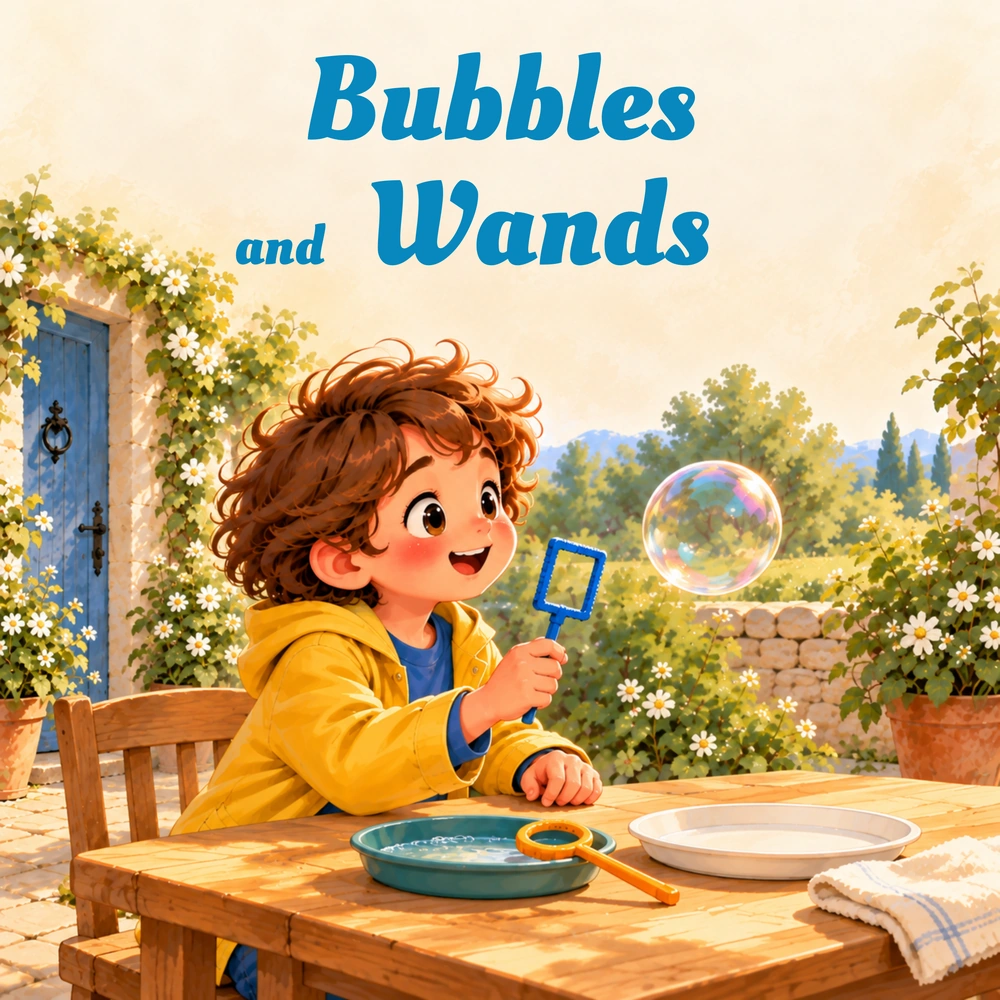
Follow Vince from a square wand to a round bubble. A dry hand, a wet palm and a wet plate invite comparisons, while neighbouring bubbles and an empty plate give him more to notice.
A favourite to hold onto.
Physical edition in development. Our physical books will be the premium option for families who want a copy to keep.
Coming soon
Price and ordering details will be announced when the physical edition is ready.
Enjoy the complete story onlineExplore the science
A wand holds a liquid filmPages 1–2
Vince dips a blue square wand, then lifts a shimmering film across its opening. Bubble solution can form a thin film across a wand. The square loop gives this flat film its edges; the opening question invites a prediction.
Ask together: What do you notice inside the square?
A free bubble can change shapePages 3–4
Vince blows through the square loop. A round bubble floats free while the wand stays square. Blowing stretches the film around air. Once free, a small bubble tends toward a sphere, even when its wand is square. Bubbles attached to a tool or surface can have other shapes.
Ask together: What changed when the bubble left the wand?
Contact can break a filmPages 5–6
Vince reaches for a bubble with a dry palm. The next picture shows an empty hand with wet flecks. Dry contact can disrupt a bubble film. This is one observed outcome; the pictures do not establish that every dry touch will always pop every bubble.
Ask together: What is different in Vince’s hand after the pop?
Changing the receiving surfacePages 7–8
Vince wets his left hand in the bubble solution, then a small bubble rests on that same palm. A hand coated in the same bubble solution can support a small bubble briefly. Clean surfaces, calm air and the solution matter; not every catch works.
Ask together: What did Vince change before trying again?
A surface changes the bubble’s shapePages 9–10
Vince spreads solution on a white plate, then watches a bubble resting there with a curved top. A wet plate can support a dome-shaped bubble. Its surface contact makes its shape different from the free round bubble earlier in the story.
Ask together: Where is this bubble curved, and where does it meet the plate?
Two bubbles can share a filmPages 11–12
Vince makes another bubble beside the first. A close view shows two joined domes with a narrow common seam. Two bubbles can join and share a film. For similar-sized bubbles the common wall is nearly flat, shown edge-on here; unequal bubbles generally have a curved shared wall. Bubbles may also pop or merge.
Ask together: Where do the two bubbles meet?
Bubbles can burst without a touchPages 13–14
Vince keeps his hands folded away from the joined bubbles. Later the plate has only wet traces. A bubble can burst without someone touching it. Drainage, evaporation or a disturbance can weaken the film. These pictures show moments, not a measured lifetime or simultaneous popping.
Ask together: What stayed the same about Vince’s hands? What changed on the plate?
A new film begins another bubblePages 15–16
Vince dips the square wand again, then quietly watches another round bubble. A fresh dip puts another film across the wand. Vince returns to the opening action after trying, changing a surface and watching what happens.
Ask together: What do you notice about how Vince watches this bubble?
Sources and evidence
A dip leaves a thin liquid film across a flat wand; blowing can inflate it around air and release a bubble.
B is for Bubble, American Chemical Society
Ordinary bubble solution contains water and detergent. The depicted setup has not been physically trialled.
A square planar wand can hold a square-edged flat film, but its small detached bubble tends toward a round, approximately spherical shape.
Magic Bubble Wands, Science World
The Shape of Bubbles, Exploratorium
A small free bubble tends toward a sphere. Bubbles still attached to a tool or surface may have different shapes.
Dry hand contact can rupture a soap film; coating the hand with the same bubble solution can let a small bubble rest briefly.
A solution-wet palm can support a small bubble briefly; not every catch works. Clean surfaces, calm air and solution affect the result.
A small bubble can rest as a dome on a plastic plate wetted with bubble solution.
Bubble Sculptures, Science World
The picture shows one possible dome on a solution-wet plate, not a guaranteed household result.
Two similar-sized joined soap bubbles can share an approximately flat film, changing their shapes at the join.
When Bubble Meets Bubble, Exploratorium
Bubble Sculptures, Science World
Two bubbles may join, pop or merge. The similar-sized pair shown shares a nearly flat wall seen edge-on; unequal bubbles generally have a curved common wall.
A bubble can rupture without being touched as its liquid film thins; the liquid remains as tiny drops or wet traces and its air joins surrounding air.
The views show moments, not an exact lifetime or simultaneous rupture. Liquid remains as tiny droplets or wet traces, while the enclosed air mixes with surrounding air.