
THE COMPLETE BOOK · FREE TO READ
Magnets and Surprises
A surprising push sends Vince exploring. Turn a magnet, compare a clip with shiny foil, move a little closer, then guide a paper fish with a magnet hidden underneath. Each discovery gives him something new to try.
Turn the pagesOr scroll to readA surprising push
Pages 1–2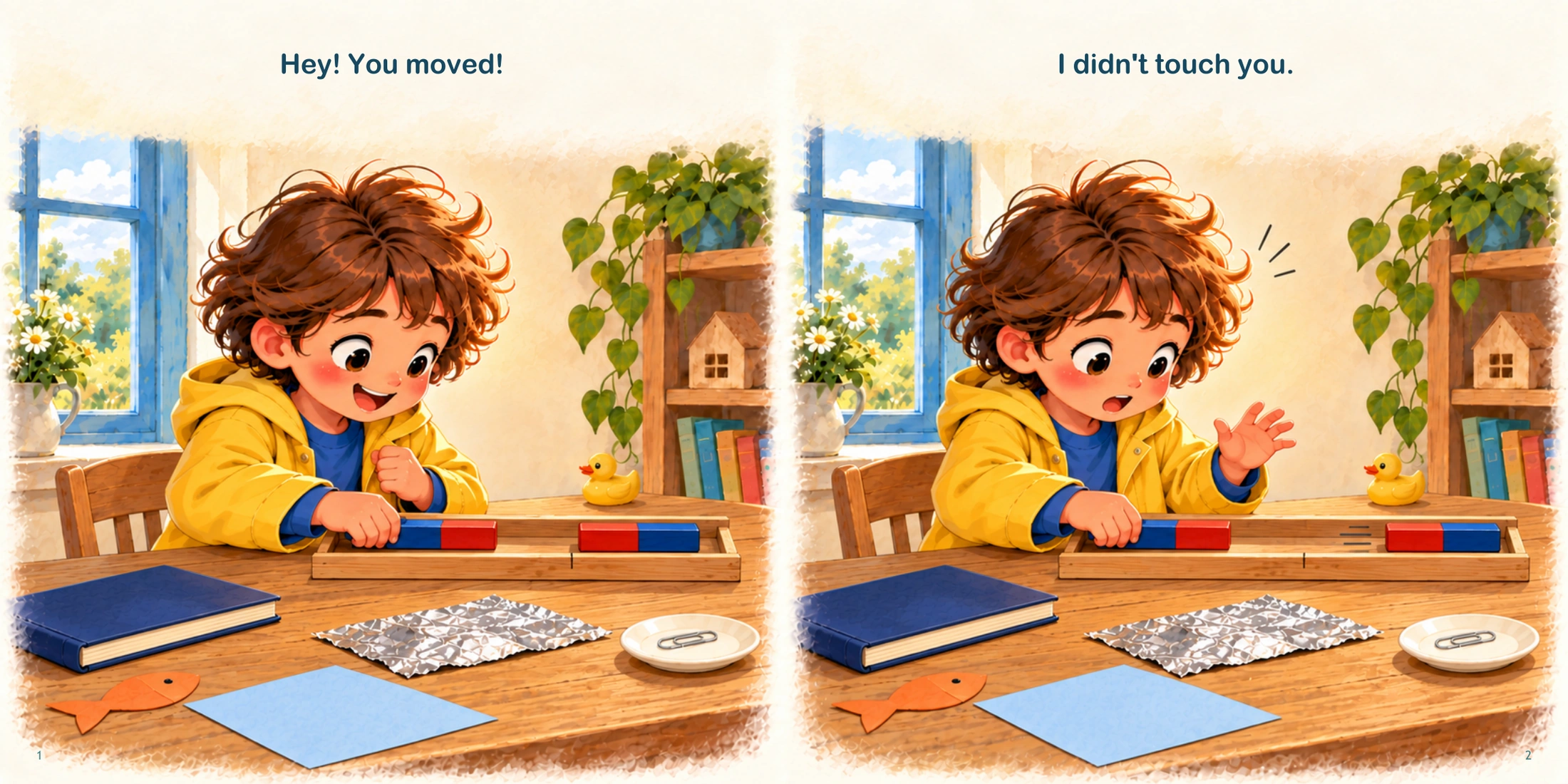
Hey! You moved! I didn't touch you.
Explore together · Magnetic force without contact
Vince brings one bar magnet near another in a shallow wooden channel. The second bar moves away before the bars touch. Matching poles of the two bar magnets repel. The channel keeps the moving magnet aligned so it cannot simply turn around. Red and blue identify ends; the colours are not the force.
Ask together: What is between the two magnets when one moves away?
Turn it around
Pages 3–4
What if I turn mine? Click! Now you come.
Explore together · Changing which poles face
Vince turns the magnet in his hand end for end. The two bars come together in the channel. Unlike poles attract. Turning one bar changes which ends face, changing the interaction from a push apart to a pull together.
Ask together: What did Vince change before the magnets came together?
Clip, yes. Foil, no.
Pages 5–6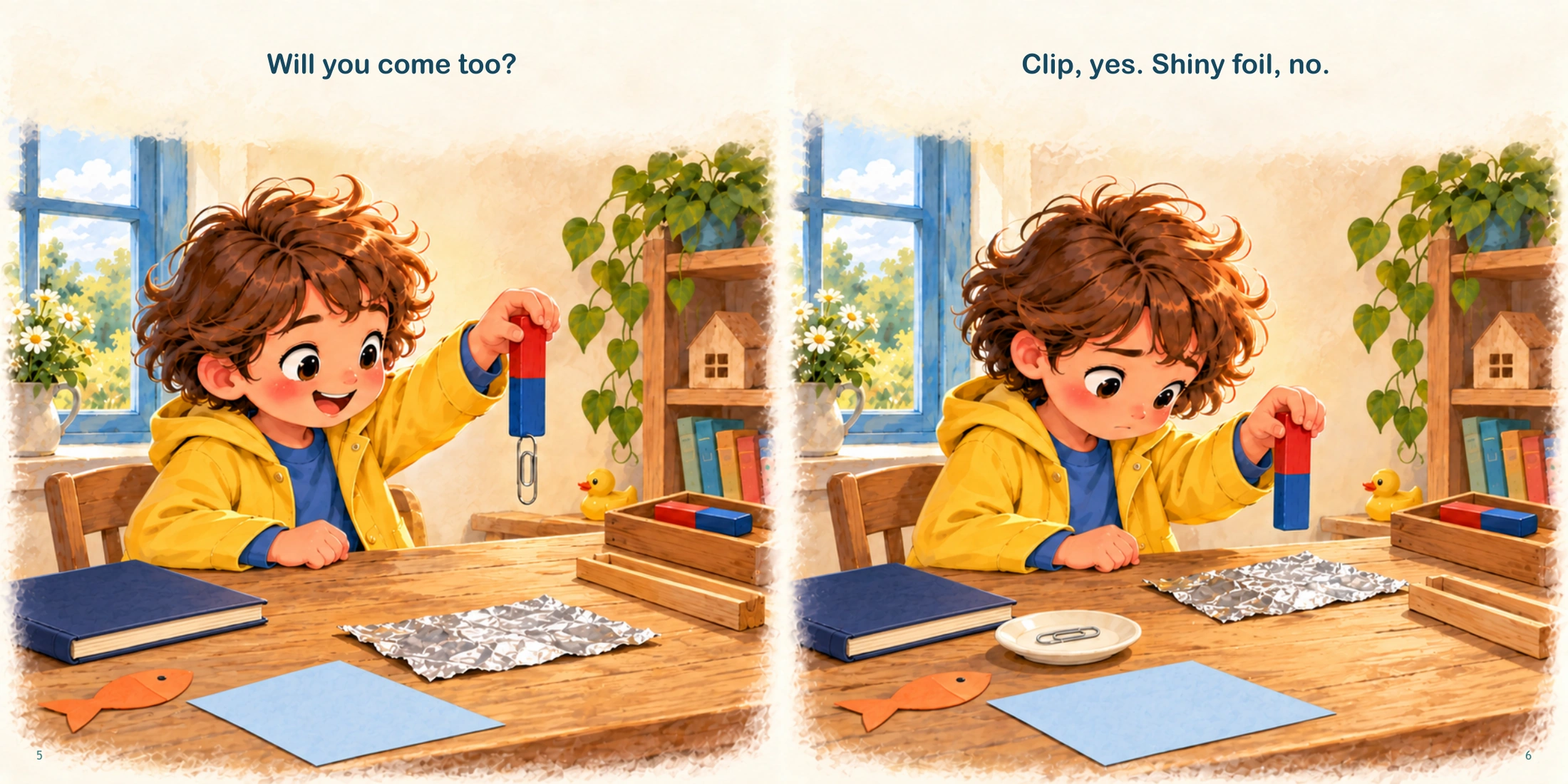
Will you come too? Clip, yes. Shiny foil, no.
Explore together · Materials respond differently
A steel paper clip follows Vince’s magnet. A shiny piece of aluminium foil stays on the table. The ordinary steel clip is strongly attracted; the foil does not visibly follow this magnet. Shiny appearance does not guarantee strong attraction. The picture compares these objects, rather than isolating every difference between them.
Ask together: Which object moved, and which stayed where it was?
Both ends can pull the clip
Pages 7–8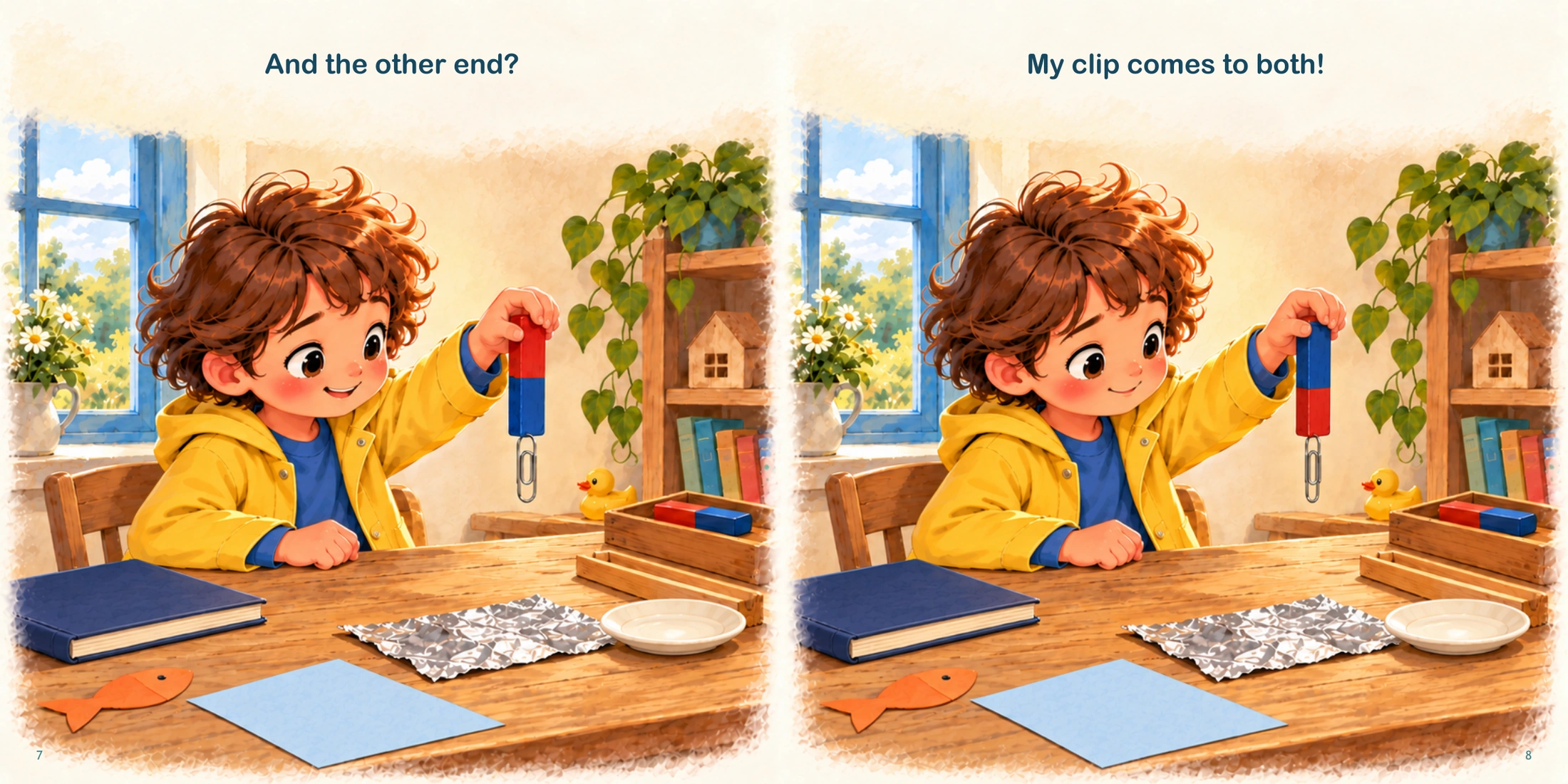
And the other end? My clip comes to both!
Explore together · A clip behaves differently from another magnet
Vince tries the blue end and then the red end near the same clip. The clip comes to either end. An ordinary initially unmagnetised steel clip can be attracted to either pole. It does not behave like the second permanent magnet in the opening.
Ask together: How is the clip’s response different from the other magnet’s?
A little closer
Pages 9–10
Not from way over there. Closer... there you go!
Explore together · Distance and visible movement
The clip rests on the tabletop while Vince holds the magnet farther away. He brings it closer along the table and the clip moves. A nearer magnet can pull strongly enough to overcome friction. A still clip farther away does not show that magnetic force has vanished. The pictured gaps are illustrative, not measured ranges.
Ask together: What changes between the two pictures?
A hidden magnet
Pages 11–12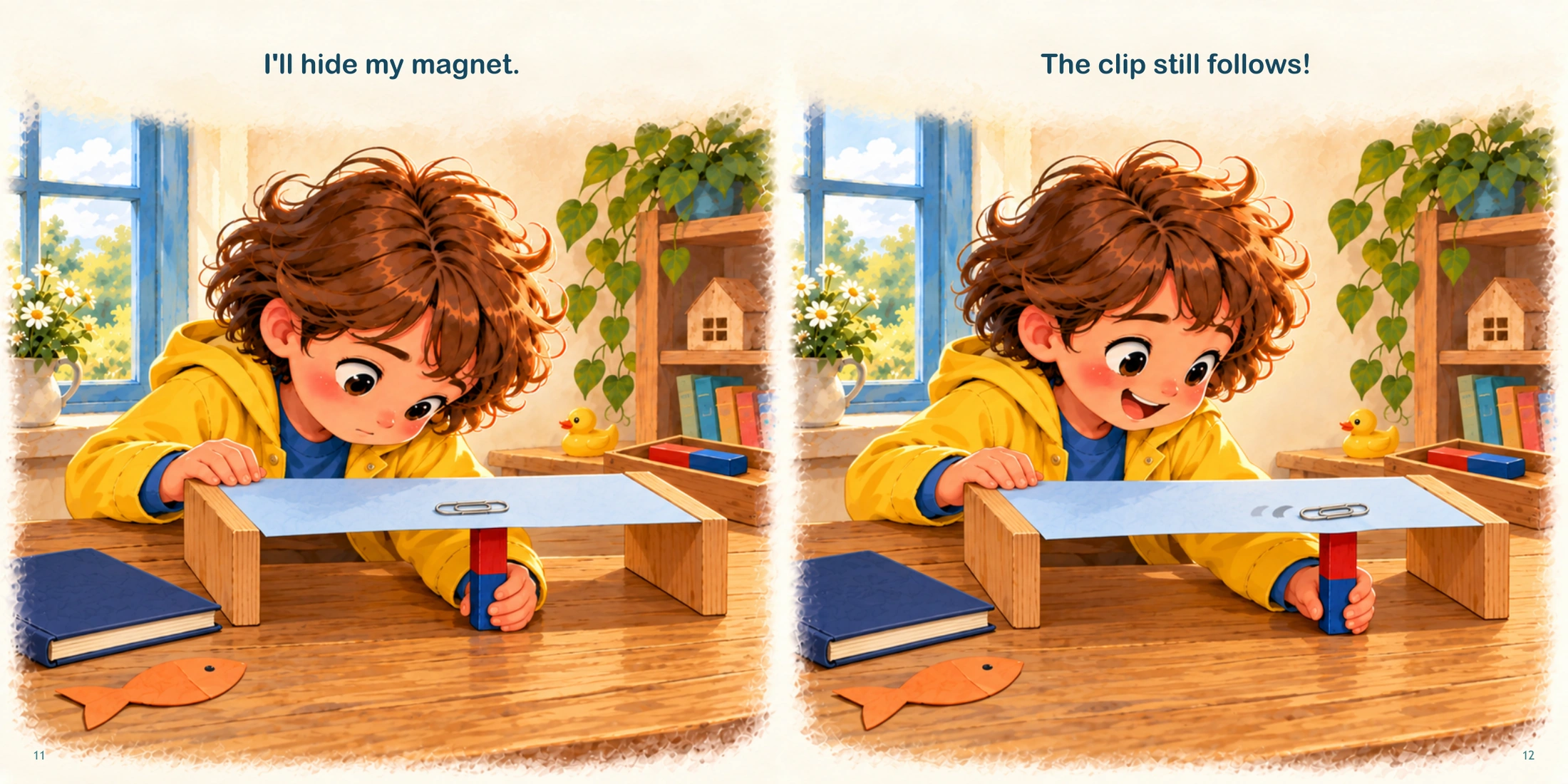
I'll hide my magnet. The clip still follows!
Explore together · A pull through a thin sheet
Vince moves the magnet just under a dry blue sheet on an open frame. The clip on top follows. A magnet can attract a steel clip through a thin nonmagnetic sheet. Thickness, separation, friction and magnet strength affect whether this setup works.
Ask together: Where is Vince’s magnet while the clip moves?
A fish for the paper pond
Pages 13–14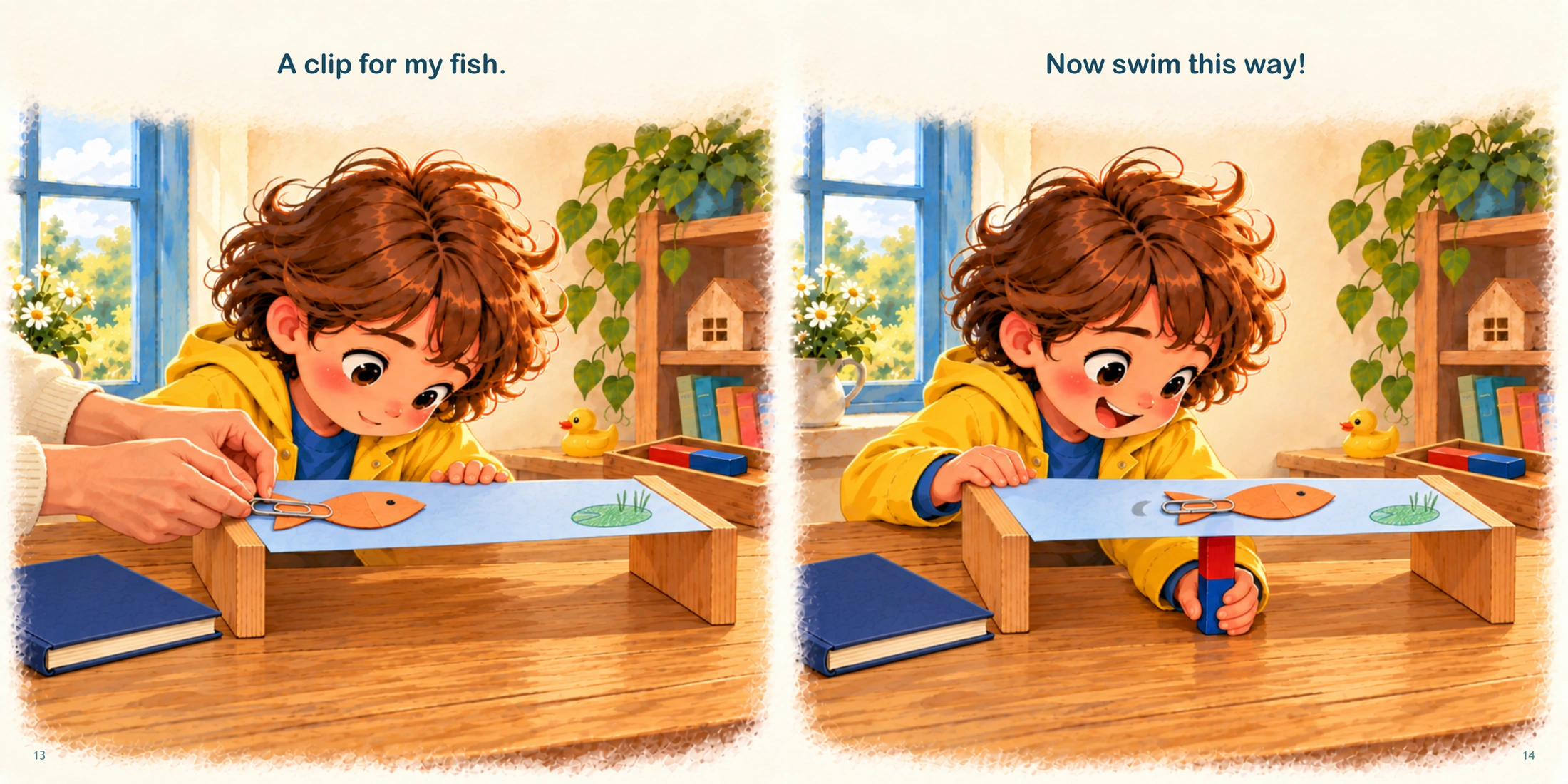
A clip for my fish. Now swim this way!
Explore together · Using the clip to carry a paper fish
An adult secures the clip to a light orange paper fish while Vince watches. Vince then moves the hidden magnet under the sheet to guide the fish above. The magnet pulls the steel clip, which carries the paper fish. This is a dry paper pond; the fish is not swimming in water.
Ask together: What part of the fish helps Vince move it?
Stop together
Pages 15–16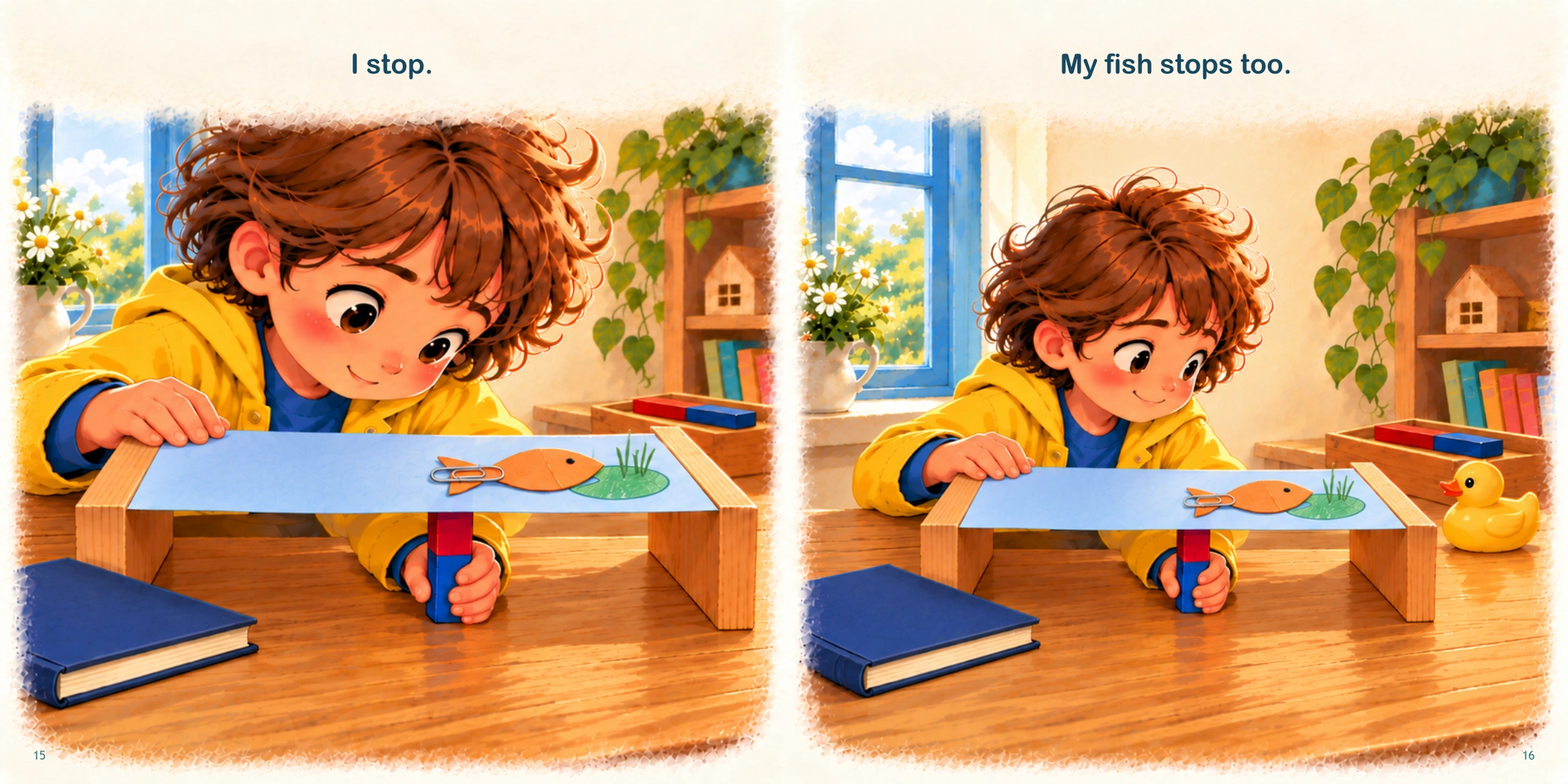
I stop. My fish stops too.
Explore together · Vince controls the paper puppet
Vince stops moving his hand under the sheet. The clipped paper fish rests above. The fish follows the magnet’s movement through its clip. When Vince stops, friction helps the fish stop too.
Ask together: What happens to the fish when Vince stops?
A quiet notebook
Pages 17–18
For grown-ups
Pages 19–20
For Grown-Ups Vince finds ways to move things without touching them. A surprising push leads to a paper-pond game. Different ends, different results The two bar magnets push apart when matching poles face. Turn one end for end and unlike poles pull together. Red and blue identify the ends; the colours are not the force. The shallow channel guides the moving bar so it cannot turn around. Not everything follows The ordinary steel clip is strongly attracted to either end. Unlike the other magnet, it does not push away when Vince turns his magnet. The aluminium foil does not visibly follow. Shiny does not mean strongly magnetic. Some metals and some steel alloys respond differently. Closer can make a difference A nearby magnet can pull the clip without contact. Farther away, its pull may not overcome friction on the table. A still clip does not show that the magnetic force has vanished. The gaps in the pictures are illustrative, not measured ranges. A pull through a thin sheet The magnet pulls the clip through the dry paper pond. It is the clip that carries the paper fish along. The sheet rests on an open frame; Vince moves the magnet just underneath. Nothing is swimming in real water. He moves slowly and stops his hand; friction helps the fish stop too. Notice together An adult can try two large, intact, age-appropriate encased magnets, then a steel clip on a smooth, level surface. Try one thin sheet before adding a light paper fish. First check that the magnet can move the clip through it. Thick card, rough surfaces, heavy fish or weak magnets may prevent movement. Follow the magnet maker’s age guidance. Keep small powerful magnets away from children. The adult handles loose clips and secures the fish clip before use. Keep all pieces away from mouths and count them back into storage. Watching counts; every activity is optional. Science behind the story Brookhaven National Laboratory: Marvelous Magnets. NASA eClips: Magnets and Metals. Exploratorium: Magnetic Shielding; Diamagnetism. U.S. CPSC: Magnets. Checked passages and links accompany the editable book.
Open these pages in the readerSources and evidence
Two bar magnets can push apart with like poles facing and pull together after one is turned end for end so unlike poles face. They need not touch to exert force.
Brookhaven National Laboratory — Marvelous Magnets
PDF p1 Background and p2 Part 2 steps 1–3 explicitly compare like/unlike pole attraction and repulsion.Only conventional bar magnets with poles at opposite ends; not arbitrary multipole fridge magnets. Red and blue identify ends, not visible force or universal colours. No field-line beams are drawn. A guided sliding setup keeps the released bar aligned; no free stable levitation.
The pictured ordinary steel paper clip is strongly attracted; an ordinary aluminium-foil piece and paper fish do not visibly follow this classroom magnet. Shiny metal does not guarantee strong attraction.
NASA eClips — Magnets and Metals, student packet
PDF printed p5 Explore lists paper clip, paper and aluminium foil; pp3/8 distinguish iron screw from aluminium items.Brookhaven National Laboratory — Marvelous Magnets
p1 objectives: test materials and discover not all metals magnetic; material list includes paperclip and aluminium foil.Precheck clip: some alloys/coatings behave differently. Do not say all metals stick, all steel sticks, or nonmagnetic materials have absolutely no magnetic response. Foil piece stays on table; moving magnets near conductors can have other effects outside this slow ordinary comparison.
An initially unmagnetised ferromagnetic steel clip can be attracted to either pole of a magnet; turning this magnet does not make that clip repel like another permanent magnet.
Exploratorium — Diamagnetism, Paul Doherty
To do, then What is going on paragraph 1: ferromagnetic iron strongly attracted to both poles; contrasts weak paramagnetic aluminium and diamagnetic water.Use ordinary initially unmagnetised steel clip, not a second magnet disguised as clip. Do not infer that every object can only attract. No microscopic domain diagram promised.
For a fixed small magnet and clip on a horizontal surface, bringing the magnet sufficiently near can make the clip move when it did not visibly move farther away.
NASA eClips — Magnets and Metals, student packet
Printed p5 Explore: adjust the magnet–clip separation so clip stands without contact; attempt to raise clip without touching.Exploratorium — Magnetic Shielding, Tien Huynh-Dinh
To do paragraph 1: a too-weak magnet, thick cardboard or large separation can prevent clips being held; setup matters.Illustrated separation is qualitative, not measured range. A stationary clip farther away does not prove zero magnetic force. Visible sliding requires attraction to overcome friction. Exact tabletop setup untried; adult must precheck a smooth level surface and magnet/clip combination.
A magnet can attract a steel clip through a thin nonmagnetic sheet. Moving a nearby magnet underneath can move a light paper fish clipped to it on top.
NASA eClips — Magnets and Metals, student packet
Printed p5 Explore: interpose paper or cloth between noncontact magnet and clip; clip remains influenced.Exploratorium — Magnetic Shielding, Tien Huynh-Dinh
To do paragraph 1 and What is going on paragraph 1: clips attracted through cardboard and air, but thickness/strength/separation can defeat the setup.The depicted pond is dry paper/thin card, not actual water. Use one thin smooth sheet on an open-bottom frame; magnet just underneath. Heavy fish, thick board, rough surface or weak magnet may fail; test before offering activity. No guaranteed distance or load. This precise fish game has not been physically tried. The adult guide must make dependence explicit; scenes cannot imply all barriers transmit unchanged.
Small high-powered magnets pose serious ingestion hazards; optional shared activity uses large intact age-appropriate encased magnets under adult control, and the adult handles loose clips.
U.S. Consumer Product Safety Commission — Magnets
Opening safety text, lines 29–41: ingestion/inhalation hazards, internal attraction and injuries.No claim that size or supervision certifies a toy. Follow manufacturer age guidance; no loose strong neodymium pieces or magnetic balls. Adult prepares and accounts for clips; watching is enough. This is an optional invitation, not a validated safety protocol.
A story worth keeping?
Read it here as often as you like. The physical edition is coming soon.