THE PHYSICAL EDITION
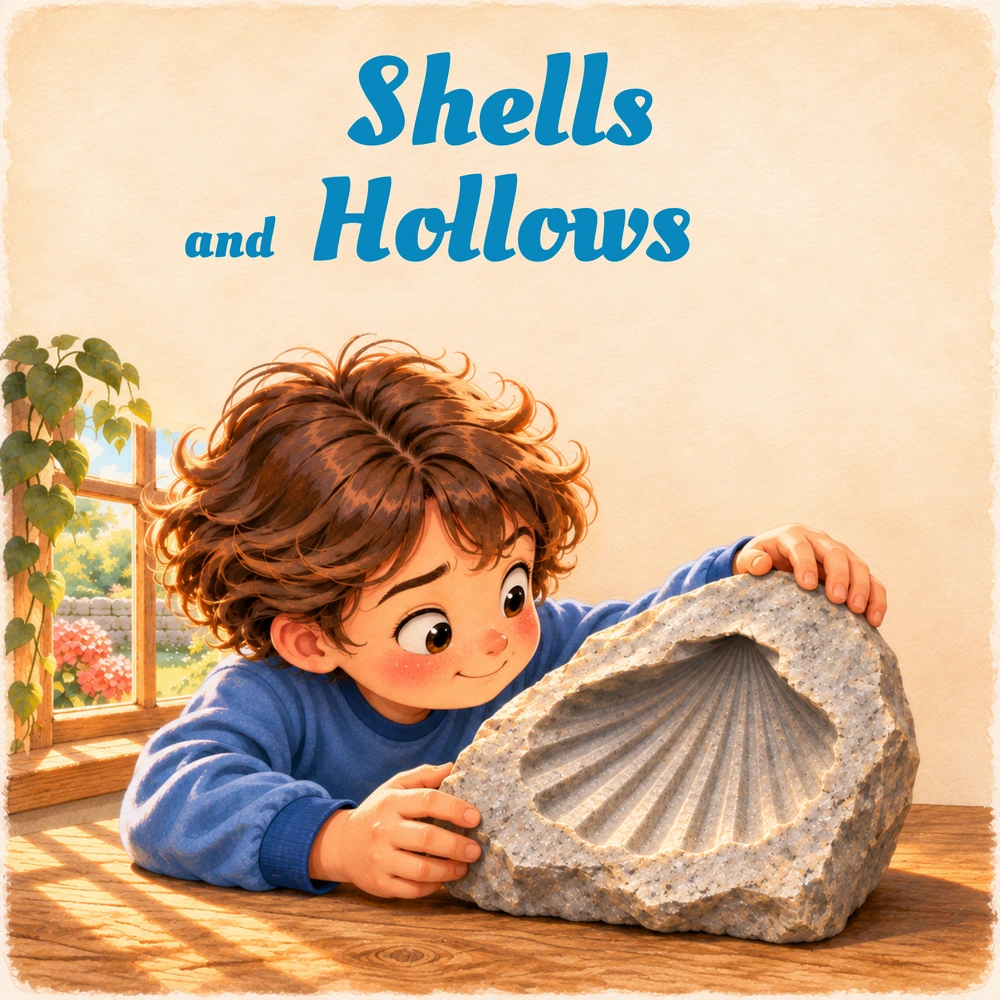
Shells and Hollows
Where did the shell in Gran’s fossil go? Vince follows its grooves from a clay impression to a ribbed glue cast, and wonders what a rock can remember.
A favourite to hold onto.
Picture book. Our physical books will be the premium option for families who want a copy to keep.
Coming soon
Price and ordering details will be announced when the physical edition is ready.
Enjoy the complete story onlineExplore the science
Reading a fossil moldPages 1–2
Vince steadies Gran’s gray rock by the window. A fan of grooves catches the light. A fossil can preserve the outside shape of a shell even after the shell itself has gone.
Ask together: What makes the hollow look like a shell to you?
Contact with soft materialPages 3–4
Vince presses the outside of a pink shell into soft clay, with his fingers inside the shell. The surface that touches the clay determines the pattern the clay can take.
Ask together: Which side of the shell is touching the clay?
An external moldPages 5–6
The pink shell rests beside the clay. Vince looks into the fan-shaped dip it left behind. The raised ribs pushed into the clay and left grooves.
Ask together: What changed when Vince lifted the shell away?
Filling a moldPages 7–8
Vince squeezes white glue into the shell-shaped hollow. Some grooves are still bare. The liquid glue spreads into low places in the clay.
Ask together: Where could the glue flow next?
A castPages 9–10
Vince holds a pale, ribbed glue copy up to the light. The pink shell and the emptied clay rest on the table. The side of the dry glue that touched the grooves carries raised ribs of its own.
Ask together: What do the pink shell and the pale copy have in common?
One path to preservationPages 11–12
One cutaway shows a pale curved shell buried in sediment. The other shows a thin curved space in the rock. A buried shell can slowly dissolve as water moves through rock, leaving a hollow. Vince imagines one way his fossil might have formed.
Ask together: What can you still trace in the second picture?
What a fossil can tell usPages 13–14
Vince touches the grooves in Gran’s rock. His own pink shell rests beside it. These grooves give him a clue to the outside shape. The plain stone leaves the ancient shell’s colour a mystery.
Ask together: What can Vince feel, and what does he still wonder?
Sources and evidence
A ridged shell can leave an impression of its outer surface in soft material.
White-glue fossils: Casts, molds, and impressions
A shallow press into soft modeling clay can pick up ridges. The detail depends on the shell and how cleanly it lifts.
A thin filling can copy the grooves in a mold and carry raised details on its contact face.
White-glue fossils: Casts, molds, and impressions
Dry the glue all the way before lifting it. Drying time and the detail it picks up vary.
A buried shell can dissolve and its outside impression can survive in rock.
In nature, sediment can harden around a shell. Water can dissolve the shell, and sometimes sediment or minerals later fill the space.
This plain rock mold holds clues to shape. It gives Vince no colour to match.
The grooves belong to this particular specimen. Vince can trace its shape and still wonder what colour the shell was.