Back to the shelf

THE PHYSICAL EDITION

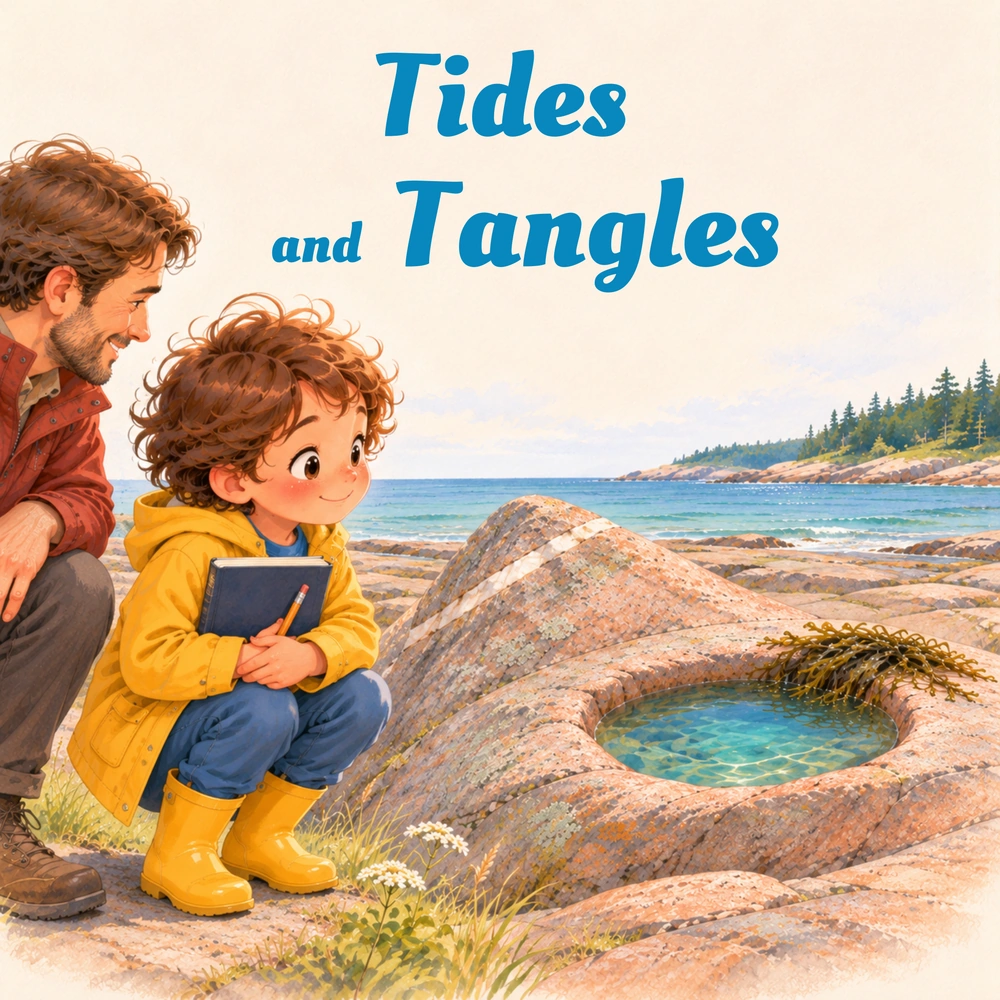
Tides and Tangles

Vince sets out to draw one stripe on a rock. Read the morning and afternoon pictures side by side to see how the tide uncovers a pool, where a sea snail crawls under a tangle of rockweed.

Picture book. Our physical books will be the premium option for families who want a copy to keep.

Coming soon

Price and ordering details will be announced when the physical edition is ready.

Enjoy the complete story online

Explore the science

A fixed landmarkPages 1–2

Vince sits beside his grown-up with a pencil and an open notebook. A pale stripe crosses the rock tip above the water. The stripe marks a spot you can find again, even when the water reaches a different part of the rock.

Ask together: What would you draw so you could recognize this rock again?

Falling tidePages 3–4

Vince opens his arm toward a broad ledge. The pale stripe is still there, with much more stone below it. As the sea level falls, more of the same rock is exposed.

Ask together: Where does the water meet the rock in your two pictures?

A tide poolPages 5–6

A raised rim surrounds a blue pool in the ledge. Beyond it, the open sea is farther away. The hollow can hold seawater after the outside sea drops below its rim.

Ask together: Where can your finger follow the edge of the water?

A crawling sea snailPages 7–8

Underwater, a snail stretches out from its spiral shell with its broad foot against the stone. A periwinkle is a sea snail. Its foot helps it crawl along the rock.

Ask together: What can you see that tells you this shell has a living animal inside?

Rockweed shelterPages 9–10

Brown fronds drape across the pool’s edge. Part of the snail’s spiral peeks out beneath one frond. At low water, attached rockweed can lie against the ledge and shelter small animals.

Ask together: Where would you look for that spiral next?

Returning tidePages 11–12

Water ripples across the pool rim. The branches fan out from the same place on its far edge. As water returns, gas-filled bladders help lift the rockweed’s fronds while its base stays attached.

Ask together: Which part of the seaweed looks as though it stayed in the same place?

Two waterlinesPages 13–14

At evening, Vince holds his notebook open. The small striped tip sticks out of the sea again. Rising water covers the ledge and leaves less of the rock showing. The small tip and broad ledge belong to one rock.

Ask together: Which part of the afternoon drawing would still be above water now?

Sources and evidence
  1. The water level at this rocky shore falls and rises over hours, uncovering and covering different parts of the same rock.

    Tides

    How many high tides are there per day?

    The timing and height of high and low water vary by place and day.

  2. A hollow in rock can hold seawater as the tide falls below its rim. A higher tide can reconnect it to the sea.

    What is a tide pool?

    The Life of a Tide Pool in Acadia

    Hollows hold water when it has no lower route out. Waves can splash water into the pool before the tide covers the rim.

  3. A living periwinkle can crawl on rock beneath the water in a tide pool.

    Tidepooling

    What is a tide pool?

    A shell can also be empty. Notice the outstretched foot in this picture.

  4. Rockweed can drape over exposed stone. As water rises, buoyant fronds can lift while the base stays attached.

    Coastal Field Guide

    Rockweed Fact Sheet

    Tides

    The brown rockweed here has gas-filled bladders and a base attached to rock.

  5. Consult local tide and surf information before visiting a rocky shore. Stay together on secure footing and leave living things where you find them.

    Tidepooling

    Use the printed morning and afternoon pictures for the drawing activity. On a shore visit, watch the waves and leave the low shore before the water rises.

Water and Wind

Water and Wind, pages 1–2: Wind moves the pinwheel.

Spread 1 / 12

Wind tickles my cheek. Round goes my pinwheel.

Explore the science

Wind & forcesPages 1–2

Wind moves the pinwheel. Wind is moving air. Vince feels it on his cheek and sees it push the pinwheel's angled blades.

Ask together: What tells you that the air is moving?

Currents & eddiesPages 3–4

Water passes the rock. A leaf circles behind it. Most water passes the rock; some circles back in an eddy. Laminar flow is orderly; turbulence is irregular, mixing motion. A swirl alone cannot distinguish them.

Ask together: How does the leaf move compared with the water passing the rock?

Waves & energyPages 5–6

Waves spread from the stream. The duck bobs. The falling stream makes waves that carry energy outward and make the toys bob. The stream's current also carries toys along. Bobbing and drifting are different motions.

Ask together: What moves up and down? What moves along the pond?

BuoyancyPages 7–8

A duck floats. A pebble sinks. Water pushes upward on both objects. This buoyancy balances the duck's weight, but not the pebble's. The pebble's splash makes the rings on the next spread.

Ask together: Where is each object compared with the surface?

When waves meetPages 9–10

Two wave patterns approach one another. When gentle waves overlap, their heights add, briefly raising or lowering the surface. This interference does not erase the waves; they continue through one another.

Ask together: What might happen where the two patterns meet?

Surface tensionPages 11–12

Tiny dents appear beneath the strider’s legs. Surface tension helps support the strider where its water-repellent legs dent the water. The duck floats mainly by displacing water.

Ask together: What do you notice where its legs meet the water?

Suction & pressurePages 13–14

The duck bubbles, fills and squirts. Squeeze underwater: air bubbles out. Release with the opening submerged: the elastic duck springs back, lowering pressure inside. The surrounding water pressure pushes water in. Squeeze above water: water exits through that same opening.

Ask together: What changes when Vince squeezes and then lets go?

Lift & gravityPages 15–16

A paper plane glides forward and down. The throw starts the plane moving. Airflow around its wings produces lift and turns air downward. Gravity pulls down; drag resists motion. In still air, the plane glides forward and gradually descends.

Ask together: Where might the plane go next?

ViscosityPages 17–18

Milk runs. Honey stretches into a thread. Honey's greater viscosity means greater resistance to flow. It makes a slow thread while milk runs readily. Temperature and pouring method also matter; this snack is an observation, not a controlled test.

Ask together: How do the milk and honey move differently?

Draining & swirlingPages 19–20

Foam curves inward toward the drain. Gravity drives water through the drain. Existing turning motion can become a curved inward flow, traced by foam. Here water travels to the outlet, unlike waves crossing the pond. Not every drain swirls.

Ask together: Can you follow the foam toward the drain?

Scientific observationPages 21–22

Vince sketches what he noticed. Vince records something he noticed. Drawings, marks or words let him return to an observation. He does not need all the answers.

Ask together: Which earlier picture matches one of his drawings?

Your basket

A spot for your next story.

Ordering opens when the books are ready.