THE PHYSICAL EDITION
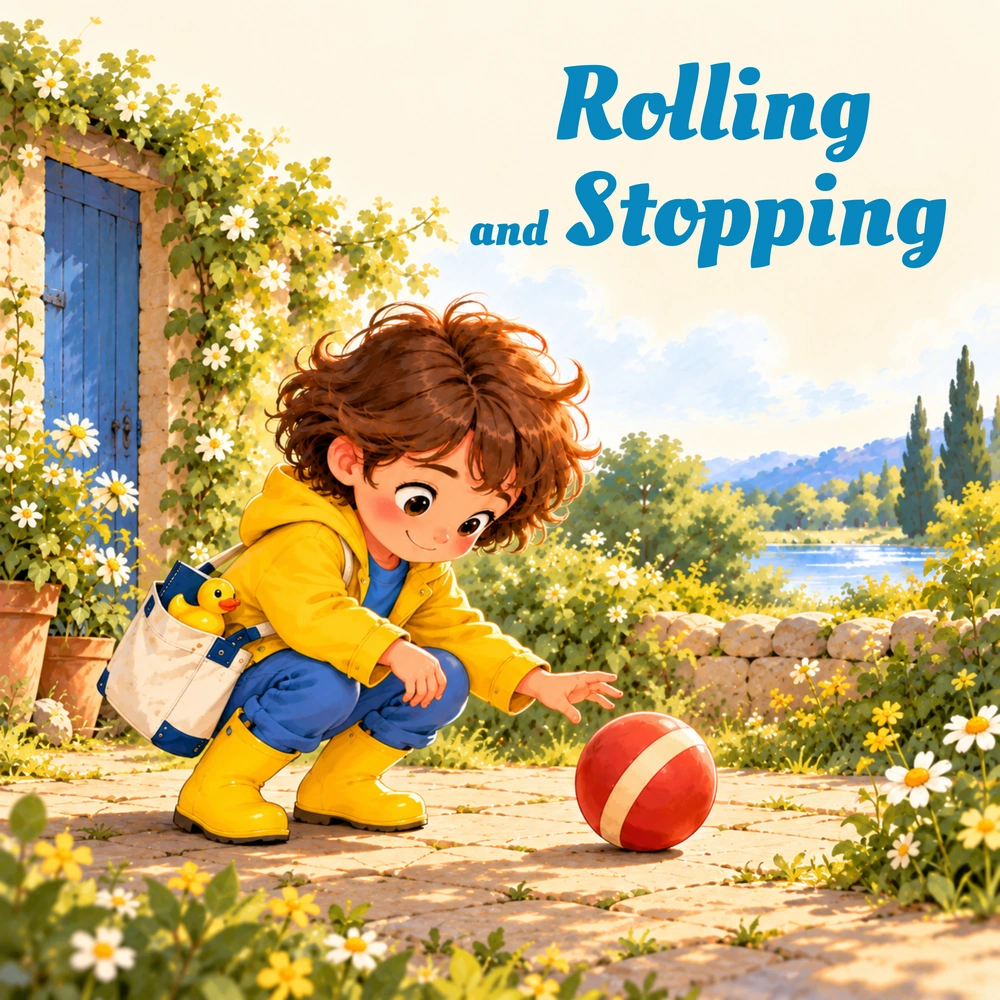
Rolling and Stopping
Follow Vince and one little ball from the cottage path to the grass, down a small hill and home again. Notice when his hands touch the ball, when they leave it, and what changes as it rolls and stops.
A favourite to hold onto.
Physical edition in development. Our physical books will be the premium option for families who want a copy to keep.
Coming soon
Price and ordering details will be announced when the physical edition is ready.
Enjoy the complete story onlineExplore the science
Starting to rollPages 1–2
Vince crouches beside a resting ball, then touches it with his hand to give it a push. Contact with his hand starts the ball moving. The next spread shows what happens when his hand leaves.
Ask together: What changes when Vince’s hand touches the ball?
Moving after the pushPages 3–4
Vince lifts his hand away. A gap stays between his hand and the ball as it rolls farther along the path. The hand’s push ends when contact ends, but the ball can keep rolling. Resistance from the real path gradually slows it; a push is not fuel that gets used up.
Ask together: What can you see between Vince’s hand and the rolling ball?
Contact that slows the ballPages 5–6
The ball rolls from the path into grass, where blades touch its lower surface. Vince finds it stopped, with his hands clear. The ball, grass and ground bend or squash, and small collisions take energy from the rolling. How much it slows depends on the ball and surface; these pictures do not show a measured comparison.
Ask together: What is touching the ball now?
Carrying the ballPages 7–8
Vince lifts the ball out of the grass and carries it toward the nearby hill. He retrieves the same ball and takes it to a new place before letting it go again. This connects the stop in the grass with the next rolling scene.
Ask together: How is the ball moving with Vince now?
Gravity and a slopePages 9–10
Vince holds the ball in place on a firm downward slope, then lifts his hand away as it rolls downhill. Earth’s gravity pulls on the ball throughout the journey. On this suitable slope, gravity can make the released ball roll without a hand push. The sloping ground supports and guides it.
Ask together: What is different about the path here?
Slowing and stoppingPages 11–12
Vince waits near the foot of the hill with his hands ready, then meets and cradles the incoming ball. His hands slow and stop the ball through contact. The ball is caught gently at ground level.
Ask together: What changes when his hands meet the ball?
Starting in a new directionPages 13–14
Vince holds the caught ball while facing home, then gives it a fresh push toward the blue door. The ball is stopped before the new push. Vince’s touch sets it off toward home; the ball does not steer itself there.
Ask together: Where does Vince send the ball this time?
Back at homePages 15–16
Inside the cottage, Vince puts the ball on the rug and sits beside it. The rolling journey ends with the ball resting beside Vince. Next comes a quiet moment with his notebook.
Ask together: What tells you that Vince and the ball are home?
Sources and evidence
A hand pushing a resting ball can set it rolling.
NGSS: K. Forces and Interactions: Pushes and Pulls
PS2.A and PS2.B: contacting objects can change motion, including starting an object. First-party curriculum framing, not a measurement of this prop.The ball is a single ordinary soft play ball on a firm, approximately level path; push near its middle. No claim about an exact push strength or speed.
After the hand leaves, the ball can keep rolling without a continuing hand push.
NASA Glenn: Newton’s Laws of Motion
First Law, opening paragraph: unchanged velocity when the net external force is zero. This distinguishes continuing motion from continuing propulsion.The illustrated ball is not force-free: gravity, support and resistance still act. It is slowing on the real path; the book does not claim constant speed or perpetual rolling. A push is not fuel stored inside the ball.
Contact with the ground and grass resists this ball’s rolling and brings it to rest.
B. N. J. Persson (2010), Rolling friction for hard cylinder and sphere on viscoelastic solid
Introduction, paragraph on Greenwood and Tabor: deformation of rubber loses some elastic energy. Theory section, equations (4)–(6): rolling resistance is linked to energy dissipation. Abstract explicitly limits the model to a rigid ball on a flat viscoelastic solid.Application to grass is a qualitative mechanical inference, not an experiment reported in this paper. The picture shows a light ball gently rolling into dense grass, bending blades and stopping; there is no measured stopping distance or comparative trial. Grass, soil and ball deform, and small collisions contribute. Ideal static friction in pure rolling is not itself a universal explanation of energy loss.
On a suitable downward slope, a released ball can start rolling without a hand push because gravity acts on it.
NASA Space Place: What Is Gravity?
Opening definition and “What else does gravity do?”: Earth attracts objects toward its centre; the pull is present before release as well as afterward.NGSS: K. Forces and Interactions: Pushes and Pulls
K-PS2-2 clarification examples include a ramp that increases an object’s speed; PS2.A describes motion changes. Starting from rest on this slope additionally applies gravity and contact mechanics, rather than reproducing a measured NGSS experiment.Gravity is downward, not a force pointing along the path. The sloping support constrains motion; sufficient downhill component overcomes resistance. A firm gentle slope is pictured, not deep grass. Gravity also acts on the earlier level path. No universal statement that every ball rolls on every slope.
Vince’s hands can slow and stop the incoming rolling ball by contact.
NGSS: K. Forces and Interactions: Pushes and Pulls
K-PS2-1 clarification includes stopping a rolling ball; PS2.A/B describe motion changes during contact.A slow soft ball is caught at ground level; hands yield slightly. No instantaneous stop, force magnitude, rebound or stopping-time claim.
Vince can send the ball toward home with another push after turning to face that way.
NGSS: K. Forces and Interactions: Pushes and Pulls
PS2.A: pushes have directions and can change an object’s motion.The ball is caught and stationary before this new push. The book does not imply that a ball follows a curved path by itself or that Vince’s gaze steers it. Direction is observed, not quantitatively compared.