THE PHYSICAL EDITION
Light and Shadow
Follow Vince from morning sunshine through the cottage lane and orchard to torchlight at bedtime. Changing shadows, puddle reflections, a straw that looks bent and colours from a prism invite children to notice, try and look again.
A favourite to hold onto.
Physical edition in development. Our physical books will be the premium option for families who want a copy to keep.
Coming soon
Price and ordering details will be announced when the physical edition is ready.
Enjoy the complete story onlineExplore the science
SunlightPages 1–2
Morning sunshine reaches Vince’s blanket as he gets up. Sunshine reaches the blanket, which reflects some of that light toward our eyes. That is how we see the bright patch.
Ask together: Where has the sunshine reached?
ShadowsPages 3–4
Vince steps through the gate with his duck, and his shadow reaches across the lane. Vince blocks some direct sunlight, leaving a darker area on the lane. Other light can still reach that area, so his shadow need not be black.
Ask together: Where do Vince and his shadow meet?
Changing shadowsPages 5–6
Vince waves; a passing cloud then softens his shadow. The shadow follows Vince’s pose when he waves. A passing cloud makes the lighting more diffuse, so the shadow becomes softer and fainter.
Ask together: What stayed the same when the shadow faded?
ReflectionPages 7–8
Vince sees an upside-down tree and his own reflection in a puddle. Still water reflects light from the tree and Vince’s face toward the observer, forming their images in the puddle. The images are not another tree or person under the water.
Ask together: Can you find the same fork in both trees?
Ripples and reflectionPages 9–10
Vince taps the puddle, and ripples make the reflected tree look wobbly. Still water reflects light to form an image. Vince's tap makes ripples that tilt small parts of the surface and redirect the reflected light. The image of the tree changes; the real tree stays still.
Ask together: Which tree is wobbly? Where did the change begin?
RefractionPages 11–12
Vince compares a bent-looking straw in water with the straight straw lifted out. Light changes direction as it passes between water and air at an angle. This refraction changes how the submerged straw appears. The glass also affects the view. Lifting the straw out lets Vince compare its appearance; the rigid straw itself has stayed straight.
Ask together: What changes at the waterline?
Prisms and colourPages 13–14
Sunlight passes through a window prism and spreads colours on the wall. A prism bends different wavelengths by different amounts, separating colours already present in sunlight. Here the coloured light reaches the wall.
Ask together: Where do the colours come from in this picture?
Projected coloursPages 15–16
Vince lifts his notebook into the coloured light. The page intercepts coloured light that would otherwise reach the wall and scatters some of it toward our eyes. The colours are light on the page, not coloured marks.
Ask together: Where are the colours now?
Projected coloursPages 17–18
Vince packs the blank page away, leaving the projected colours on the wall. After Vince removes his notebook from the prism’s light, the colours reach the wall again. They were projected light, not marks left on the paper.
Ask together: What is Vince taking home, and what is still on the wall?
Sunlight and shadowsPages 19–20
Vince returns through the familiar lane with a long shadow reaching the gate. With the sun lower in the sky, Vince's shadow stretches across the lane. Shadow length depends on the light's direction and the surfaces it falls on. Early and late sunlight can both make long shadows.
Ask together: Which way does Vince's shadow point? Where might the light be coming from?
Torchlight and shadowsPages 21–22
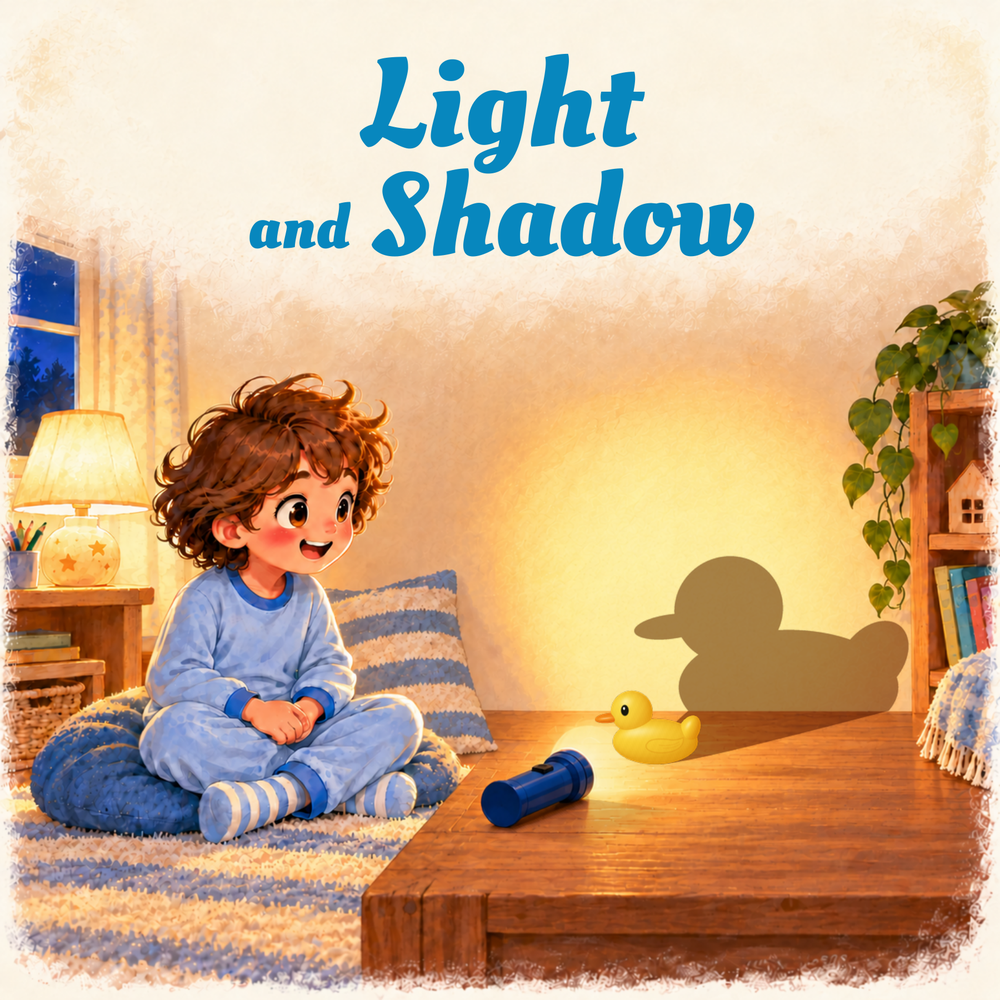
The torch illuminates the duck and produces its shadow on the wall. The duck blocks some of the light travelling from the torch to the wall, leaving a darker area behind it. Other light in the room can still reach that area.
Ask together: What is making light, what is in its way, and where is the shadow?
Shadow sizePages 23–24
Vince moves the duck closer to the torch, making its wall shadow larger. With the torch and wall fixed in this setup, moving the duck toward the torch makes its shadow larger. The duck itself stays the same size. Try the actual torch first; different torch beams can behave differently.
Ask together: Which thing moved? Did the duck itself get bigger?
Observation and drawingPages 25–26
Vince quietly draws in his notebook; the facing page is intentionally blank. Vince records something he noticed. A few imperfect marks are enough; he does not need to explain every discovery. Leave the first reading quiet here.