Back to the shelf

THE PHYSICAL EDITION

Sound and Vibration

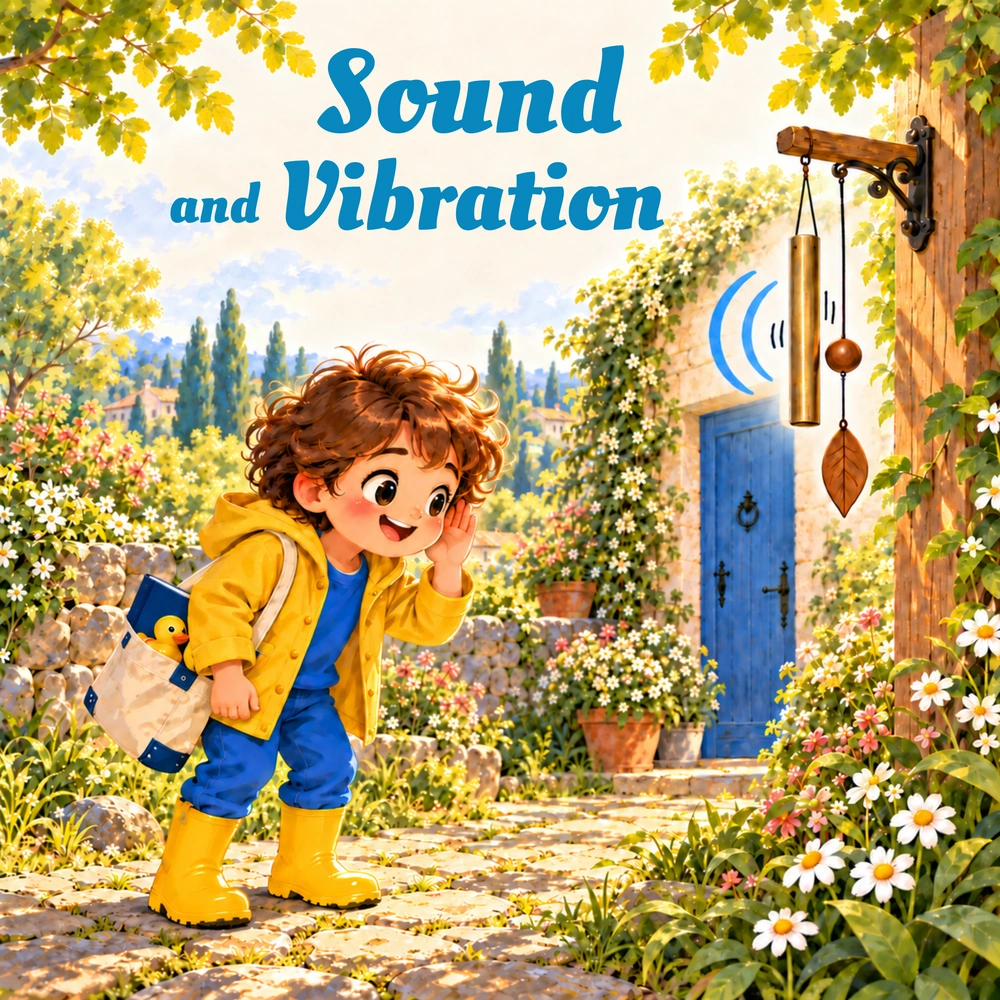
Follow a ringing chime through Vince’s day. Crunching footsteps, a returning clap, jumping rice and rippling water invite children to connect sounds with things that move and tremble.

Physical edition in development. Our physical books will be the premium option for families who want a copy to keep.

Coming soon

Price and ordering details will be announced when the physical edition is ready.

Enjoy the complete story online

Explore the science

Sound through airPages 1–2

Vince hears a ring while the ringing object is still outside. Sound travels through air and can reach us before we see what made it. Sound is invisible; the blue curves in these pictures are symbols that help us follow it.

Ask together: What makes Vince turn toward the door?

VibrationPages 3–4

A small striker knocks the metal chime, then moves away while the chime keeps ringing. The knock makes the metal vibrate: move back and forth very quickly. This vibration makes the ring. The slow swing of the whole chime is a different movement.

Ask together: What touches the chime before it rings?

Quieting a vibrationPages 5–6

Vince holds the metal tube, and the ringing stops. His hand reduces the metal’s vibration, so the ring dies away quickly. He touches the tube itself.

Ask together: Which part does Vince touch?

Different surfaces, different soundsPages 7–8

The same yellow boot presses small stones on the path and then lands on wooden boards. The stones knock and scrape against one another and the boot, making vibrations and sound. On the boards, the boot and wood vibrate. Both the surface and the step affect what Vince hears.

Ask together: What changes beneath his boots?

EchoPages 9–10

Vince claps once, then listens as the clap comes back from the far stone wall. Some sound reflects from the wall and returns after a short pause: an echo. The arrows help us follow its direction. A nearby wall can reflect sound without a separate echo.

Ask together: Can you follow the sound to the wall and back?

Seeing movementPages 11–12

Vince taps the drum and lifts the beater away. Rice grains jump on the drumhead. The tap makes the drumhead vibrate. Contact with the moving head pushes the grains up; sound in the air does not lift them. A grown-up handles loose rice.

Ask together: What moves after Vince taps?

One vibration, two effectsPages 13–14

Vince taps a metal bowl. He hears a ring and sees ripples on the water. The bowl’s trembling wall makes sound in the air and moves the water touching it. Visible water ripples and invisible sound in air are different waves. Results depend on the bowl, its support, the water level and the tap.

Ask together: What can Vince hear? What can he see?

Feeling a vibrationPages 15–16

Vince keeps his fingers lightly in place as he hums, then stops humming. Air from the lungs makes the vocal folds vibrate. The tremble he feels stops when he stops humming; his fingers stay in place. Looking is an option, too.

Ask together: Hum, pause, then hum again. What can you feel?

Recognising a soundPages 17–18

Vince hears the familiar chime as he arrives home. The chime rings when its metal vibrates, just as it did at the start. A familiar sound can help us recognise a place.

Ask together: Which sound has Vince heard before?

Observation and drawingPages 19–20

Vince quietly draws in his notebook; the facing page is intentionally blank. His drawing helps him remember what he noticed. Leave this ending quiet.

Water and Wind

Water and Wind, pages 1–2: Wind moves the pinwheel.

Spread 1 / 12

Wind tickles my cheek. Round goes my pinwheel.

Explore the science

Wind & forcesPages 1–2

Wind moves the pinwheel. Wind is moving air. Vince feels it on his cheek and sees it push the pinwheel's angled blades.

Ask together: What tells you that the air is moving?

Currents & eddiesPages 3–4

Water passes the rock. A leaf circles behind it. Most water passes the rock; some circles back in an eddy. Laminar flow is orderly; turbulence is irregular, mixing motion. A swirl alone cannot distinguish them.

Ask together: How does the leaf move compared with the water passing the rock?

Waves & energyPages 5–6

Waves spread from the stream. The duck bobs. The falling stream makes waves that carry energy outward and make the toys bob. The stream's current also carries toys along. Bobbing and drifting are different motions.

Ask together: What moves up and down? What moves along the pond?

BuoyancyPages 7–8

A duck floats. A pebble sinks. Water pushes upward on both objects. This buoyancy balances the duck's weight, but not the pebble's. The pebble's splash makes the rings on the next spread.

Ask together: Where is each object compared with the surface?

When waves meetPages 9–10

Two wave patterns approach one another. When gentle waves overlap, their heights add, briefly raising or lowering the surface. This interference does not erase the waves; they continue through one another.

Ask together: What might happen where the two patterns meet?

Surface tensionPages 11–12

Tiny dents appear beneath the strider’s legs. Surface tension helps support the strider where its water-repellent legs dent the water. The duck floats mainly by displacing water.

Ask together: What do you notice where its legs meet the water?

Suction & pressurePages 13–14

The duck bubbles, fills and squirts. Squeeze underwater: air bubbles out. Release with the opening submerged: the elastic duck springs back, lowering pressure inside. The surrounding water pressure pushes water in. Squeeze above water: water exits through that same opening.

Ask together: What changes when Vince squeezes and then lets go?

Lift & gravityPages 15–16

A paper plane glides forward and down. The throw starts the plane moving. Airflow around its wings produces lift and turns air downward. Gravity pulls down; drag resists motion. In still air, the plane glides forward and gradually descends.

Ask together: Where might the plane go next?

ViscosityPages 17–18

Milk runs. Honey stretches into a thread. Honey's greater viscosity means greater resistance to flow. It makes a slow thread while milk runs readily. Temperature and pouring method also matter; this snack is an observation, not a controlled test.

Ask together: How do the milk and honey move differently?

Draining & swirlingPages 19–20

Foam curves inward toward the drain. Gravity drives water through the drain. Existing turning motion can become a curved inward flow, traced by foam. Here water travels to the outlet, unlike waves crossing the pond. Not every drain swirls.

Ask together: Can you follow the foam toward the drain?

Scientific observationPages 21–22

Vince sketches what he noticed. Vince records something he noticed. Drawings, marks or words let him return to an observation. He does not need all the answers.

Ask together: Which earlier picture matches one of his drawings?

Your basket

A spot for your next story.

Ordering opens when the books are ready.