THE PHYSICAL EDITION
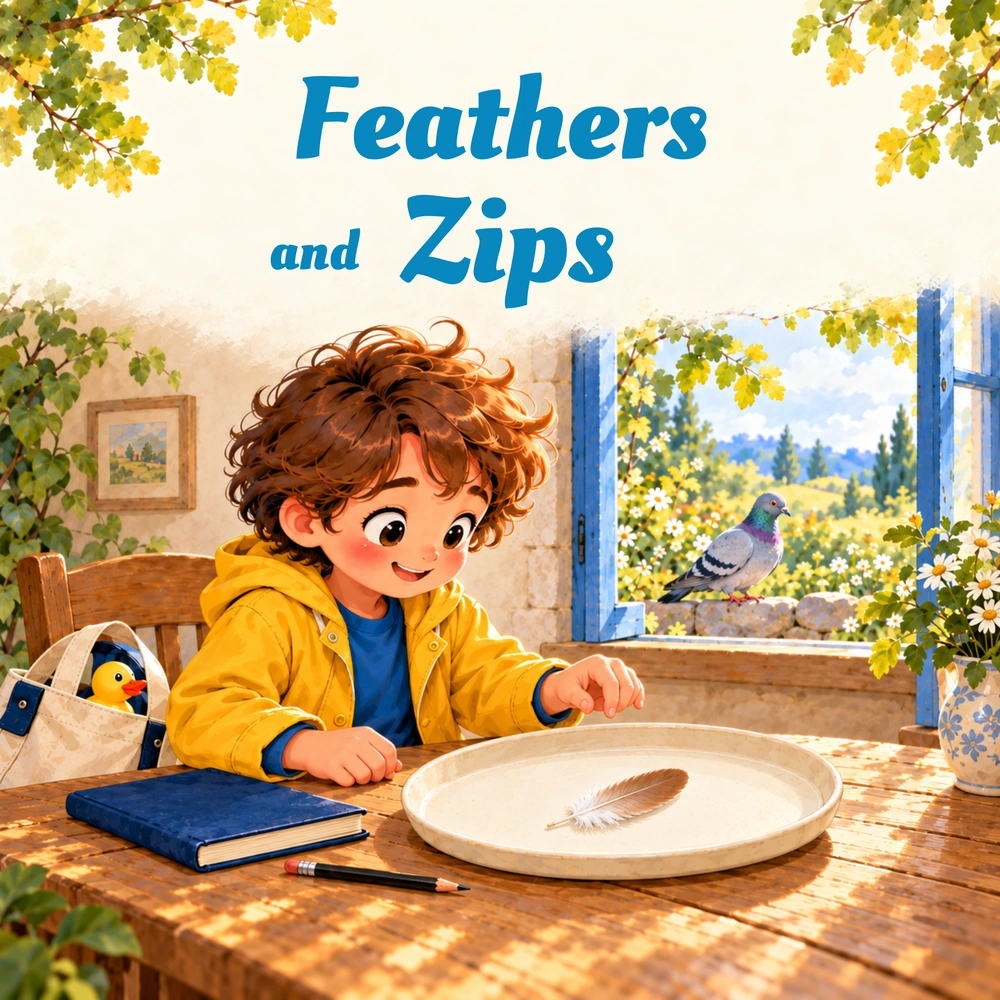
Feathers and Zips
A feather for a drawing takes Vince from a little gap to a whole bird. Follow his gentle stroke, compare firm and fluffy parts, and watch a pigeon care for its feathered wings.
A favourite to hold onto.
Picture book. Our physical books will be the premium option for families who want a copy to keep.
Coming soon
Price and ordering details will be announced when the physical edition is ready.
Enjoy the complete story onlineExplore the science
Looking closelyPages 1–2
Vince receives a feather in a shallow tray while his open notebook waits on the table. A single body feather can have both a firm vane and a fluffy base.
Ask together: What can Vince look closely at before he draws?
A branching surfacePages 3–4
A gentle finger movement parts a small patch in the feather’s firm surface. Neighbouring branches can separate while the shaft and branches stay whole.
Ask together: What has come apart?
Reconnecting an intact vanePages 5–6
Vince gently strokes the feather; the separated patch joins again. Tiny interlocking structures can reconnect when gently aligned, if they are intact. This does not mend a broken shaft or replace missing material.
Ask together: Where is the gap after the stroke?
Different feather structuresPages 7–8
Vince smooths the loose base, then lifts his fingers; it stays fluffy. This loose structure differs from the firm vane. Pressing it does not turn it into the same joined sheet.
Ask together: Which part stays fluffy?
PreeningPages 9–10
Vince watches a pigeon touch its wing feathers with its bill. Preening helps birds arrange and care for feathers, including realigning interlocking parts.
Ask together: How is the bird’s action like Vince’s?
A feathered wingPages 11–12
A stretching wing reveals rows of overlapping feathers. Long wing feathers overlap as parts of an attached, moving wing.
Ask together: Where do the feathers overlap?
Noticing a coveringPages 13–14
Vince closes his coat while the pigeon raises its body feathers. Loose feathers hold air near the body and slow heat loss. Fluffing can thicken insulation, but a puffed outline alone does not tell us why a bird fluffs.
Ask together: How do Vince and the bird change their coverings?
The whole bird in flightPages 15–16
The pigeon leaves the fence with its feathered wings spread, and Vince waves. Feathers form part of the flight surface; the bird’s whole moving wing and body take part.
Ask together: What can Vince see now that the wings are spread?
Sources and evidence
A contour feather’s firm vane consists of many branches from a central shaft; adjoining branches can separate without the shaft breaking.
Composition and Structure — AMNH Science Conservation
How Feathers Are Built — Cornell Lab Bird Academy
The picture shows visible branches and gaps. The tiny interlocking structures are too small to see without magnification.
Gently aligning separated parts of an intact firm feather vane can reconnect its tiny interlocking structures. This does not mend a broken shaft or regrow lost material.
Feathers: better than Velcro? — UC San Diego Jacobs School
How Feathers Are Built — Cornell Lab Bird Academy
Keeping Backyard Poultry — Minnesota Department of Health
Rejoining requires intact structures; damaged or processed feathers may not reconnect.
Use a specimen prepared for children’s handling, supplied by an adult. Do not use raw flock feathers. Keep away from mouths and wash hands with soap and water afterward. Looking at the pictures is an alternative.
The loose fluffy basal portion of the selected contour feather does not form the same joined flat sheet when smoothed.
Composition and Structure — AMNH Science Conservation
How Feathers Are Built — Cornell Lab Bird Academy
Loose basal branches may be pressed down temporarily; they do not become the same joined firm vane. Fluff is not simply damage.
Birds use their bills to arrange and maintain feathers, including realigning the interlocking parts of firm vanes.
Preening, sunbathing, dustbathing and waterbathing — BTO
How Feathers Are Built — Cornell Lab Bird Academy
Preening includes several kinds of feather care; a bill touching a feather does not show microscopic connections moving. Watch wild birds from a distance.
Long overlapping wing feathers spread with a bird’s wing and help form a flight surface. A bird flies using its whole wing and body, not loose feathers alone.
How Bird Feathers Work — Natural History Museum of Los Angeles County
The feathered wing and whole body act together. A detached feather is not a complete flying wing.
Loose feather structure retains air near a bird’s body; fluffing can increase insulation and reduce heat loss. Feathers do not create heat.
How Feathers Are Built — Cornell Lab Bird Academy
How do birds keep warm in the winter? — U.S. Fish & Wildlife Service
Feathers slow heat loss rather than make heat. Birds fluff in several contexts, so a puffed outline alone does not establish cold.