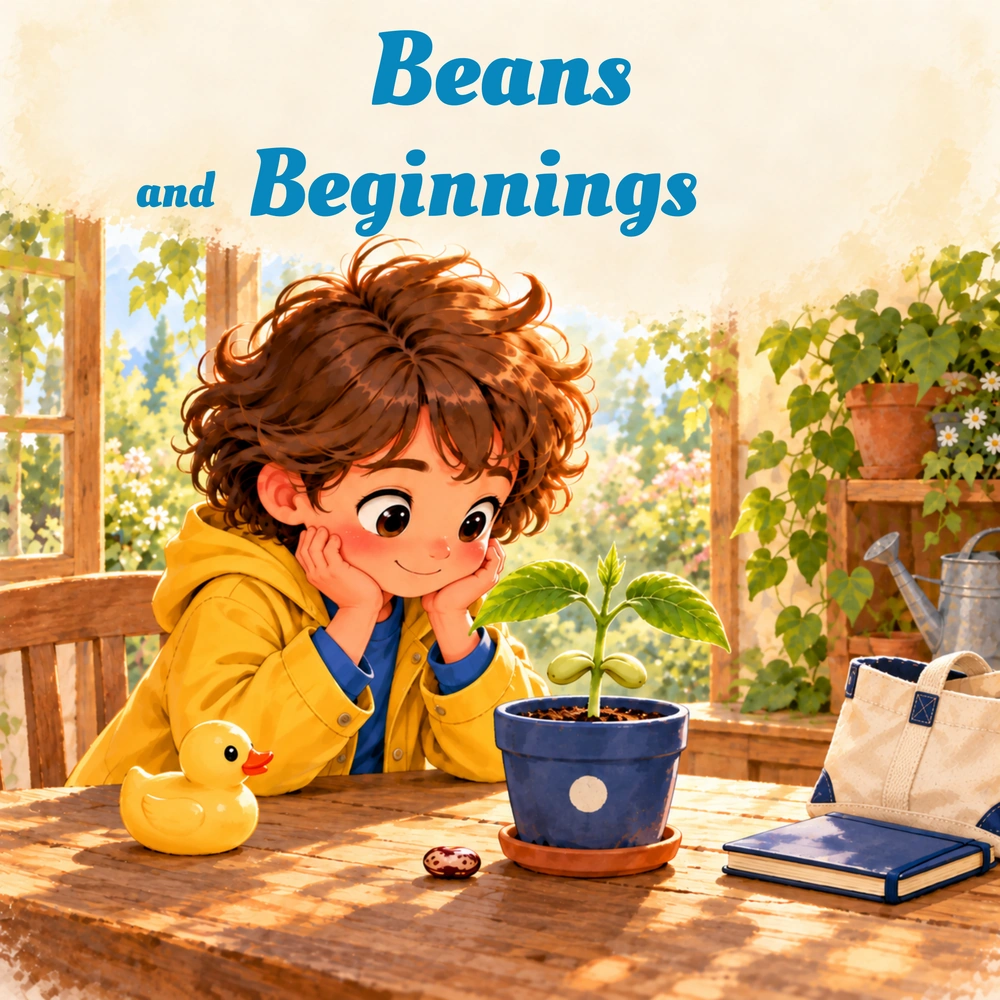
THE PHYSICAL EDITION
Beans and Beginnings
Follow Vince from a handful of beans to a plant by the window. Compare dry and damp seeds, watch roots and leaves develop, then turn a pot and look for new growth.
A favourite to hold onto.
Physical edition in development. Our physical books will be the premium option for families who want a copy to keep.
Coming soon
Price and ordering details will be announced when the physical edition is ready.
Enjoy the complete story onlineExplore the science
Seeds can develop into plantsPages 1–2
Vince compares the beans in his palm with the plant pictured on their packet. A viable common-bean seed can begin growing when its conditions are suitable. The picture poses the question; it does not promise that every seed will sprout.
Ask together: What looks different about the beans and the plant on the packet?
Comparing dry and damp conditionsPages 3–4
Three beans rest against white paper in each open jar. Vince adds water to the blue-banded jar and leaves the red-banded jar dry. Moisture is one condition for germination. Oxygen, a suitable temperature and a viable seed also matter; adding water alone cannot guarantee growth.
Ask together: What has Vince changed in one jar?
Germination becomes visiblePages 5–6
Days later, the dry beans look unchanged. A swollen bean in the damp jar is splitting, with a short white root emerging. The root is the first part to emerge from the germinating seed. Seeds can develop at different rates, and some may not sprout.
Ask together: What can you spot on the splitting bean?
Different parts developPages 7–8
A long pale root curls downward while a green shoot lifts two fleshy seed leaves and a small folded tip. In this common bean, the shoot lifts the cotyledons, or seed leaves. The first true leaves begin above them. Other kinds of beans can emerge differently.
Ask together: Which part goes down, and which part lifts up?
Roots branch and true leaves openPages 9–10
Fine roots branch from the main root and two flatter leaves open above the fleshy seed leaves. Vince points to his earlier bean drawing. The first true leaves of a common bean form an opposite pair. Later leaves have three leaflets. These drawings show changes in parts, rather than measured growth in height.
Ask together: What has changed since Vince drew the little bean?
Moving from observation to carePages 11–12
An adult steadies the seedling while Vince tucks soil around its roots in a blue pot. Two seedlings remain in the damp jar. A paper-lined jar is a temporary observation setup. An adult can help transfer a seedling gently into potting mix, with drainage, suitable light and water; avoid pulling the stem or roots.
Ask together: Where are the roots going now?
An action changes the plant's orientationPages 13–14
The plant leans toward the right-hand window. Vince turns the pot, and the existing plant now leans away from the window. Turning the pot turns the plant with it. The cream dot on the pot moves out of view; the window stays on the same side. This turn is Vince's action, not new growth.
Ask together: What moved when Vince turned the pot?
New growth can change directionPages 15–16
Vince waits. The lower stem keeps its older bend while a longer upper tip curves back toward the window. The growing shoot can curve toward light as its two sides grow differently. This is gradual growth, not a decision or an instant turn. A clear bend depends on conditions and is not guaranteed.
Ask together: Where is the new tip pointing now?
Sources and evidence
A dry bean seed can begin growing when conditions are suitable; in this illustrated comparison the damp-paper beans sprout while dry-paper beans remain unchanged.
University of Illinois Extension, Great Plant Escape: Germination
Opened 2026-10-23; Germination paragraphs 1-2: water, oxygen and suitable temperature; root emerges before shoot; dry conditions and excessive water can prevent germination.Royal Horticultural Society: All about seeds
Opened 2026-10-23; Activities / What are seeds: apparently inactive seeds can grow under suitable conditions; damp-paper observation and comparison with dry seeds.University of New Hampshire Extension: Grow a bean in a jar
Opened 2026-10-23; Plant beans in a jar (Week 1), steps 1-7: 3-4 beans between jar and damp paper, observe each day and record changes if any, add water only as needed. Source supplies a multiweek exploration, not guaranteed timing.Use several viable untreated common-bean seeds from one packet, same containers/place; vary moisture only. Water is necessary, not sufficient: oxygen, suitable warmth and seed viability matter. Results and timing vary. No claim every seed sprouts. Physical setup not performed.
In the depicted common bean, the seed coat opens, a root emerges first, then the shoot develops; roots and leaves are visibly different structures.
University of Illinois Extension, Great Plant Escape: Germination
Opened 2026-10-23; Germination paragraphs 1-2: water, oxygen and suitable temperature; root emerges before shoot; dry conditions and excessive water can prevent germination.University of Florida / Kentucky / Texas A&M: Germination patterns
Opened 2026-10-23; epigeous pattern: hypocotyl hook and cotyledons raised above substrate. Distinguishes hypogeous pattern; not every bean species shares the same morphology.Government of Saskatchewan — Dry Bean Adaptation and Varieties
Lead independently opened 2026-10-23 after reviewer check. Opened actual page; Classes of dry bean, web line 109, after the list that includes kidney types. Raised cotyledons, a first opposite pair of simple true leaves, followed by alternate trifoliolate leaves.Show common bean (Phaseolus vulgaris), not broad/runner bean morphology. Roots emerge continuously from the seed axis; two fleshy cotyledons and two emerging true leaves must not be confused. No instant plant or detachable sprout. Downward root/upward shoot describe depicted growth, not an absolute direction rule.
Agronomic guidance supplies morphology, not household timing. This directly resolves the leaf-stage question without changing the chosen species.
The first true leaves are opposite and simple; later leaves are alternate and trifoliolate. Final growing tip remains folded with no second simple leaf pair.
As this seedling grows, its root system branches and true leaves unfold; a whole developing plant came from the original small seed.
University of Florida / Kentucky / Texas A&M: Germination patterns
Opened 2026-10-23; epigeous pattern: hypocotyl hook and cotyledons raised above substrate. Distinguishes hypogeous pattern; not every bean species shares the same morphology.University of Illinois Extension, Great Plant Escape: Germination
Opened 2026-10-23; Germination paragraphs 1-2: water, oxygen and suitable temperature; root emerges before shoot; dry conditions and excessive water can prevent germination.Government of Saskatchewan — Dry Bean Adaptation and Varieties
Lead independently opened 2026-10-23 after reviewer check. Opened actual page; Classes of dry bean, web line 109, after the list that includes kidney types. Raised cotyledons, a first opposite pair of simple true leaves, followed by alternate trifoliolate leaves.Gurdeep Singh, South Dakota State University — Quantification of Auxin-Cytokinin Response During Primary Root and Lateral Root Development in Common Bean (2025)
Lead independently opened 2026-10-23 after reviewer check. Opened original thesis repository abstract; web lines 40–48. The research explicitly addresses lateral-root initiation and emergence in Phaseolus vulgaris, independently supporting the branching mechanism in c3.Illustrative sequence over multiple days; no guaranteed rate or size. Distinguish new structures from repeated increase in height. Root absorption and seed stores may be explained in guide but are not claimed visible experimental discoveries.
Agronomic guidance supplies morphology, not household timing. This directly resolves the leaf-stage question without changing the chosen species.
Abstract inspected, not full thesis or figures. Reporter and transgenic-root experiments do not establish the illustrated jar sequence or timing.
A growing shoot can curve toward light; after the pot is turned, later new growth can curve toward the window again.
Georgia Tech Organismal Biology: Plant Hormones and Sensory Systems
Read 2026-10-23 via verified-TLS curl after web fetch 502; local HTML and extracted text retained. Response to Blue Light / Phototropism: differential stem elongation bends growing shoots toward light. Plant Responses to Gravity treats roots and shoots differently. Mechanism supports gradual new curvature, not rigid repositioning or intent.Phototropism is growth, not walking, feeling or conscious searching. Keep older stem bend after half-turn; only later growing upper section curves back. Light direction and elapsed days must be explicit. Illustration is source-supported possible response, not a tested household result or exact time promise.
Growing upper tissue may already exist before turning; new growth wording means elongation/development, not a universal claim that only newly created tissue bends.
Moist but aerated conditions and careful handling support the observation; a seedling can be moved gently into potting mix for continued growth.
University of New Hampshire Extension: Grow a bean in a jar
Opened 2026-10-23; Plant beans in a jar (Week 1), steps 1-7: 3-4 beans between jar and damp paper, observe each day and record changes if any, add water only as needed. Source supplies a multiweek exploration, not guaranteed timing.University of Illinois Extension: Snap Beans
Opened 2026-10-23; Care: excessive moisture can crack seed coats and harm germination; do not pre-soak these beans for sowing. Weak/shallow roots can be injured. Used as counterevidence against generic soak-all-beans instructions.University of Illinois Extension, Great Plant Escape: Germination
Opened 2026-10-23; Germination paragraphs 1-2: water, oxygen and suitable temperature; root emerges before shoot; dry conditions and excessive water can prevent germination.Colorado State University Extension, Stephanie Lamm — Plants in a Bag
Lead independently opened 2026-10-23 after reviewer check. Opened the actual two-page PDF text; page 1 steps 1–3 and page 2 steps 4–7, especially Step 7 lines 37–41. The extension activity moves damp-paper green-bean seedlings gently into soil in a pot or garden for possible continued growth.Adult helps with seeds, containers and potting; avoid pulling stem/root, support seedling gently, keep roots covered in receiving hole, use pot drainage. Do not soak common-bean seeds as a universal instruction. No tasting experiment material; wash hands. Guide invites observation rather than guaranteed reproduction.
This is a bag activity, not a trial of this open jar. It supports qualified possible transplantation; its suggested height is not imposed on the story. PDF screenshot failed with cache miss, so the diagrams were not visually inspected.