Back to the shelf

THE PHYSICAL EDITION

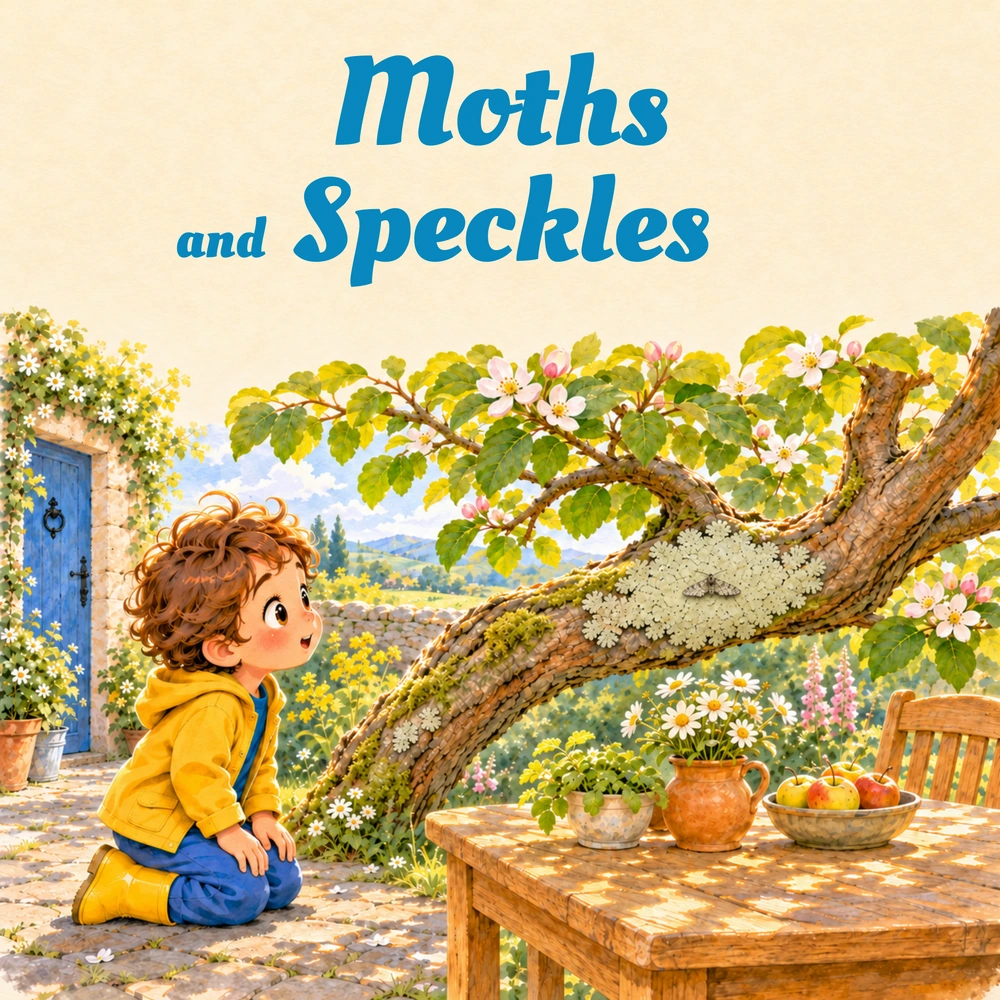
Moths and Speckles

A moth flutters past Vince and seems to vanish on a branch. Can his paper wings hide in plain sight, too?

Picture book. Our physical books will be the premium option for families who want a copy to keep.

Coming soon

Price and ordering details will be announced when the physical edition is ready.

Enjoy the complete story online

Explore the science

Following movementPages 1–2

A pale, dark-speckled moth flies past Vince toward a low tree branch. Movement draws Vince’s eye as he follows the insect.

Ask together: Where is Vince looking?

Background matchingPages 3–4

Vince studies the pale flecks on a rough branch. A moth rests on one of the patches. When the moth is still, the marks on its wings can be hard to separate from the marks around it.

Ask together: Where would you look first?

Finding an outlinePages 5–6

A close view shows a fuzzy body between pale speckled wings and two fine antennae above the head. A piece of wing edge or the little body can help you see a shape among similar marks.

Ask together: Can you follow one wing tip back to the body?

Making a modelPages 7–8

A plain cream paper moth lies on a much larger flecked sheet. Vince studies it from the side. The empty shape interrupts the field of speckles. Vince can change it with his crayon.

Ask together: What could Vince add?

Adding matching marksPages 9–10

Vince brings the tip of a gray crayon to one paper wing. Dots and short dashes reach toward both tips. Putting marks on the cutout makes it look more like the sheet underneath.

Ask together: Which marks on the wing look like the ones on the sheet?

Changing the backgroundPages 11–12

The same speckled wing shape rests first on speckled paper and then on a navy notebook. The notebook provides a contrasting background, so the shape becomes easier to pick out.

Ask together: What stayed the same across the two pictures?

Using a cluePages 13–14

Vince leans forward with his hands behind him. A little speckled moth rests by the fork of the branch. This time Vince knows to look for the wing tip, even when the moth is still.

Ask together: What helped you find it this time?

Sources and evidence
  1. A moving shape can draw the eye against a still background.

    Camouflage, detection and identification of moving targets

    A flutter is one possible clue. Other movements in the background can change what draws the eye.

  2. The pale mottled wings in Vince’s picture resemble the leafy lichen. In a separate bird-vision study, pale peppered moths matched crust-forming lichen better than dark moths did.

    Avian vision models and field experiments determine the survival value of peppered moth camouflage

    Vince looks with human eyes. Different kinds of lichen can look different to a bird even when their colours look similar to us.

  3. A paper shape can be harder to pick out on a similar pattern than on a contrasting plain surface.

    Camouflage, detection and identification of moving targets

    Avian vision models and field experiments determine the survival value of peppered moth camouflage

    Light, marks and the paper edge affect how easily the shape can be found.

  4. A little bit of an outline or body can give a resting moth away.

    Avian vision models and field experiments determine the survival value of peppered moth camouflage

    Camouflage, detection and identification of moving targets

    The edge is one clue in this particular picture. Camouflaged animals can still be found.

Water and Wind

Water and Wind, pages 1–2: Wind moves the pinwheel.

Spread 1 / 12

Wind tickles my cheek. Round goes my pinwheel.

Explore the science

Wind & forcesPages 1–2

Wind moves the pinwheel. Wind is moving air. Vince feels it on his cheek and sees it push the pinwheel's angled blades.

Ask together: What tells you that the air is moving?

Currents & eddiesPages 3–4

Water passes the rock. A leaf circles behind it. Most water passes the rock; some circles back in an eddy. Laminar flow is orderly; turbulence is irregular, mixing motion. A swirl alone cannot distinguish them.

Ask together: How does the leaf move compared with the water passing the rock?

Waves & energyPages 5–6

Waves spread from the stream. The duck bobs. The falling stream makes waves that carry energy outward and make the toys bob. The stream's current also carries toys along. Bobbing and drifting are different motions.

Ask together: What moves up and down? What moves along the pond?

BuoyancyPages 7–8

A duck floats. A pebble sinks. Water pushes upward on both objects. This buoyancy balances the duck's weight, but not the pebble's. The pebble's splash makes the rings on the next spread.

Ask together: Where is each object compared with the surface?

When waves meetPages 9–10

Two wave patterns approach one another. When gentle waves overlap, their heights add, briefly raising or lowering the surface. This interference does not erase the waves; they continue through one another.

Ask together: What might happen where the two patterns meet?

Surface tensionPages 11–12

Tiny dents appear beneath the strider’s legs. Surface tension helps support the strider where its water-repellent legs dent the water. The duck floats mainly by displacing water.

Ask together: What do you notice where its legs meet the water?

Suction & pressurePages 13–14

The duck bubbles, fills and squirts. Squeeze underwater: air bubbles out. Release with the opening submerged: the elastic duck springs back, lowering pressure inside. The surrounding water pressure pushes water in. Squeeze above water: water exits through that same opening.

Ask together: What changes when Vince squeezes and then lets go?

Lift & gravityPages 15–16

A paper plane glides forward and down. The throw starts the plane moving. Airflow around its wings produces lift and turns air downward. Gravity pulls down; drag resists motion. In still air, the plane glides forward and gradually descends.

Ask together: Where might the plane go next?

ViscosityPages 17–18

Milk runs. Honey stretches into a thread. Honey's greater viscosity means greater resistance to flow. It makes a slow thread while milk runs readily. Temperature and pouring method also matter; this snack is an observation, not a controlled test.

Ask together: How do the milk and honey move differently?

Draining & swirlingPages 19–20

Foam curves inward toward the drain. Gravity drives water through the drain. Existing turning motion can become a curved inward flow, traced by foam. Here water travels to the outlet, unlike waves crossing the pond. Not every drain swirls.

Ask together: Can you follow the foam toward the drain?

Scientific observationPages 21–22

Vince sketches what he noticed. Vince records something he noticed. Drawings, marks or words let him return to an observation. He does not need all the answers.

Ask together: Which earlier picture matches one of his drawings?

Your basket

A spot for your next story.

Ordering opens when the books are ready.