THE COMPLETE BOOK · FREE TO READ
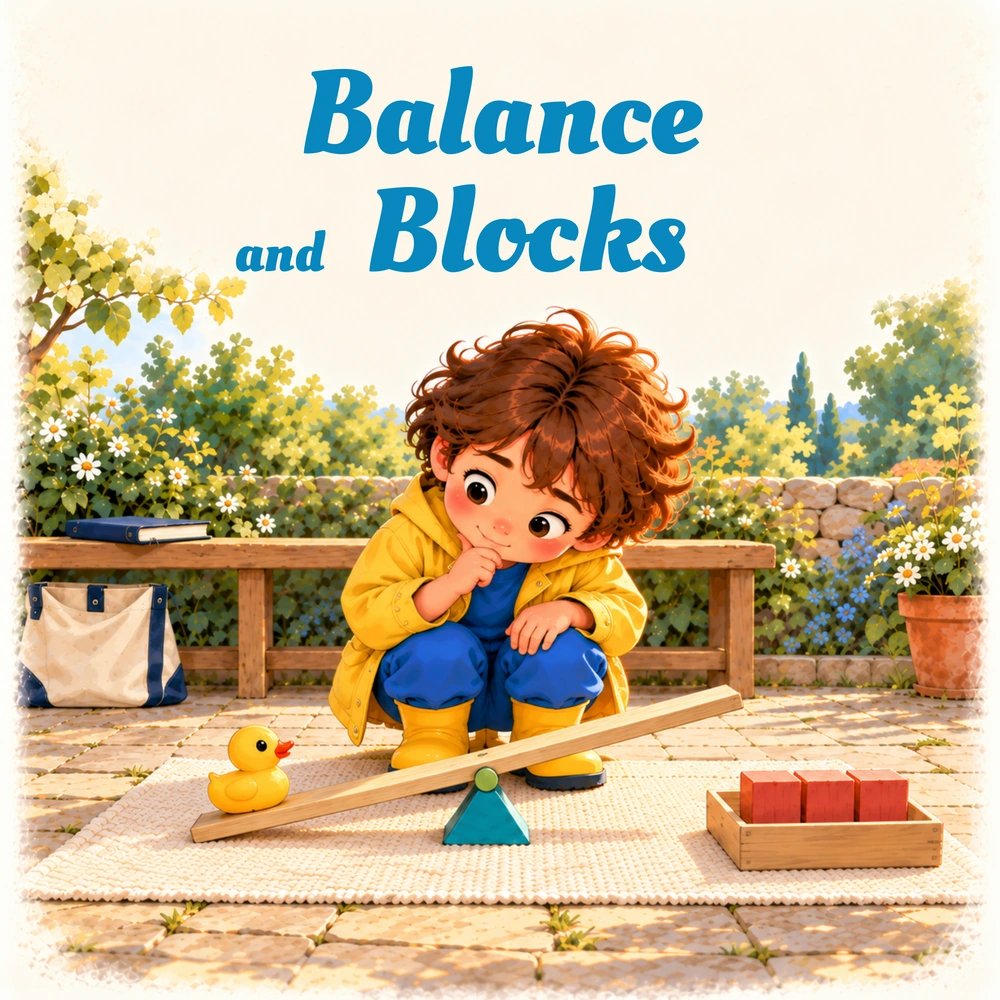
Balance and Blocks
Vince wants to lift Duck's end of a tiny seesaw. He tries matching blocks, moves them and adds one more, discovering how weight and position work together.
Turn the pagesOr scroll to readA ride for Duck
Pages 1–2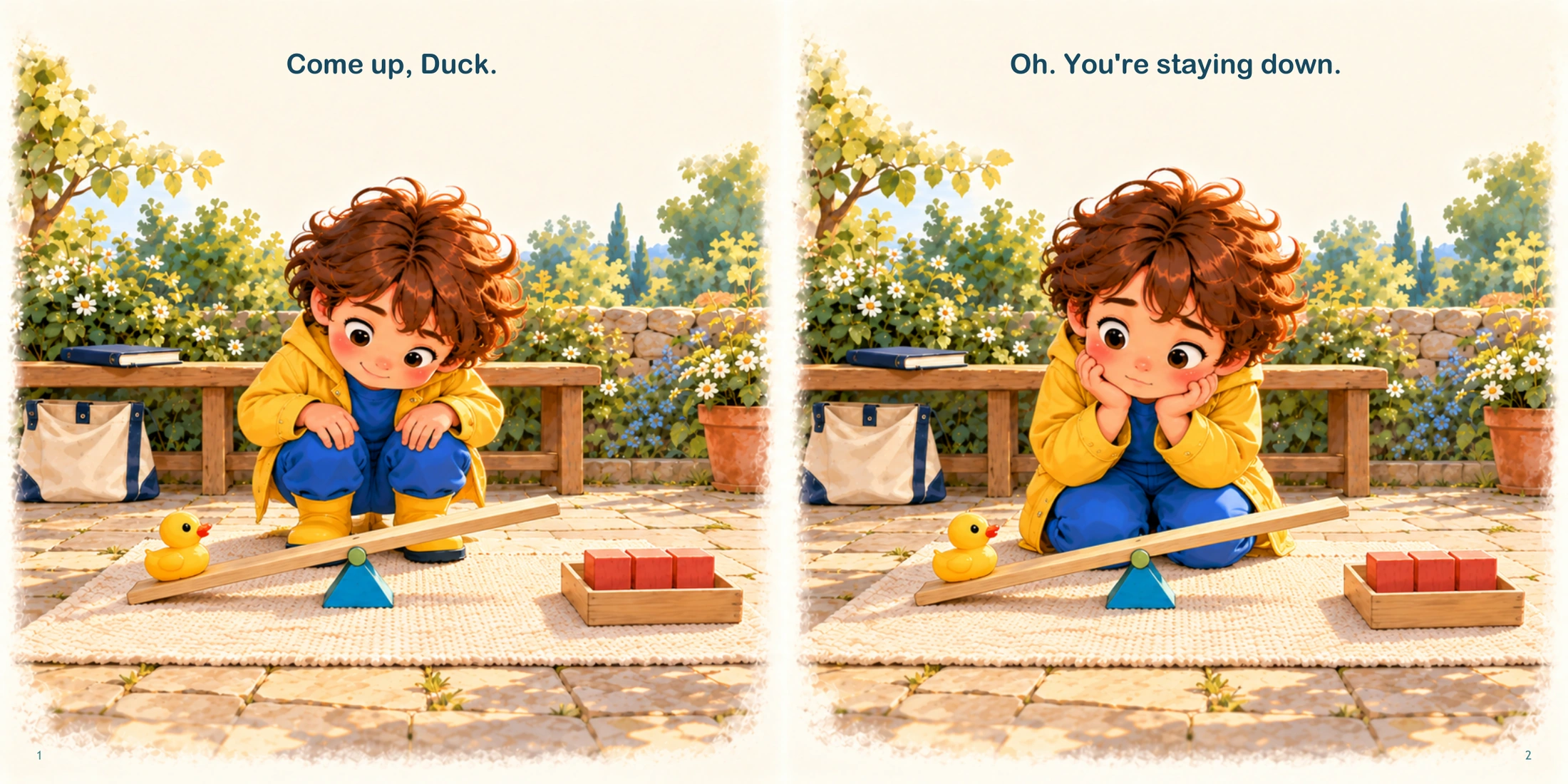
Come up, Duck. Oh. You're staying down.
Explore together · A load can tip a seesaw
Vince watches his yellow toy duck on the low end of a wooden beam. The other end is raised. A load away from the pivot can turn the beam toward its side. The lowered end rests on the mat.
Ask together: Which end is down?
Trying the blocks
Pages 3–4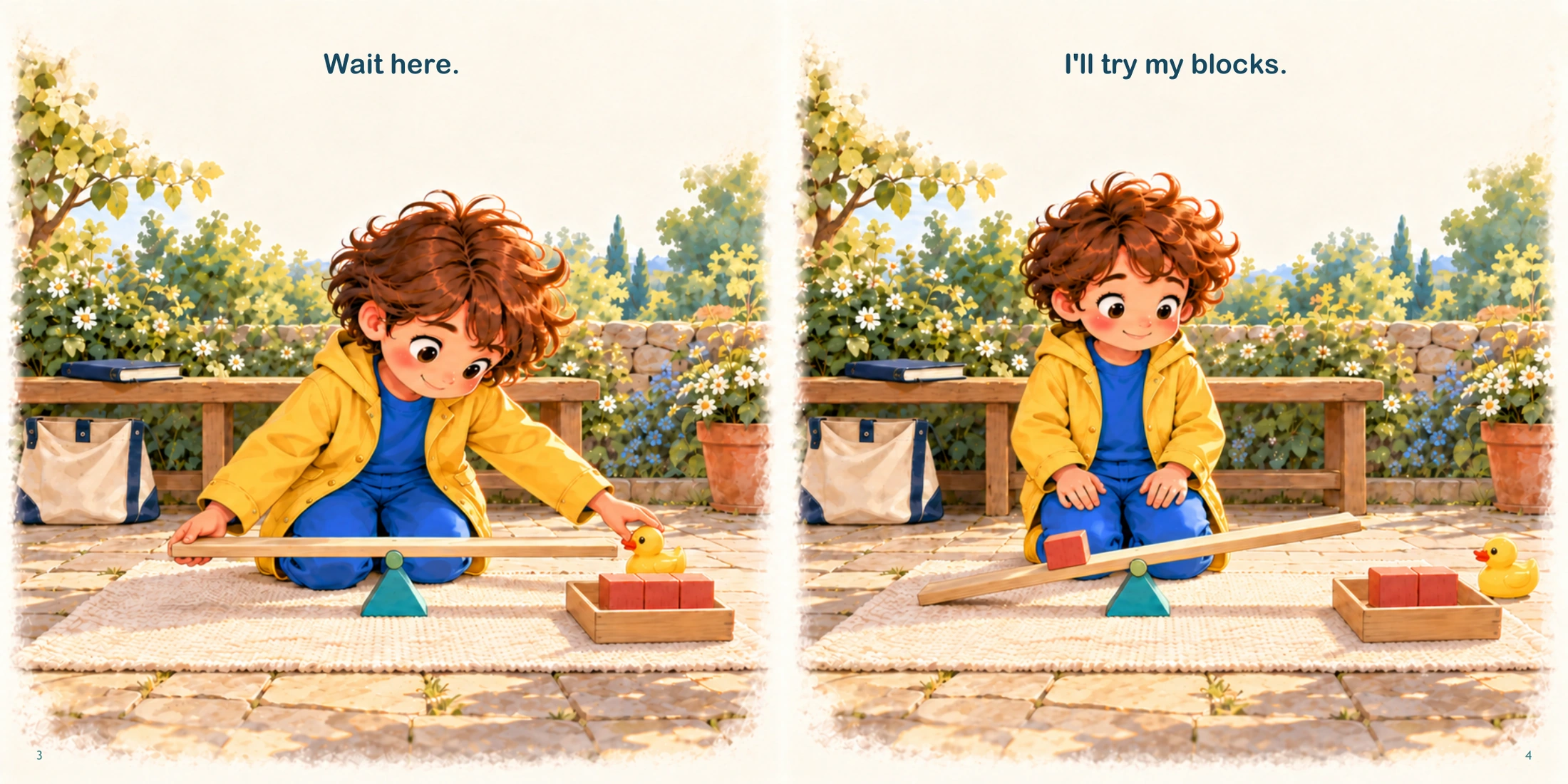
Wait here. I'll try my blocks.
Explore together · Choose objects to compare
Duck waits beside the tray while Vince puts one matched block on the beam. The three blocks are alike in weight as well as appearance. Using matched objects helps Vince compare their positions.
Ask together: What will Vince try with his blocks?
One each
Pages 5–6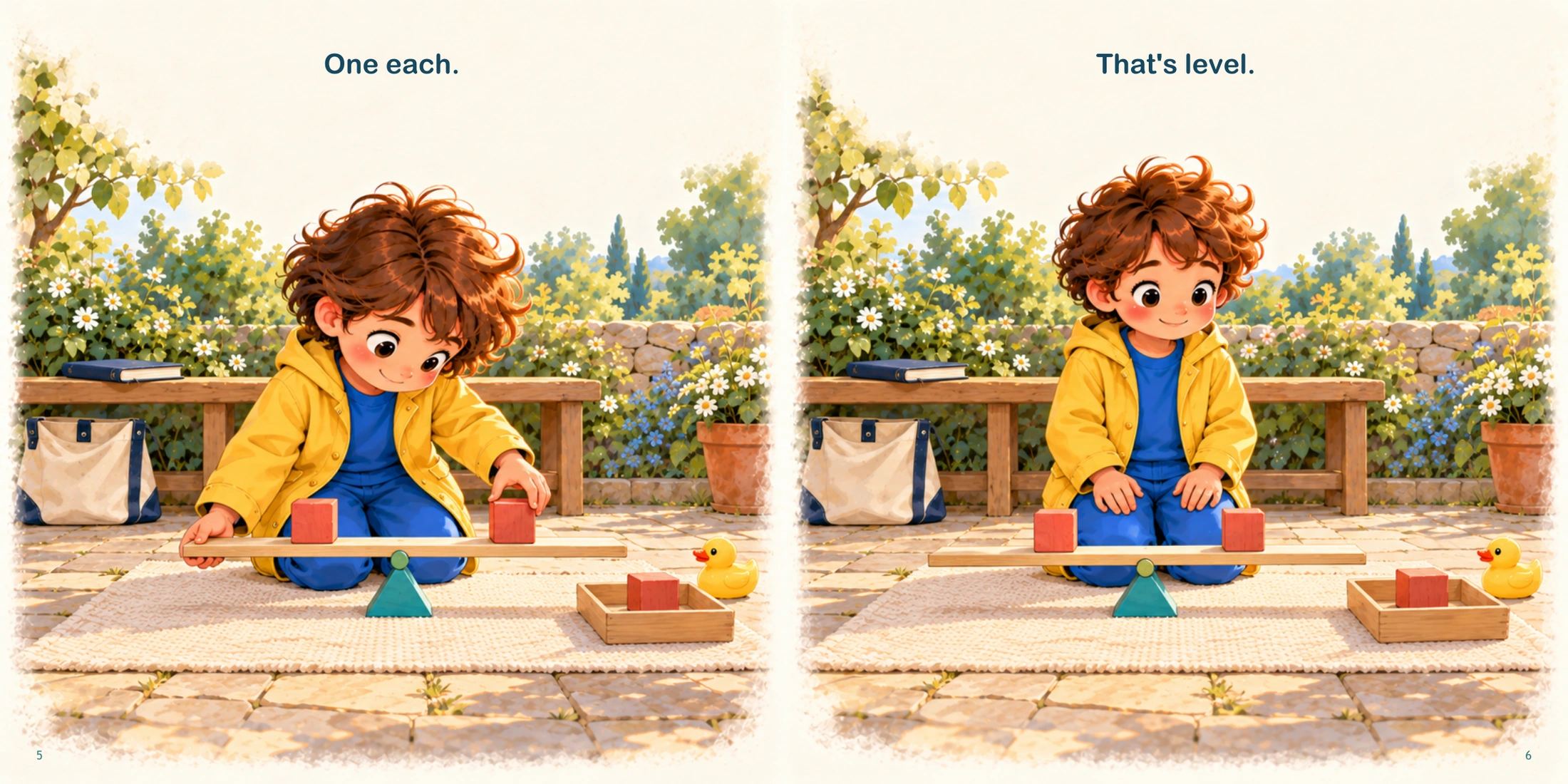
One each. That's level.
Explore together · Matching weight and distance
Vince steadies the beam as he places a block opposite the first. After he releases it, the beam is level. Equal weights at matching distances can balance a centered beam. This brief result does not promise that the beam will stay level after a disturbance.
Ask together: Where are the two blocks?
Farther out
Pages 7–8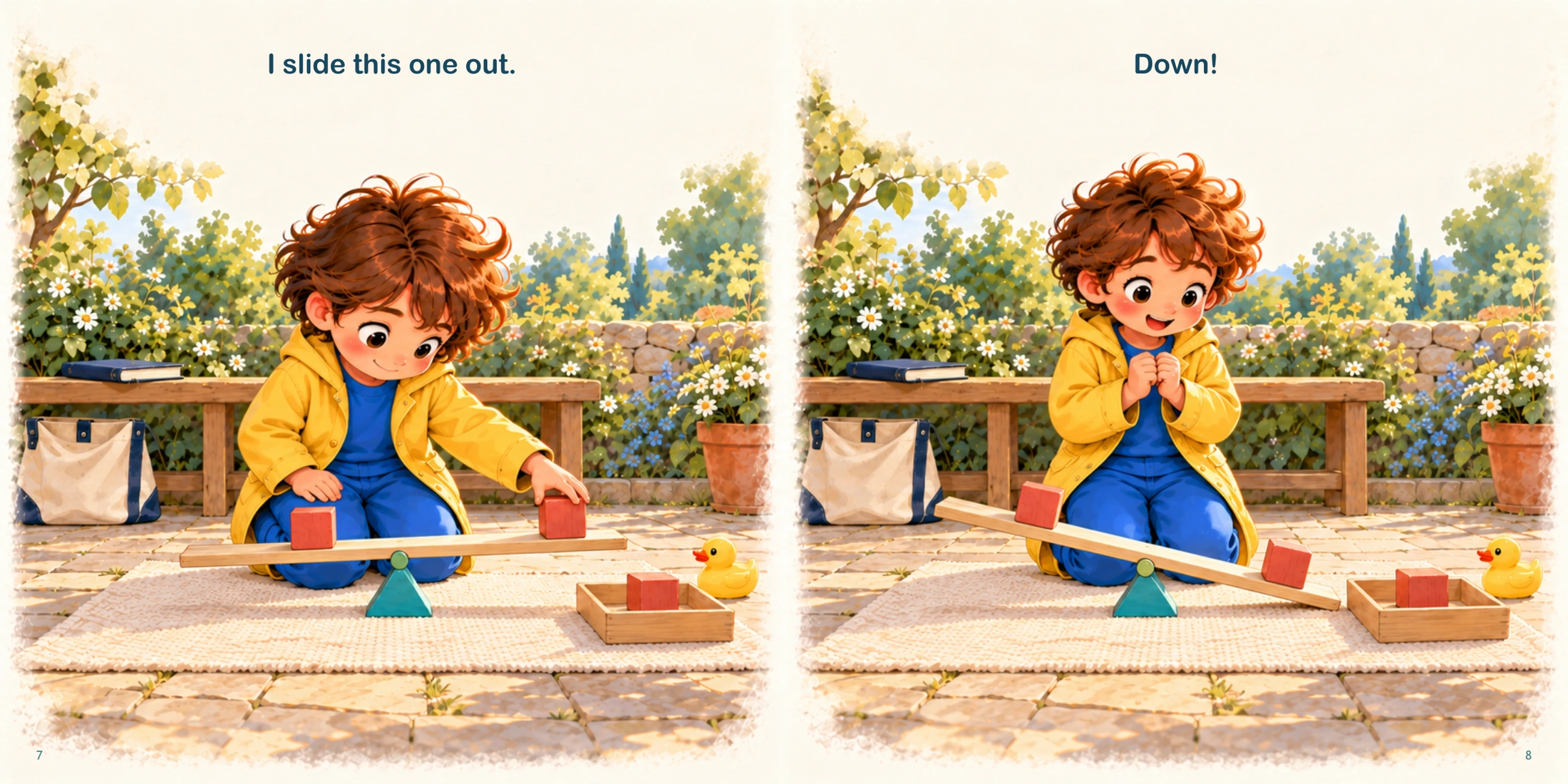
I slide this one out. Down!
Explore together · Position changes turning effect
Vince moves the right block farther from the pivot. That side tips down after he lets go. The block has not become heavier. Farther from the pivot, it has a greater turning effect.
Ask together: What changed while the blocks stayed the same?
Matching again
Pages 9–10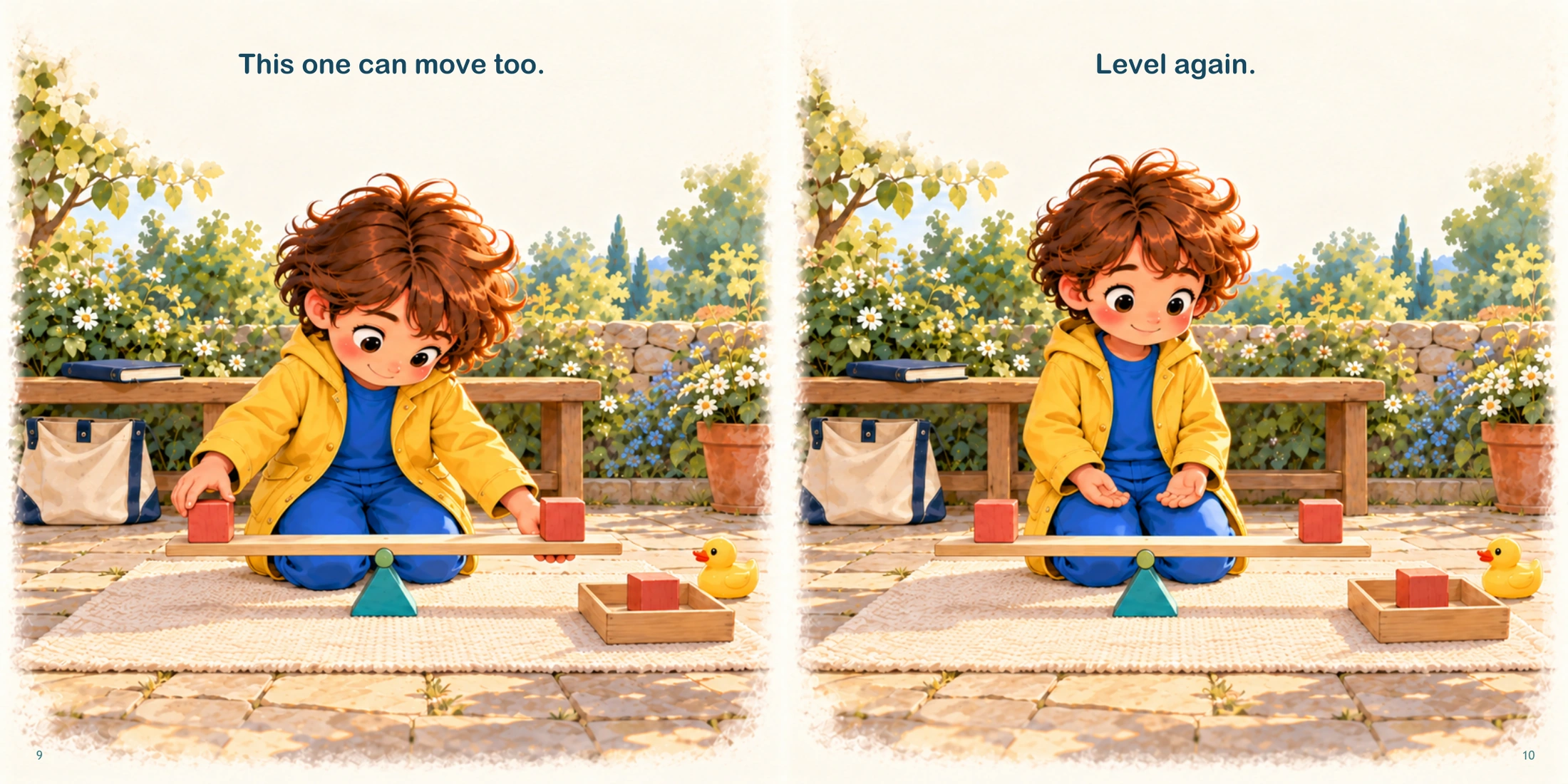
This one can move too. Level again.
Explore together · Restore the comparison
Vince moves the other block out too, steadies the beam, and releases it to find level again. Matching the distances restores equal opposing turning effects. Vince prepares the level position by hand.
Ask together: How did Vince match the blocks this time?
One more
Pages 11–12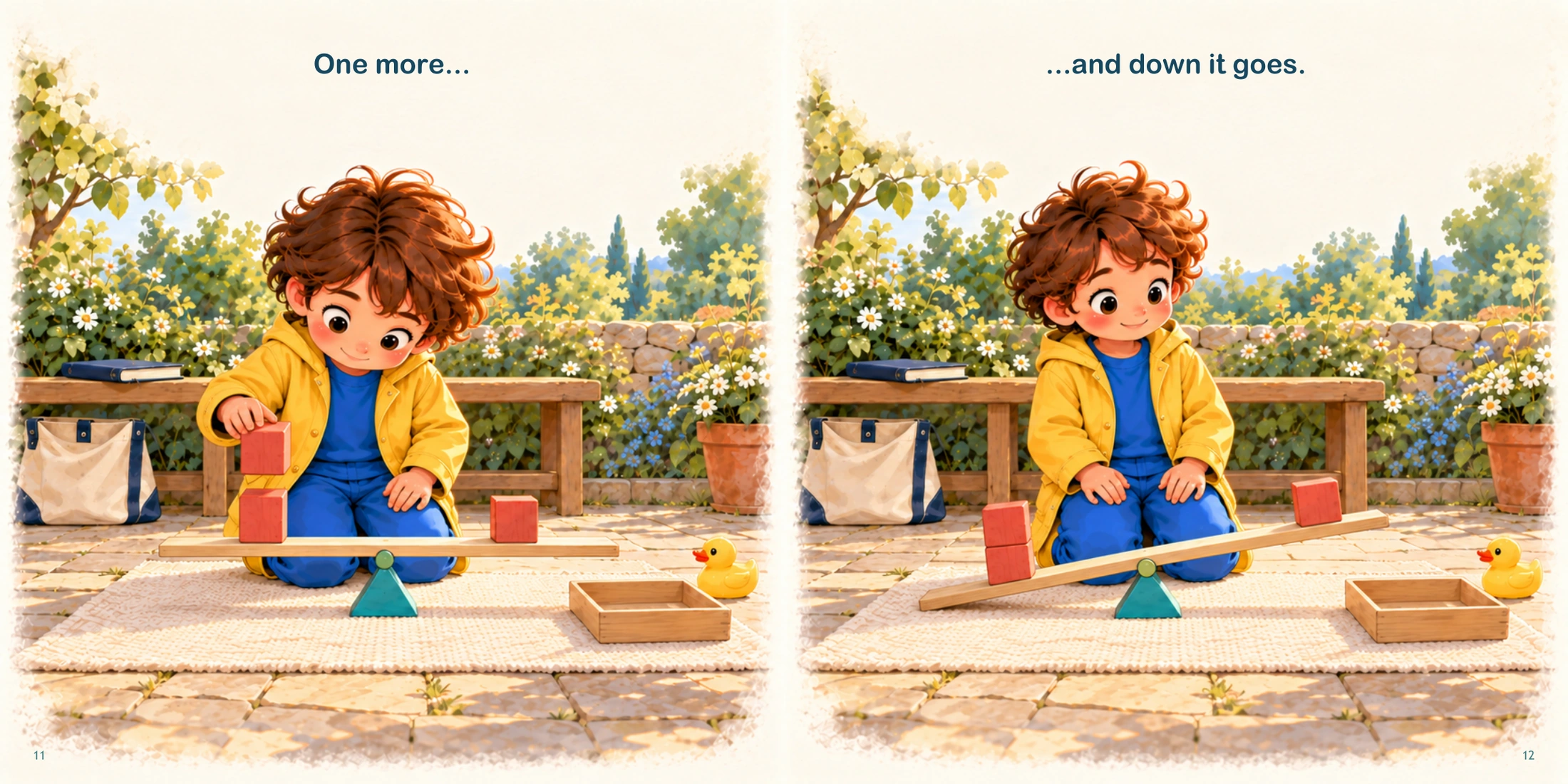
One more... ...and down it goes.
Explore together · More weight at one position
Vince stacks the third block on the left block. The pair's side goes down. The pair shares one horizontal position. Adding a matched block increases that side's turning effect.
Ask together: What is different on the low side?
Two close, one far
Pages 13–14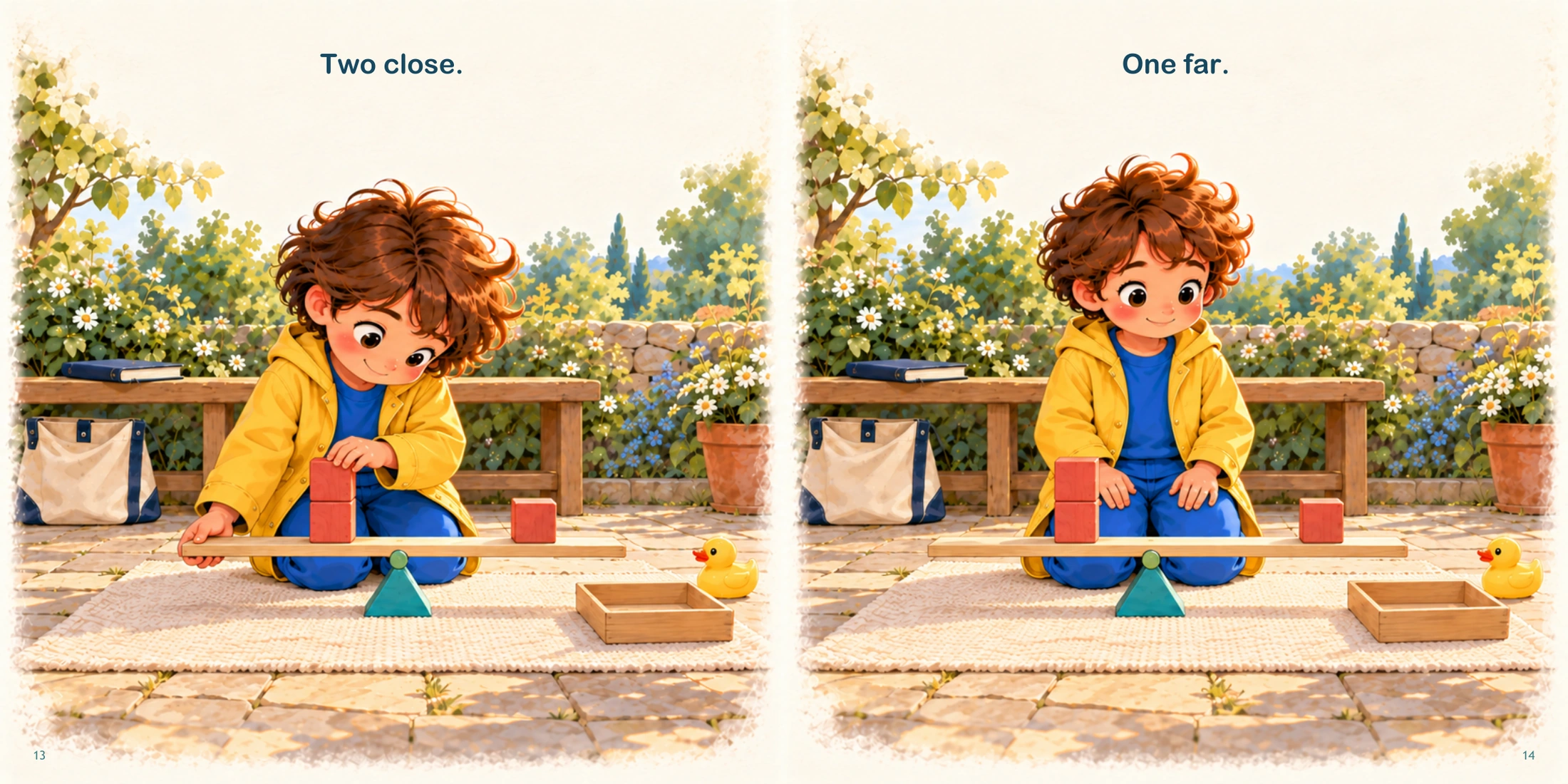
Two close. One far.
Explore together · Weight and distance work together
Vince steadies the beam while moving the pair closer to the pivot. The two close blocks balance the single block farther away for a moment. For matched blocks and a centered beam at level, two can balance one when their shared center is about half as far from the pivot. Real materials need adjustment.
Ask together: Which blocks are closer to the middle?
Duck's turn
Pages 15–16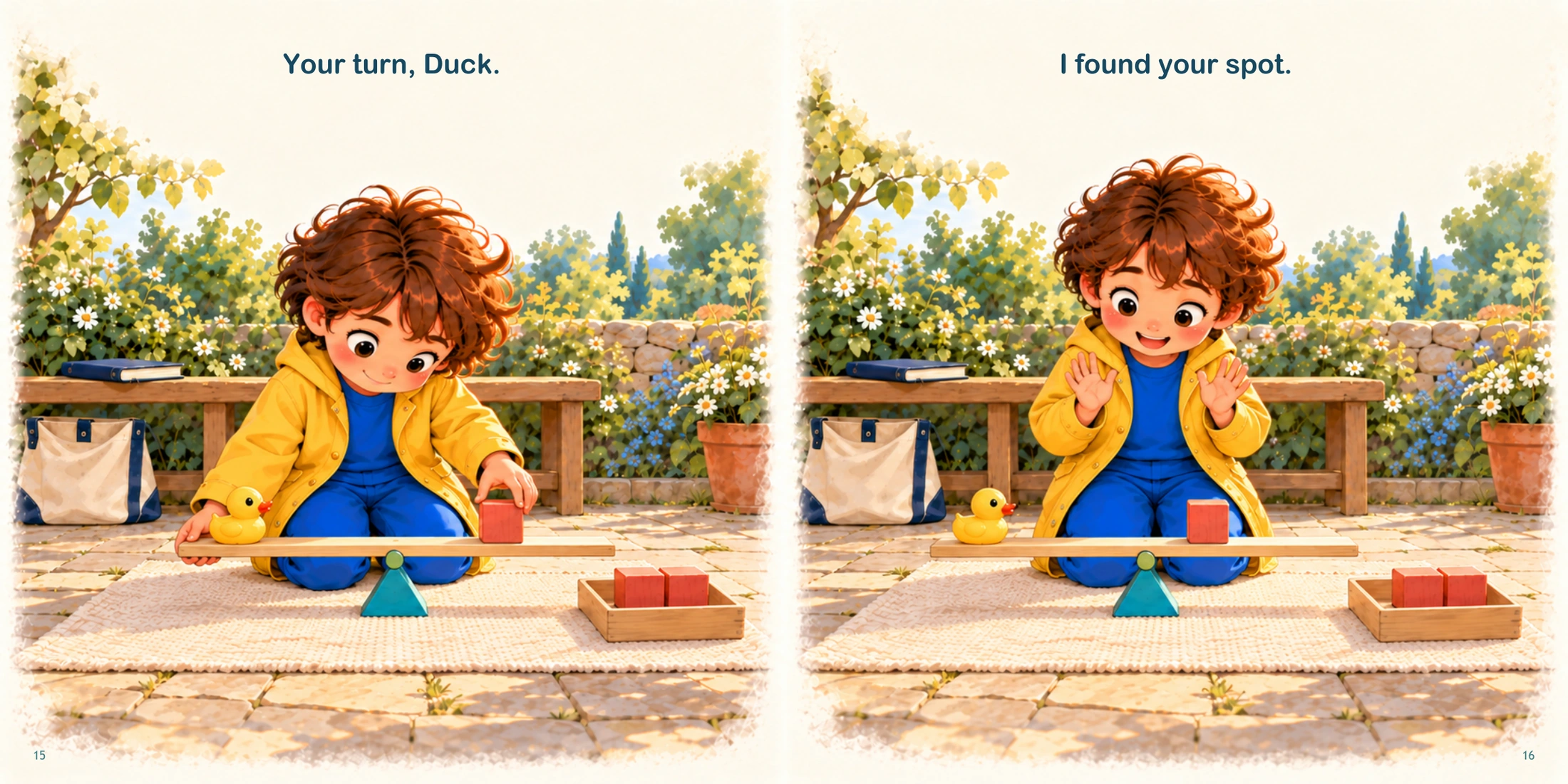
Your turn, Duck. I found your spot.
Explore together · Try a discovery with a new object
Vince tries a place for the duck and a closer place for one block, then releases the level beam. The duck and block need not weigh the same. Vince adjusts their positions to balance their opposing turning effects.
Ask together: How has Duck's ride changed since the beginning?
A quiet notebook
Pages 17–18
For grown-ups
Pages 19–20
For Grown-Ups A seesaw turns around its support, or pivot. What sits on each side matters, and so does how far it sits from the pivot. 1–6 · Finding level One load tips the beam. Matching blocks at matching distances can balance it. These three blocks are alike in weight, not just colour. The empty beam is balanced over its support first. 7–10 · Same blocks, new positions A block farther from the pivot has a greater turning effect. Vince moves one outward, then moves the other out to match. They still weigh the same. 11–14 · Weight and distance together Adding a block increases the turning effect on that side. Moving the pair closer to the pivot can balance the single block farther away. For matched blocks and a centered beam, the pair is about half as far from the pivot. 15–18 · A place for Duck The duck and cube need not weigh the same. Vince tries positions until their turning effects balance. His drawing remembers the game. Explore together With an adult, try a stiff light strip on a low support with large, light matched blocks. Balance the empty strip first. Keep the support still and change one thing at a time. Steady the beam level while placing blocks, then let go gently. Adjust in small steps; a level beam may tip again. Keep fingers clear of lowering ends. Stop if pieces slide or topple. These pictures show possible results, not measurements or a tested kit. Friction, unequal blocks and an uneven beam can change the positions that work. Watching is welcome; no activity is required. Science sources: Science Buddies, Lifting with a Lever; Exploratorium, Center of Gravity.
Open these pages in the readerSources and evidence
A centered uniform beam with a load on only one side tends to turn down on that side.
Lifting with a Lever — Ben Finio, Science Buddies
Center of Gravity — Exploratorium Teacher Institute
Rigid approximately uniform beam; narrow freely rocking support; sufficient load to exceed friction. A down end may rest on the mat; it is not then in free balance.
Equal-weight blocks at equal distances on opposite sides can balance the centered beam.
Lifting with a Lever — Ben Finio, Science Buddies
9.3 Stability — OpenStax College Physics 2e
Identical looking does not always mean identical mass; these three matched wooden cubes are one set. Center the unloaded beam first.
Equal moments at level do not imply self-righting. Vince steadies the beam level before release; the result is brief and may tip again. Physical support friction and load height affect stability.
With equal loads, moving one farther from the pivot increases its turning effect; matching the other distance can restore balance.
Lifting with a Lever — Ben Finio, Science Buddies
9.3 Stability — OpenStax College Physics 2e
Distance is horizontal distance from pivot to load center, not distance from the edge. Keep pivot/beam/blocks fixed except specified moved block.
Equal moments at level do not imply self-righting. Vince steadies the beam level before release; the result is brief and may tip again. Physical support friction and load height affect stability.
Adding a matched block at the same side/distance increases that side's turning effect.
Lifting with a Lever — Ben Finio, Science Buddies
Stack the pair centered at the same longitudinal position; added mass, not increased height, causes the changed moment at level.
Two equal blocks can balance one if their shared center is about half as far from the pivot as the single block.
Lifting with a Lever — Ben Finio, Science Buddies
9.3 Stability — OpenStax College Physics 2e
Idealized weight-distance relation at level; friction, block variation and beam balance require small practical adjustment. Exact illustration is not measured data.
Equal moments at level do not imply self-righting. Vince steadies the beam level before release; the result is brief and may tip again. Physical support friction and load height affect stability.
A differently weighted toy and block can balance by adjusting their distances from the pivot.
Lifting with a Lever — Ben Finio, Science Buddies
Center of Gravity — Exploratorium Teacher Institute
9.3 Stability — OpenStax College Physics 2e
Toy has an unspecified mass; do not imply one duck equals one block. Final duck farther out and denser wooden cube nearer support is plausible for a light hollow duck; art is illustrative.
Equal moments at level do not imply self-righting. Vince steadies the beam level before release; the result is brief and may tip again. Physical support friction and load height affect stability.
An adult can explore these relationships with a stiff strip, a low support and matched large blocks, making small adjustments.
Lifting with a Lever — Ben Finio, Science Buddies
9.3 Stability — OpenStax College Physics 2e
Source uses ruler/pencil/weights; our broad smooth strip/low triangular wood support is an adaptation, not a physically tried kit. Prebalance beam and confirm each comparison. Use light large pieces on a low surface; keep fingers clear. Not a claim that every toy/beam works.
Equal moments at level do not imply self-righting. Vince steadies the beam level before release; the result is brief and may tip again. Physical support friction and load height affect stability.
A story worth keeping?
Read it here as often as you like. The physical edition is coming soon.