THE PHYSICAL EDITION
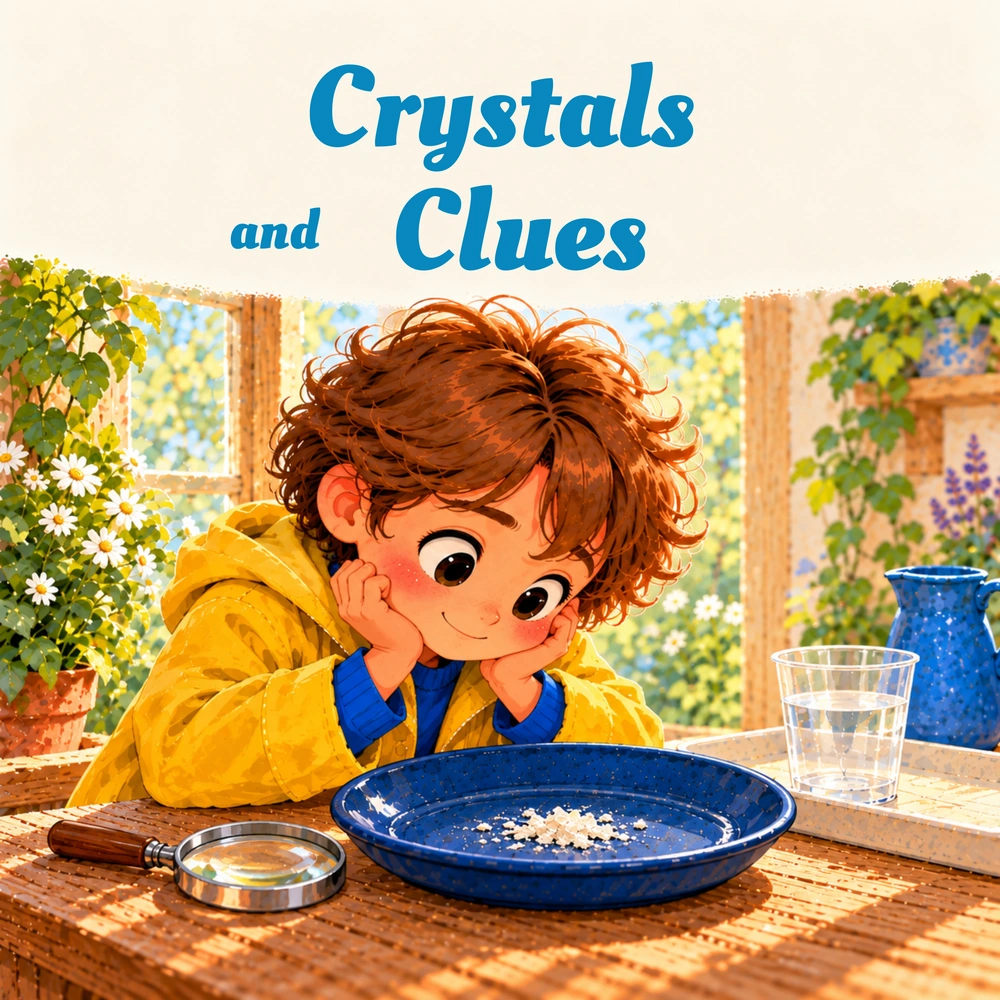
Crystals and Clues
Salt and sand are all mixed up. Vince follows the clues through a sieve, a paper filter and a shrinking pool, discovering that something out of sight can still be there.
A favourite to hold onto.
Physical edition in development. Our physical books will be the premium option for families who want a copy to keep.
Coming soon
Price and ordering details will be announced when the physical edition is ready.
Enjoy the complete story onlineExplore the science
Different materials in one mixturePages 1–2
Vince adds white salt to tan sand. Both kinds of grain are visible together in a clear cup. The two materials begin as visible grains. Mixing them does not make them the same material.
Ask together: What different grains can you see?
Compare grains with openingsPages 3–4
Vince shakes a coarse sieve. White and tan grains fall into the cup below. In this setup, both kinds of grain fit through the openings. A sieve with different openings could give a different result.
Ask together: What falls through this sieve?
Dissolved does not mean gonePages 5–6
Vince stirs water into the mixture. Tan sand remains at the bottom, but the white salt grains are no longer visible. Enough water dissolves the salt into particles too small to see. The selected sand stays as grains; the salt has not melted or ceased to exist.
Ask together: What can Vince still see in the cup?
Choose another toolPages 7–8
Vince points to the sand, then fits clean paper into a funnel seated in an empty receiving cup. The paper and supported funnel prepare a different kind of separation. The sand-bearing cup remains separate until the next pour.
Ask together: What has Vince chosen to try next?
Filtering has limitsPages 9–10
Vince pours into the supported paper filter. Sand collects in the paper while liquid drips into the cup beneath. Intact coffee paper can hold these sand grains while water and dissolved salt pass through. Clear liquid can still contain dissolved material and is not made safe to drink.
Ask together: What stays in the paper, and what reaches the cup?
Water can leave a mixturePages 11–12
Vince pours collected liquid into a shallow blue dish. Over days, the pool becomes smaller. Water escapes into the air as invisible water vapour. Drying time depends on depth, warmth, airflow and humidity; it can take days or longer.
Ask together: What changes as Vince waits?
Recover evidence of dissolved saltPages 13–14
Vince looks closely at white crystals left in the blue dish. As water is lost, salt can form new crystals, clusters or a crust. The original grains need not return unchanged.
Ask together: What does the white patch help Vince work out?
Use a discovery in a new comparisonPages 15–16
Vince adds water to a small sample of recovered salt. The sample becomes invisible while a remaining dry patch stays in the dish. A little recovered salt can dissolve again in enough fresh water. The dry patch gives Vince a comparison while he recognizes the clear mixture.
Ask together: Where does Vince think the salt is now?
Sources and evidence
A coarse sieve whose openings exceed both selected grain sizes lets both salt and sand pass; this attempt need not separate them.
Separating Mixtures: Teacher version
Not all sieves behave alike. This particular sieve has openings larger than the illustrated grains. No claim that every sieve fails or that this exact prop trial occurred.
A small amount of salt dissolves in sufficient room-temperature water while the selected clean sand remains visibly undissolved.
Use additive-free salt and washed coarse sand; appearance varies with impurities. Dissolving is not melting or destruction. Amount must be below capacity; original grain size need not be preserved.
A supported coffee-paper filter retains the selected sand while liquid containing dissolved salt passes through.
Separating Mixtures: Teacher version
The filter must be intact and supported; do not overfill. Extremely fine suspended material may pass. Clear filtrate is not purified drinking water. UCSD incorrectly says atoms: use ions, as supported by ACS. Omit its tasting suggestion and all heating.
Water in an open shallow dish can evaporate into the air while dissolved salt remains and forms visible crystals as the water is lost.
No fixed completion time: allow days, potentially longer with humidity or depth. Small deposits may be crusts or clusters, not large perfect cubes. No visible steam, salt floating away or sunlight as an essential requirement.
Recovered salt can dissolve again when sufficient fresh water is added; recovery shows that clear salt solution contained salt.
Separating Mixtures: Teacher version
The same ions can form new crystals, not necessarily the original grains. Re-dissolve a small recovered sample in ample water. No claim of complete quantitative recovery or safe tasting.