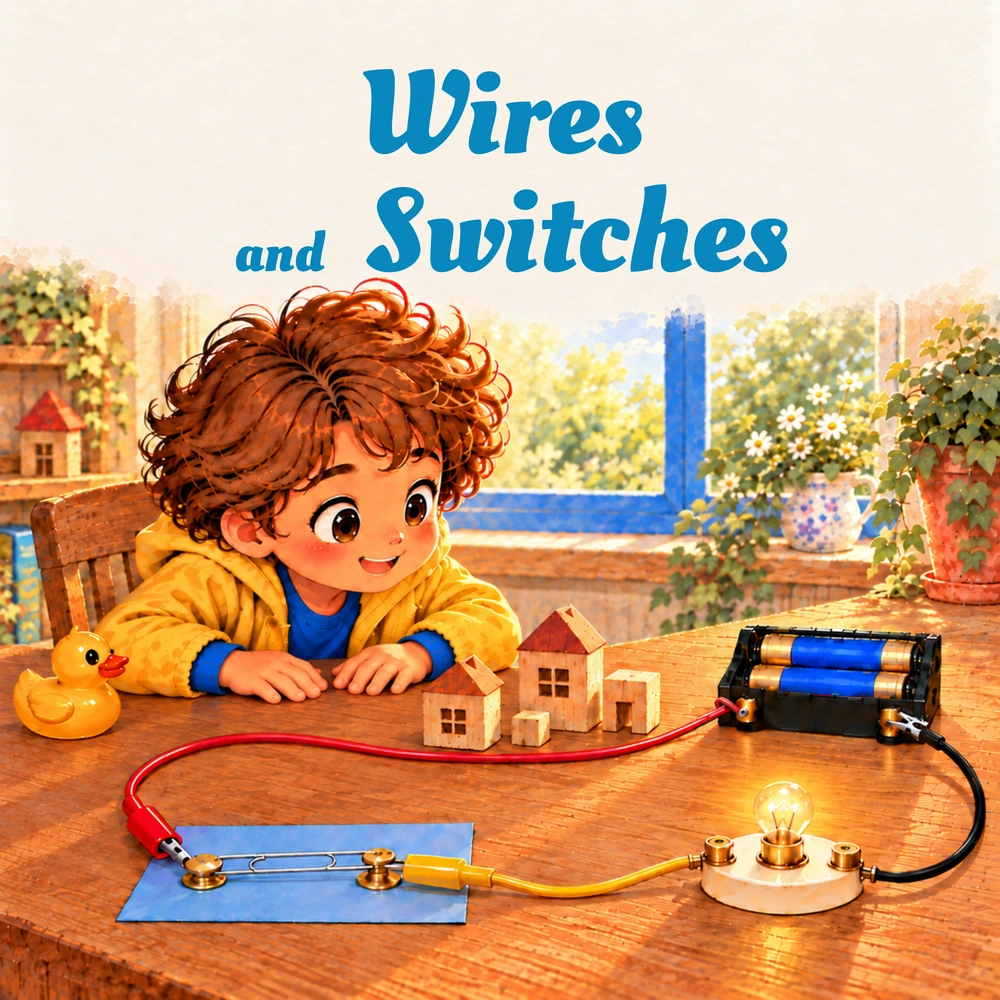
THE PHYSICAL EDITION
Wires and Switches
Vince’s little lamp shines, goes dark, and shines again as he changes one connection. Compare a dry wooden bridge with foil, then see a movable metal contact become a switch for his block street.
A favourite to hold onto.
Picture book. Our physical books will be the premium option for families who want a copy to keep.
Coming soon
Price and ordering details will be announced when the physical edition is ready.
Enjoy the complete story onlineExplore the science
Preparing a battery-and-lamp circuitPages 1–2
Vince points to his wooden street while an adult brings the parts on a tray. The two free clips are apart and the lamp is dark. The battery supplies energy, but the lamp needs a complete conducting path through its two contacts. The prepared set leaves one gap for Vince to join.
Ask together: What do you notice about the two clips on the tray?
Completing the pathPages 3–4
The red and yellow metal jaws touch, and the small lamp shines. The wires lead from the battery through the lamp and back. With working matched parts, joining the metal contacts completes this single conducting path. Electric current itself is invisible; the light is an observable result.
Ask together: Where do the red and yellow clips meet?
Every connection in a single path mattersPages 5–6
Vince lifts the black return clip from the battery holder, then reconnects it. The lamp is dark, then bright, while the red and yellow clips stay joined. A break elsewhere in this same path also stops current through the lamp. Restoring that connection completes the path again.
Ask together: Which connection changes between these two pictures?
Physical contact is not enoughPages 7–8
The clips grip opposite ends of a dry wooden stick. The metal jaws are separated, and the lamp remains dark. The stick bridges the physical gap, but this dry wood does not carry enough current to light the lamp. The rest of the circuit remains connected.
Ask together: What is between the two metal jaws now?
Comparing conducting materialsPages 9–10
A strip of foil takes the wood’s place between the separated clips, and the lamp shines. The wooden stick rests beside Duck. Clean aluminum foil provides a conducting connection here. Comparing the same apparatus helps distinguish the material change from a loose connection elsewhere.
Ask together: What changed, and what stayed the same?
A movable contactPages 11–12
Vince finds a foil clip fiddly. An adult helps with a metal arm on a card; one end stays at a pivot and the other can move toward a second contact. The arm can open or close the existing path without repeatedly joining the two loose clips. The lamp remains part of the circuit.
Ask together: Which end of the metal arm stays attached?
Using a switchPages 13–14
The arm touches the second contact and the street’s lamp shines. With the arm turned away, the lamp is dark. A switch controls whether this path is complete. It does not create electricity; the battery still supplies the energy.
Ask together: What changes at the far end of the metal arm?
Sources and evidence
In the pictured low-voltage battery circuit, closing the final conductive connection through the correctly rated working lamp lets it light.
Which Materials are the Best Conductors?
Circuit Workbench — Exploratorium Teacher Institute
Use adult-prepared, low-voltage educational parts that match. Loose contacts, weak cells or a faulty lamp can keep an apparently joined circuit dark.
Opening a different point of that single path also extinguishes the lamp; the lamp needs the entire connected path.
Which Materials are the Best Conductors?
The different-gap comparison concerns the single unbranched path shown. A circuit with another available path can behave differently.
A dry plain wooden craft stick between separated clip jaws does not light this lamp, while clean aluminum foil bridging those same jaws can.
Which Materials are the Best Conductors?
Make a Simple Circuit — Energizer
Metals — They’re Electrifying! — American Chemical Society
The comparison uses dry plain wood and clean aluminum foil. Moisture, coatings and contact quality can change results; appearance alone does not establish conductivity.
A movable metal connection can serve as a switch: contact closes the path; separation opens it.
Make a Simple Circuit — Energizer
Making a Switch — University of Nebraska–Lincoln Extension
The metal arm must stay in conducting contact at its pivot and actually touch the second contact when closed. An adult prepares and checks the small parts and sharp ends.
The battery supplies energy; the lamp transfers electrical energy to light and heat, while current is not consumed as material inside the bulb.
Circuit Workbench — Exploratorium Teacher Institute
The battery supplies energy transferred by the lamp to light and heat. Electric current is invisible and is not a substance consumed by the lamp. The energy explanation is in the grown-up guide.