THE PHYSICAL EDITION
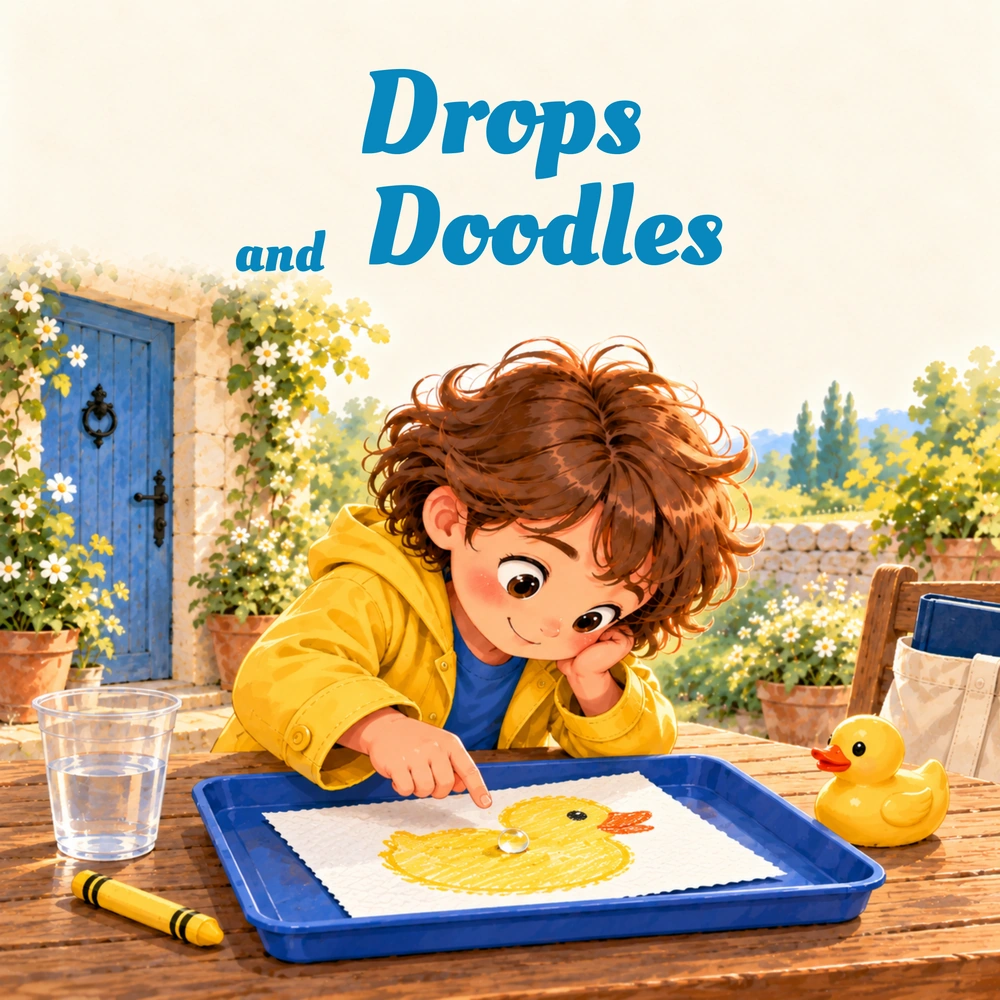
Drops and Doodles
A spill sends Vince following water into paper, up a towel and across different surfaces. Watch him use a wax crayon and a watery wash to turn what he notices into a new duck picture.
A favourite to hold onto.
Physical edition in development. Our physical books will be the premium option for families who want a copy to keep.
Coming soon
Price and ordering details will be announced when the physical edition is ready.
Enjoy the complete story onlineExplore the science
AbsorptionPages 1–2
Water from Vince's cup reaches his pencil duck drawing and spreads into the paper. Absorbent paper takes water into small spaces among its fibres. The damp patch spreads while the pencil outline remains visible.
Ask together: Where has the paper become wet?
Water moving into paperPages 3–4
A towel corner touches the puddle. Its wet patch grows while some puddle remains. Water can move into an absorbent towel without wiping. The water has changed location, rather than vanished.
Ask together: What changes in the towel and in the puddle?
Capillary actionPages 5–6
Only the tip of the towel strip is in the cup, but wetness rises above the waterline. Water's interactions with the paper fibres and with itself help it move through small spaces. Gravity still limits how far it can rise.
Ask together: Where is the waterline, and how high is the wet patch?
Material comparisonPages 7–8
A shallow puddle remains on intact foil beside a damp patch in absorbent paper. Foil does not absorb water like the chosen paper. Water can spread on its surface without soaking inside.
Ask together: Where can you see water sitting on top?
Changing a paper surfacePages 9–10
Vince makes a dense crayon patch. A drop remains above it while nearby bare paper becomes damp. A thick wax coating reduces how readily water wets the paper beneath it. The uncoated part can still take water in.
Ask together: What is different about the two wet places?
Coated and bare paperPages 11–12
Vince tips the sheet and water runs from the waxy area onto adjoining bare paper. A sufficiently large drop may run downhill on a tilted coating and reach absorbent paper. Tiny drops can remain stuck, so this is not a guaranteed result for every crayon or drop.
Ask together: What happens where the wax ends?
Wax-resist artPages 13–14
Vince draws a waxy yellow duck, then brushes a light blue wash across the picture. Colour reaches exposed paper while the dense wax drawing remains visible. Gaps in wax can leave speckles; the coating, rather than yellow colour, matters.
Ask together: Where has the blue wash reached?
Sources and evidence
Water can soak into uncoated absorbent paper and spread beyond its first contact area; a paper towel can take up a small spill.
American Chemical Society — Waterproof Wonders
USGS Water Science School — Capillary Action and Water
Use absorbent, uncoated paper and an ordinary paper towel. Coated or heavily sized paper may behave differently. The wet patch can darken without added colour; its speed and size depend on the materials and amount of water.
The exact materials pictured have not been physically tried. No fixed soaking time, capacity or instant drying is promised.
With only the lower tip of a paper-towel strip in water, wetness can travel upward above the water surface through the strip.
USGS Water Science School — Capillary Action and Water
Keep only the lower tip submerged and hold the strip still. The rise takes time and varies with the towel; no particular height or time is guaranteed.
Water moves through small wettable spaces in the towel. Gravity still limits the rise; this does not mean gravity has stopped.
A small puddle remains on intact aluminum foil rather than soaking through as it does in the selected absorbent paper.
American Chemical Society — Waterproof Wonders
Use intact foil without holes. Water can spread into a shallow surface puddle; perfectly round beads are not required.
This comparison concerns the chosen foil and absorbent paper. Materials and surface coatings vary.
A thick wax-crayon coating on part of the same paper reduces wetting there; bare paper nearby can absorb water.
American Chemical Society — Waterproof Wonders
University of Florida Harn Museum — Watercolor Resist Painting
Press a wax crayon firmly to cover a broad patch densely. Sparse marks, cracks, washable crayon products and paper sizing can change the result.
Water may form beads or a shallow pool on the wax. The coating does not make the entire sheet permanently waterproof.
A sufficiently large surface drop can run downhill on tilted wax-coated paper and soak into a bare-paper region it reaches.
American Chemical Society — Waterproof Wonders
The picture illustrates runoff from a coated surface onto adjoining absorbent paper, extending the coated-surface demonstration described by ACS. The exact crayon, paper, drop and tilt combination has not been physically tried.
Tiny drops can stay pinned in place. A larger drop may run when the sheet is tilted, but no particular angle or speed is guaranteed. Water can soak into bare paper when it reaches it.
Applying watery watercolor after a firm wax-crayon drawing can colour exposed paper while leaving the crayon drawing visible.
University of Florida Harn Museum — Watercolor Resist Painting
Crayola — A Paper Relief for the Coral Reef
American Chemical Society — Waterproof Wonders
Use non-toxic wax crayons, firm coverage and a light watery wash on suitable sturdy paper. Thin pigment can briefly cover wax before beading, and gaps in crayon can leave speckles.
The picture shows a representative result. The wax coating matters, rather than the yellow colour; results vary with materials.