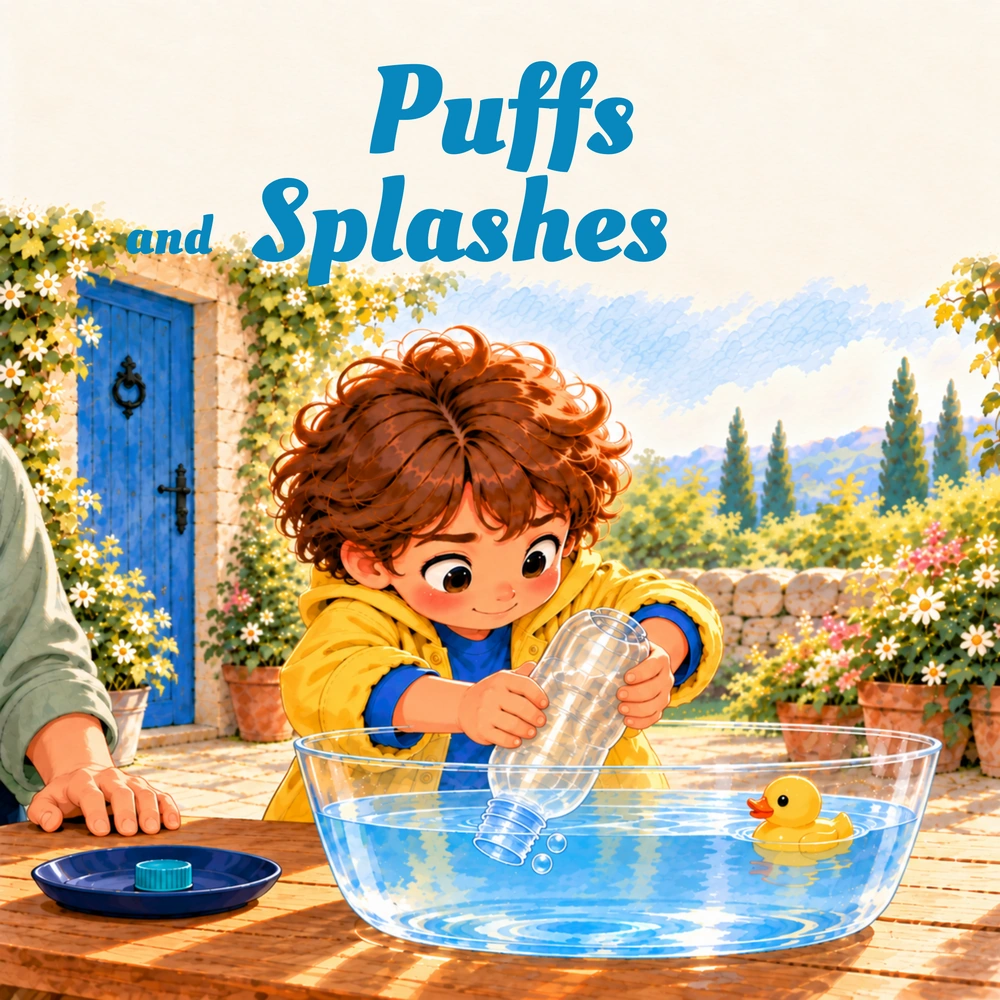
THE PHYSICAL EDITION
Puffs and Splashes
Vince wonders what is inside a bottle that looks empty. A puff on his hand leads him to bubbles, water flowing in, and a surprising difference when the lid goes back on. A story about air, water and following a clue.
A favourite to hold onto.
Physical edition in development. Our physical books will be the premium option for families who want a copy to keep.
Coming soon
Price and ordering details will be announced when the physical edition is ready.
Enjoy the complete story onlineExplore the science
Air takes spacePages 1–2
Vince holds up an empty-looking capped bottle, then gently dents its flexible sides. The bottle contains air. With the lid closed, a gentle squeeze puts that air into a smaller space; the bottle wall also resists bending.
Ask together: What might be inside even when we cannot see it?
An open way outPages 3–4
A grown-up removes the cap. Vince squeezes the bottle toward his open palm. With the mouth open, the squeeze can push some air out. Its effect can be felt even though the air itself is invisible.
Ask together: What changes when the lid comes off?
Air bubbles under waterPages 5–6
Vince lowers the open bottle mouth under water and squeezes. Bubbles leave the mouth and rise through the basin. Water gives the escaping air visible boundaries. These are air bubbles in plain water, not soap bubbles.
Ask together: Where do the first bubbles appear?
Water enters as the bottle recoversPages 7–8
Vince relaxes his hands with the bottle mouth still submerged. The sides recover and water appears inside. A resilient bottle expanding after a squeeze lowers its internal pressure. Water can enter through the submerged opening; the amount depends on the bottle and squeeze.
Ask together: What is different inside after Vince lets go?
Water resists compressionPages 9–10
A grown-up fills the same bottle to the brim. With its cap on, Vince finds it much harder to squeeze. With the bottle full and closed, its volume changes very little under a gentle squeeze because water compresses far less than air.
Ask together: How does this compare with the first squeeze?
Water can flow outPages 11–12
The cap comes off again. Vince gently squeezes the bottle over the basin and a short splash leaves its mouth. Opening the mouth gives the water a route out. A squeeze can drive outflow, and tipping an open bottle can also pour.
Ask together: What has the open lid changed?
Air returnsPages 13–14
Vince drains the remaining water, then holds the empty-looking bottle and feels another puff against his palm. Air enters as the bottle recovers outside the water. The bottle can look empty while still holding air.
Ask together: Does the bottle seem the same to Vince now?
Sources and evidence
A bottle without liquid still contains air, which occupies space.
Science World: What's in a Bottle?
Air is invisible; the story depicts observable effects rather than air particles.
Air in a tightly capped flexible bottle can be compressed into less space; a gentle squeeze changes its shape but meets resistance.
ACS Inquiry in Action, Grade 5 Lesson 1.1: Matter is Made of Tiny Particles
Use a flexible bottle that recovers after a gentle squeeze. Some resistance comes from its wall; a crushed disposable bottle may not recover.
Squeezing an open flexible bottle pushes some of its contents out through its mouth; escaping air can be felt, and escaping water is visible.
UBC PHAS: Punctured Bottle, Pressure Grade 4
Science World: What's in a Bottle?
The opening provides an outlet. Tipping can also pour water; a stream alone does not measure the contribution of the squeeze.
Squeezing an uncapped resilient bottle with its mouth under water expels air as bubbles; releasing the squeeze while the mouth remains submerged allows water into the recovering bottle.
Dorothy Alfke, Squeeze Bottle Science (The Science Teacher, October 1954), reprinted NSTA 1963
ACS Inquiry in Action, Grade 5 Lesson 1.1
JSME Fluids Engineering Division: Water Fountain 3 (Using Negative Pressure)
Keep the opening submerged and downward while the sides recover. Orientation and bottle stiffness affect the result; no particular bubble count, refill fraction or timing is implied.
The same capped flexible bottle filled to the brim with water is much harder to squeeze than when it contained air.
ACS Inquiry in Action, Grade 5 Lesson 1.1
The comparison uses the same bottle filled to the brim with its lid closed and a gentle squeeze. Trapped air and wall stiffness affect how it feels.
As the drained, uncapped resilient bottle recovers its shape in air, surrounding air enters again; it can give another puff.
Science World: What's in a Bottle?
UBC PHAS: Punctured Bottle, Pressure Grade 4
A drained bottle can retain droplets while air enters the space left by the water.