THE PHYSICAL EDITION
Snails and Shelter
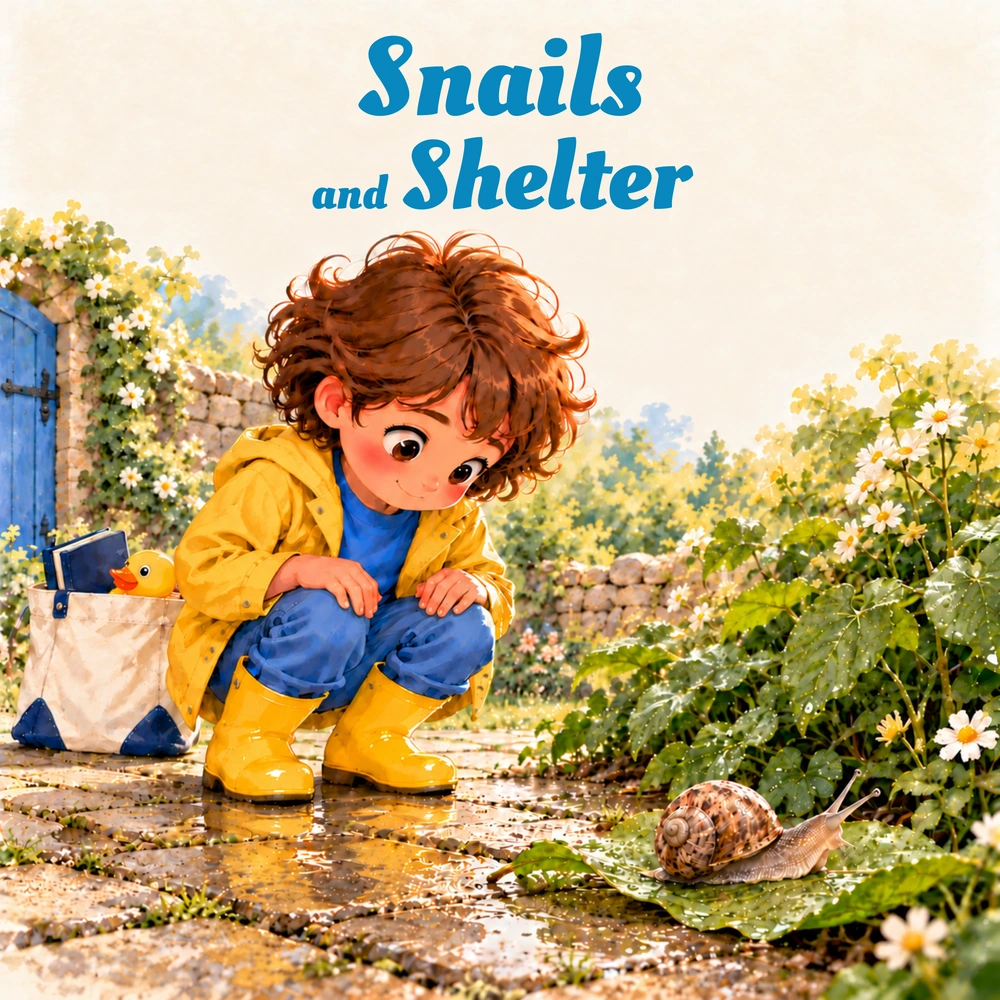
A moving shell catches Vince’s eye. Follow one garden snail as it glides, explores a leaf, tucks away and comes out again. Vince discovers how much there is to notice when he gives a small animal space.
A favourite to hold onto.
Physical edition in development. Our physical books will be the premium option for families who want a copy to keep.
Coming soon
Price and ordering details will be announced when the physical edition is ready.
Enjoy the complete story onlineExplore the science
An animal and its shellPages 1–2
Vince looks beneath a moving shell and notices the snail’s head and body. The shell stays attached while the snail travels. It is part of the animal, not an empty object being pushed along.
Ask together: What can you see underneath the shell?
A foot and a trailPages 3–4
The snail glides over the stone and leaves a narrow shining trail. A broad muscular foot moves the snail. Mucus helps it move and can leave a visible trace; the shine varies with the surface and light.
Ask together: Where does the trail begin and end?
Tentacles and eyesPages 5–6
Vince watches the snail’s long tentacles, with tiny eyes at their tips. This snail has two long upper tentacles and two short lower ones. They carry sensory structures; the eyes sit on the upper tips.
Ask together: Which tentacles are long, and which are short?
Sensing and feedingPages 7–8
The snail reaches a leaf and grazes its edge. A garden snail’s mouth faces downward. Inside, a tiny toothed ribbon scrapes food; those teeth are too small to see in this picture. Snail diets differ.
Ask together: What changes at the edge of the leaf?
Withdrawing into the shellPages 9–10
The snail pulls its head and exposed body into its shell. The shell can protect soft parts. We do not know what triggered this withdrawal, and the shell remains attached.
Ask together: Which parts can you still see?
Watching without controllingPages 11–12
Vince waits back from the shell. Later, the snail extends again. Waiting gives the animal space, but does not make it come out. Another snail might stay tucked away much longer.
Ask together: What could Vince do if the snail stayed inside?
Environmental shelterPages 13–14
The snail is beneath the edge of low leaves, and Vince leaves it there. Many land snails are sensitive to drying. Damp, shaded places can offer cover; a single scene does not reveal everything a snail needs.
Ask together: What is different about this spot and the open stone?
Sources and evidence
A brown garden snail carries its attached shell while moving on a broad muscular foot, without legs.
Missouri Department of Conservation — Land Snails and Slugs
This story depicts a brown garden snail. Other gastropods have different body forms.
Mucus associated with crawling can leave a shiny trail behind a land snail.
A trail’s visibility depends on the surface, moisture and lighting.
The depicted garden snail has two long upper tentacles with eye tips and two shorter lower tentacles; these sensory structures help it explore.
Missouri Department of Conservation — Land Snails and Slugs
Carnegie Museum of Natural History — Land Snails Ecology: Diet & Behavior
Tentacles also sense chemicals; the story does not suggest human-like sight.
A brown garden snail can scrape leaf material with the radula in its downward-facing mouth.
Carnegie Museum of Natural History — Land Snails Ecology: Diet & Behavior
Missouri Department of Conservation — Land Snails and Slugs
Snail diets vary. A single leaf encounter is not a promise that every snail will eat an offered leaf.
A shelled land snail can withdraw exposed soft parts into its shell and later extend them again.
Carnegie Museum of Natural History — Land Snails Ecology: Predators & Defenses
Missouri Department of Conservation — Land Snails and Slugs
The trigger and delay are unknown. Waiting does not cause or guarantee emergence.
Many land snails are sensitive to drying and are often active in damp conditions or found in cool shaded cover.
Carnegie Museum of Natural History — Land Snails Ecology: Diet & Behavior
Missouri Department of Conservation — Land Snails and Slugs
Snails differ in habitat. The leafy border is cover, not a complete captive-care prescription.